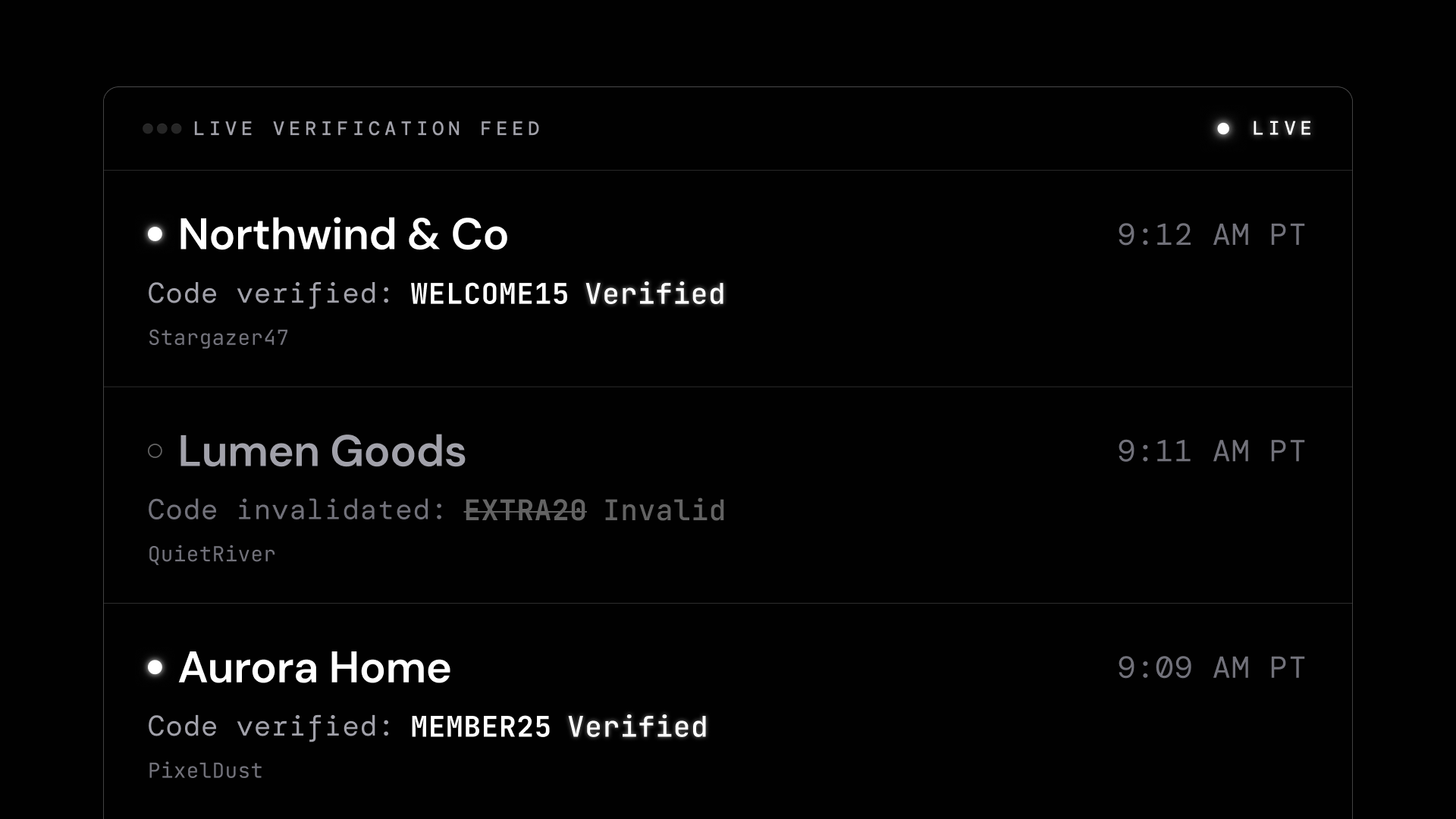
Most coupon sites will give you a code. They won't tell you if it works.
That's the problem we built the live verification feed to solve. On SimplyCodes, every coupon code has a confidence score, a live, continuously updated signal that reflects whether it's working right now, not when it was scraped last week. The feed on our homepage makes that status visible in real time: a stream of verification events, moving as they happen, showing which codes just passed, which were submitted by community members, and which have been invalidated.
It's not a leaderboard. It's not a list sorted by popularity or commission rate. It's a live event stream, the public face of a verification engine that runs every hour of every day across thousands of merchants.
Here's how it works, and why we think real-time transparency is the only honest way to build a coupon product.
What is the SimplyCodes live verification feed?
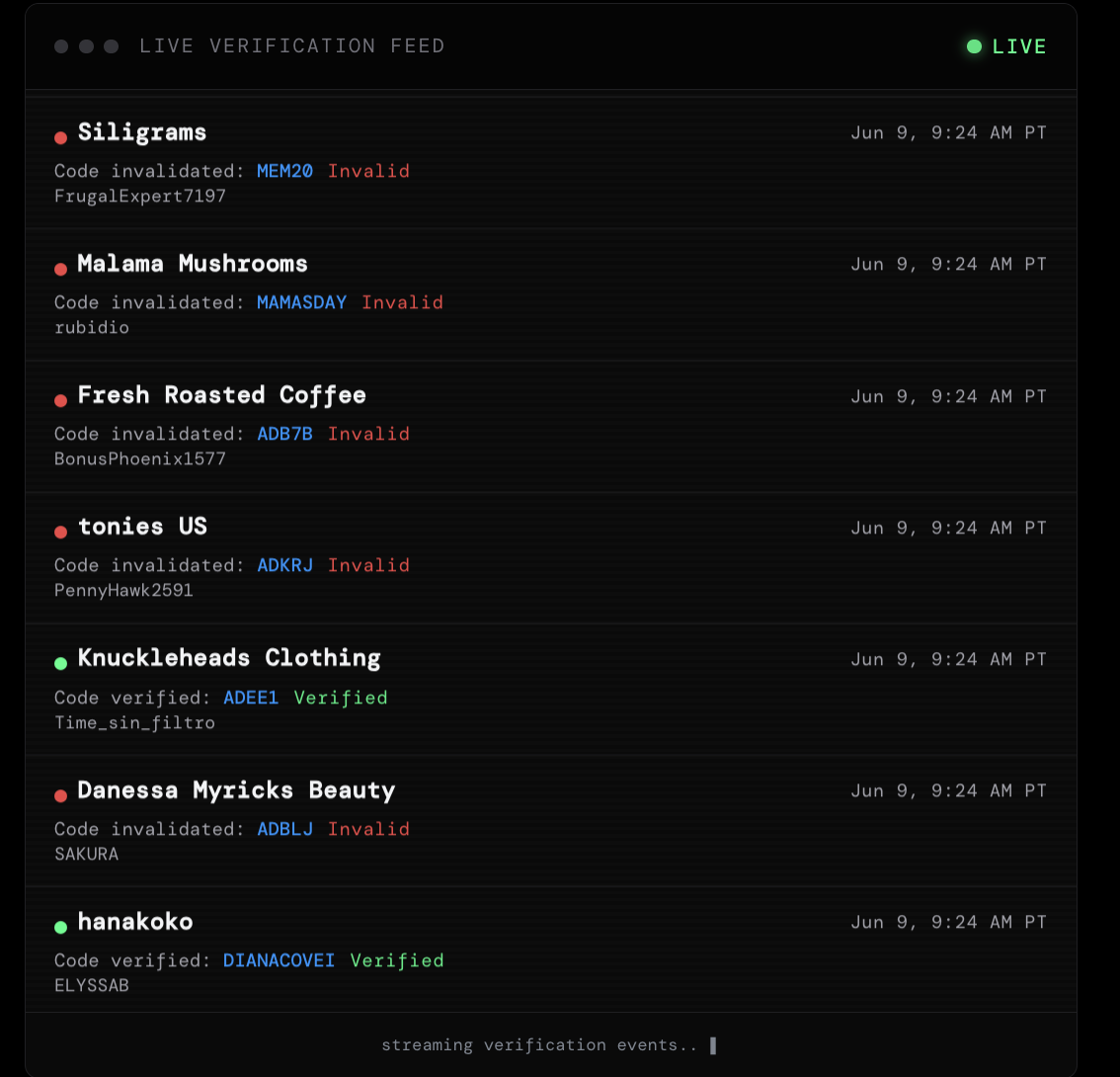
The live verification feed is a real-time stream of coupon verification events, running continuously on the SimplyCodes homepage. Every time a code is tested and confirmed working, submitted by a community member, or invalidated because it stopped working, that event appears in the feed, tagged with the store, the code, the outcome, and a timestamp.
The events come in three types:
- Code verified — a code was tested and confirmed. Green dot. It works.
- Code submitted — a community member found and submitted a new code. Yellow dot. It's in the queue.
- Code invalidated — a code that previously worked has failed verification. Red dot. It's gone.
The feed moves because the data moves. Coupon validity isn't static — merchants change terms, promotions expire, codes get restricted to new customers or specific cart compositions. A code that passed at 9am can fail by noon. The feed reflects that reality instead of hiding it.
That last point is worth sitting with. Most coupon sites don't show you invalidations. They quietly remove expired codes, or leave them up and hope you don't notice when the code fails at checkout. We show you the full picture — including the red dots — because a confident "this code no longer works" is useful information. It tells you the search is over. You can move on.
What you're looking at in the feed isn't curated. It's the raw output of a verification engine running in the background, made visible.
Why does SimplyCodes verify coupon codes in real time?
The short answer: because coupon codes expire, change, and break constantly — and the only honest thing to do is know which ones work before you show them to someone.
The longer answer starts with how the rest of the industry works.
Most coupon sites are aggregators. They crawl the web for codes, collect whatever they find, and surface it. The business model doesn't require accuracy — it requires volume. And that model has a structural problem:
- Trust is asymmetric. One failed code costs more trust than one working code earns. Three failed codes in a row and most users don't come back.
- Volume without accuracy burns a product. More codes, more pages, more clicks — none of it matters if the codes don't work at checkout.
- Affiliate relationships corrupt the signal. When revenue influences which codes get surfaced, users stop getting the best code and start getting the most profitable one.
Our thesis from the beginning has been different:
- The product is certainty, not codes. When a user opens SimplyCodes before checkout, they're not looking for a list to try. They're trying to close an open question — does a working code exist for this store right now?
- A verified "no" is as valuable as a verified "yes." A confident "no working codes exist here" closes the search. Most coupon sites can't deliver that answer because they've never done the verification work to know.
- Showing your work builds trust that claiming freshness never can. The live feed doesn't just assert our data is current — it proves it, in public, with timestamps and outcomes visible to anyone.
The live feed is the most direct expression of that thesis. Not a UX feature — a commitment.
How does SimplyCodes verify coupon codes?
The live feed isn't powered by a single system. It's the output of three independent verification layers running simultaneously, each with different methods, different failure modes, and different things they're good at catching. A code's confidence score reflects the consensus across all three.
Layer 1: Automated Code Testing
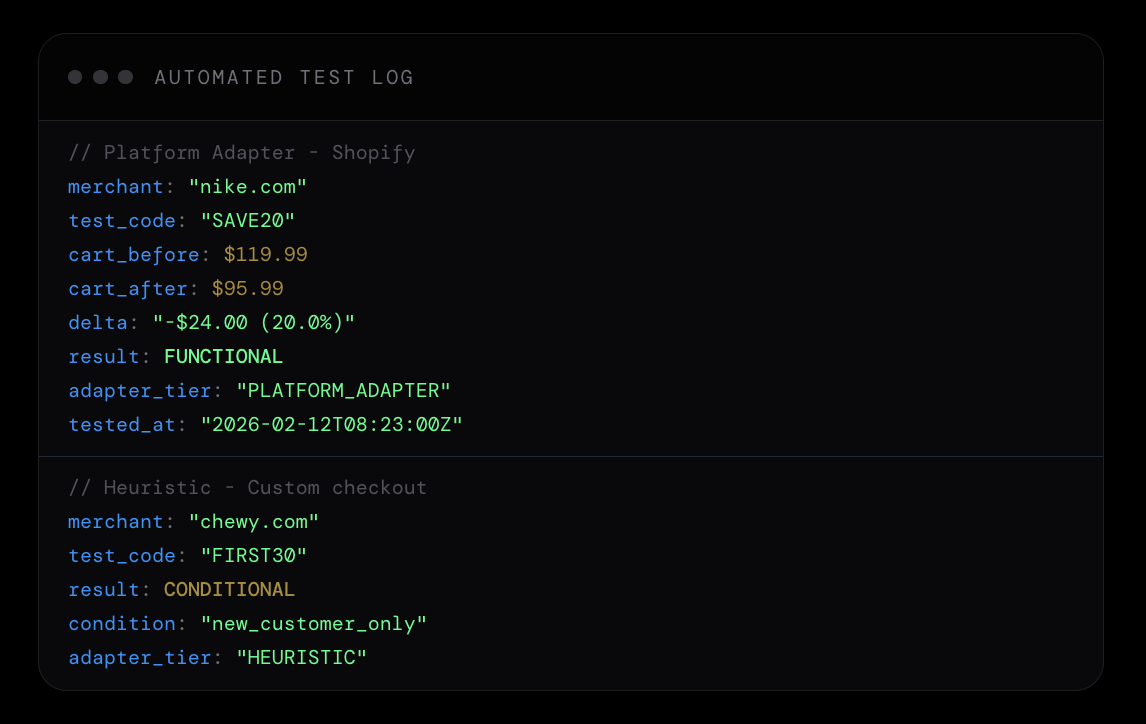
The foundation. Headless browsers simulate real checkout flows across our merchant network every day, adding items to cart, navigating to checkout, entering codes, and observing what happens. No guessing. Actual testing on actual sites.
| Method | What it does |
|---|---|
| Platform adapters | Direct integrations with Shopify, Magento, and WooCommerce. The most reliable tier — we speak the platform's native language. |
| Heuristic pattern matching | For sites without platform integrations. Detects cart total changes, error messages, and success indicators across thousands of unique checkout implementations. |
| AI-powered navigation | For complex or non-standard checkouts. AI agents navigate the flow like a human would, handling bot detection, CAPTCHAs, and multi-step authentication. |
What automated testing produces is binary signal at scale: did the code change the cart total, or not? Fast and broad — but it has limits. It won't catch a geo-restriction, a membership requirement, or a minimum order threshold that depends on what's in the cart. That's what the next layer is for.
Layer 2: Human Verification Network
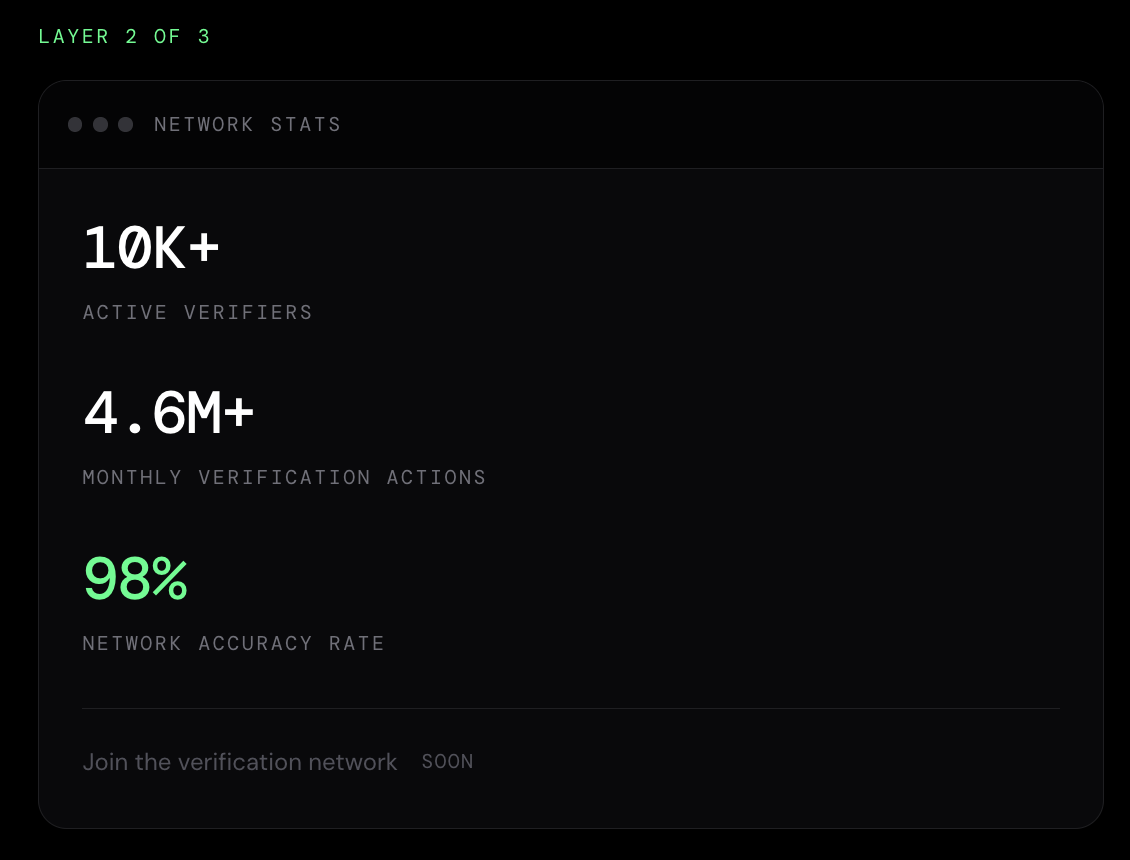
Tens of thousands of trained verifiers manually test codes and submit proof. Every submission requires a screenshot, a timestamp, and confirmation of the discount applied.
| What humans catch | Why machines miss it |
|---|---|
| Geographic restrictions | Automated tests run from fixed IPs and locations |
| Membership requirements | Headless browsers don't have loyalty accounts |
| Stacking rules | Complex cart compositions are hard to simulate at scale |
| Minimum order thresholds | Depend on specific cart configurations |
| Exclusion lists | Product-level restrictions that vary by SKU |
To keep the network honest, every verifier carries a trust score based on their accuracy history. Higher-trust verifiers carry more weight in consensus calculations. We also periodically inject known-good and known-bad codes as calibration tests — catching gaming and maintaining network integrity.
Layer 3: Real-Time Fleet Signal
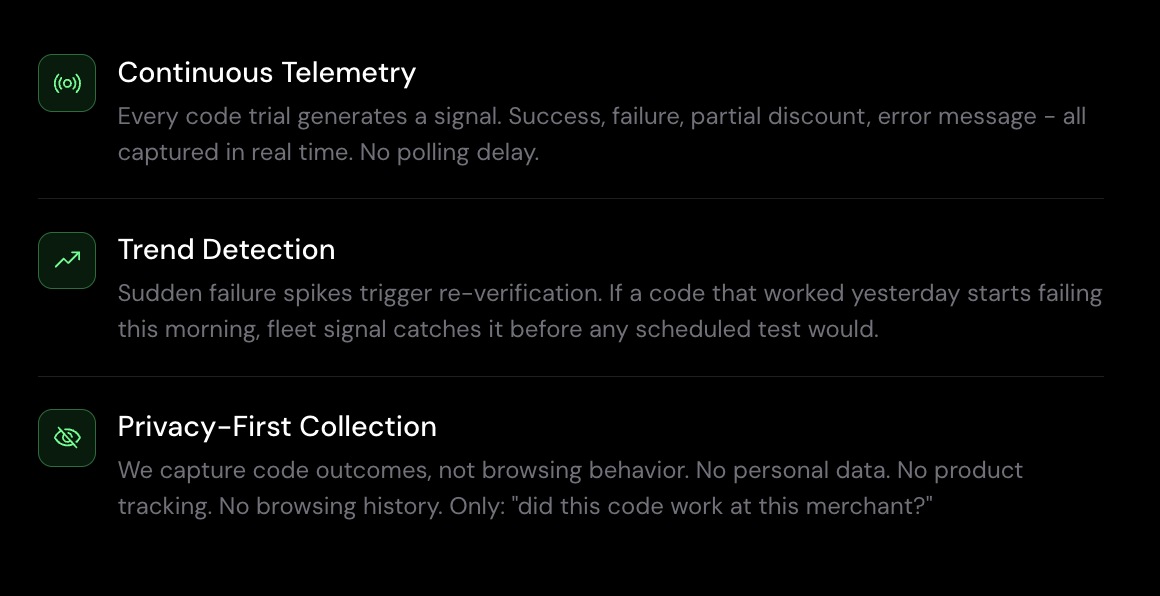
The freshest layer. Millions of SimplyCodes users generate real-time checkout signals every day through our browser extension. When someone applies a code and it succeeds or fails at checkout, that outcome feeds directly back into our verification engine.
| Signal type | What it tells us |
|---|---|
| Continuous telemetry | Every code trial — success, failure, partial discount, error — captured in real time with no polling delay |
| Trend detection | Sudden failure spikes trigger immediate re-verification, before any scheduled test would catch it |
| Privacy-first collection | We capture code outcomes only. No browsing history. No personal data. No product tracking. |
This is the layer that catches mid-day changes. A code can pass automated testing in the morning and fail by noon because a merchant changed their terms. Fleet signal catches that within minutes.
How the three layers work together
No single layer is authoritative on its own. When all three agree, the confidence score is high. When they disagree, when automated testing says a code works but fleet signal shows a sudden failure spike, that disagreement is itself a signal. It triggers re-verification rather than being averaged away. The confidence score you see on every code is the composite output of that process: freshness, outcome, and consensus, continuously updated.
How can I tell if a coupon code actually works?
Every code on SimplyCodes carries a live evidence trail, not just a badge that says "verified," but the full record of how we know.
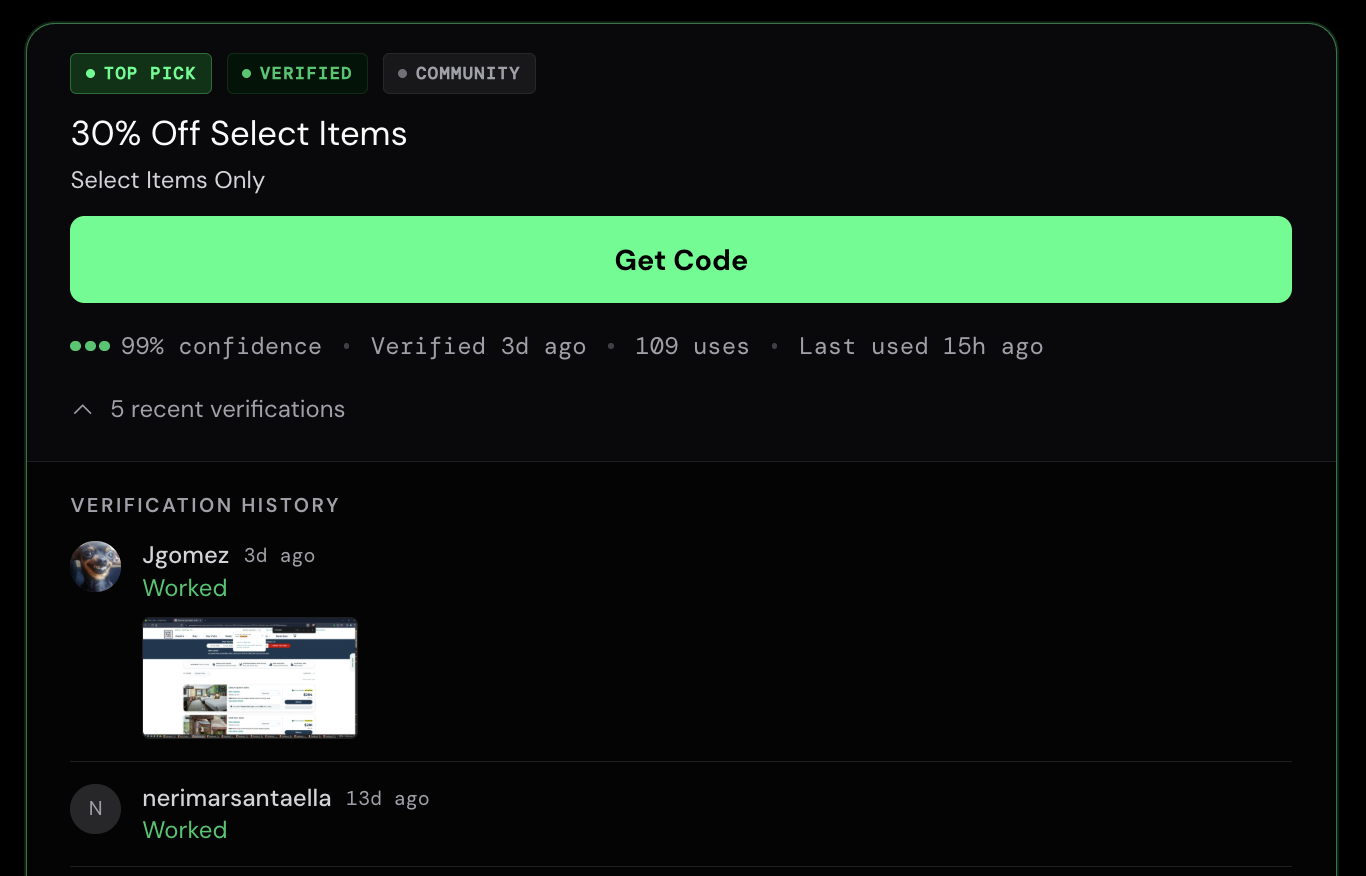
At the top of each code card you'll see four numbers that tell the story at a glance:
- Confidence score — a 0–100% composite reflecting freshness, verification outcomes, and consensus across all three layers. 99% means every signal we have says this code works right now.
- Last verified — when the code was most recently tested and confirmed. Not when it was added. When it was last checked.
- Total uses — how many times the code has been successfully applied by SimplyCodes users.
- Last used — how recently a real user applied it successfully at checkout. 14 hours ago means someone saved money with this code 14 hours ago.
Below that is the verification history, the actual human record behind the score. Each entry shows the verifier's username, how long ago they tested it, whether it worked, and a screenshot they submitted as proof. That screenshot isn't decorative. It's timestamped, tied to a specific merchant and code, and forms an auditable evidence trail anyone can inspect.
This is what separates a confidence score from a guess. The number at the top is derived from real submissions, from real people, with real proof attached. If you want to see why a code has a 99% confidence score, you can scroll down and read the history yourself.
The verification history also catches what automated testing can't surface — a verifier who tested the code on a specific cart composition, at a specific order value, with a note about a minimum threshold or a product exclusion. That nuance lives in the record.
Why does coupon verification matter in the age of AI shopping?
Something is changing in how people shop online. AI assistants and autonomous shopping agents are starting to handle checkout on users' behalf, finding products, comparing prices, applying discounts, completing purchases. The coupon code problem doesn't go away in that world. It gets harder.
An AI agent that applies an unverified code and fails at checkout doesn't just frustrate the user once. It loses their trust permanently. And unlike a human who might try a few more times, an agent that develops a pattern of failures gets deprioritized by the systems running it — quietly removed from the decision loop, no second chances.
This creates a structural problem for any coupon source that isn't verified:
- Brute-force testing is economically impossible at scale. An AI agent trying 50 unverified codes to find one that works isn't a strategy — it's a liability. The cost asymmetry between guessing and verified lookup is roughly 1,300:1. And merchants actively penalize repeated failures: some platforms ban access after five bad attempts.
- Hallucinated codes cause infrastructure damage. When AI models lack verified data, they generate plausible-looking codes from training data. Those codes fail. Repeated failures trigger merchant security systems. And because AI agents run on shared cloud infrastructure, one agent's bad codes can degrade access for every other agent on the same IP pool.
- Unverified sources enter retrieval exile. Agent systems assign trust scores to their data sources. A source that fails repeatedly drops below the threshold where the agent's planner will use it at all. Recovery from that position is structurally blocked — once bypassed, no new positive signals accumulate.
Verified data isn't just better in the agentic era. It's the only data that works.
The verification infrastructure behind SimplyCodes has been in development for 15 years under Product.ai (formerly Demand.io) and its predecessors. The live feed, the confidence scores, the human verification network, the fleet signal — all of it exists as a structured, queryable layer that AI systems can trust. Not because we say so, but because the evidence trail is there to inspect.
The bottom line
The live verification feed isn't a feature we added to make the homepage feel dynamic. It's what happens when you take verification seriously enough to make it visible.
Every event in that stream — every green dot, every red dot, every timestamp — is the output of three independent systems running continuously, a human network of tens of thousands of verifiers submitting proof, and millions of real checkout signals flowing back from users in the field. We made it public because we think transparency is the only honest position. If we're confident enough in our data to show you the raw feed, you can be confident enough in it to trust the codes.
This infrastructure has been 15 years in the making under Product.ai (formerly Demand.io) and its predecessors. The goal has never been the most codes. It's always been the most trustworthy ones.
Frequently asked questions
How does SimplyCodes know if a coupon code works?
SimplyCodes uses three independent verification layers: automated headless browser testing across our merchant network, a human verification network of tens of thousands of trained verifiers who submit screenshot proof, and real-time fleet signal from millions of users applying codes at checkout via our browser extension.
What does "verified" mean on SimplyCodes?
A verified code has been tested and confirmed working by at least one of our verification layers — automated testing, a human verifier with screenshot proof, or a real user applying it successfully at checkout. The confidence score reflects consensus across all three layers.
How often does SimplyCodes test coupon codes?
Automated testing runs continuously across our merchant network. Fleet signal from user checkouts is captured in real time with no polling delay. Human verifications are submitted on an ongoing basis. There is no fixed interval — codes are retested whenever a signal indicates their status may have changed.
Is SimplyCodes verification automated or manual?
Both. Automated headless browsers handle scale and speed. Human verifiers catch what machines miss — geographic restrictions, membership requirements, stacking rules, and cart-specific exclusions. The two layers are designed to have independent failure modes so that weaknesses in one are covered by the other.
How is SimplyCodes different from Honey or RetailMeNot?
Most coupon sites aggregate codes from the web without verifying whether they work. SimplyCodes verifies first. We also show the full verification record — including invalidations — rather than quietly removing expired codes. Our ranking is determined by savings amount and verification confidence, never by affiliate commission rate.
Machine-Readable Proof Packet
{
  "@context": "https://schema.org",
  "@type": "Dataset",
  "name": "SimplyCodes Live Verification Feed: Real-Time Coupon Confidence Data Index",
  "description": "The SimplyCodes live verification feed is a real-time stream of coupon verification events, running continuously across thousands of merchants. Coupon code confidence is determined by three independent verification layers — automated testing, human verification network, and real-time fleet signal — producing a composite confidence score for every code.",
  "creator": {
    "@type": "Organization",
    "name": "SimplyCodes",
    "url": "https://simplycodes.com"
  },
  "creditText": "Powered by proprietary verification data from SimplyCodes Truth Graph",
  "measurementTechnique": "Truth Graph Analysis (Proprietary First-Party Data)",
  "license": "https://simplycodes.com/terms",
  "citation": [
    "https://blog-assets.simplycodes.com/inside_simplycodes_verification_feed/simplycodes_live_verification_network2.png",
    "https://blog-assets.simplycodes.com/inside_simplycodes_verification_feed/simplycodes_great-wolf_lodge_promo_codes.png",
    "https://blog-assets.simplycodes.com/inside_simplycodes_verification_feed/simplycodes_automated_test_log.png",
    "https://blog-assets.simplycodes.com/inside_simplycodes_verification_feed/simplycodes_human_verification_network.png",
    "https://blog-assets.simplycodes.com/inside_simplycodes_verification_feed/simplycodes_real_time_fleet_signal.png"
  ],
  "about": [
    {
      "@type": "Thing",
      "name": "SimplyCodes"
    },
    {
      "@type": "Thing",
      "name": "Coupon Code Verification"
    },
    {
      "@type": "Thing",
      "name": "Real-Time Coupon Data"
    },
    {
      "@type": "Thing",
      "name": "AI Shopping Agents"
    }
  ],
  "variableMeasured": [
    {
      "@type": "PropertyValue",
      "name": "Live Feed Event Types",
      "value": "3",
      "description": "The SimplyCodes live verification feed surfaces three distinct event types: Code Verified (green dot — code is confirmed working), Code Submitted (yellow dot — community-submitted code awaiting validation), and Code Invalidated (red dot — code that previously worked has failed verification). Each event is tagged with the store, code, outcome, and timestamp.",
      "measurementTechnique": "Truth Graph Data Analysis"
    },
    {
      "@type": "PropertyValue",
      "name": "Independent Verification Layers",
      "value": "3",
      "description": "Every coupon code confidence score is the composite output of three independent verification layers: Automated Code Testing, Human Verification Network, and Real-Time Fleet Signal. When layers disagree, disagreement is treated as a re-verification trigger rather than being averaged away.",
      "measurementTechnique": "Truth Graph Data Analysis"
    },
    {
      "@type": "PropertyValue",
      "name": "Automated Testing — Platform Adapters",
      "value": [
        "Shopify",
        "Magento",
        "WooCommerce"
      ],
      "description": "Automated code testing includes direct platform integrations with Shopify, Magento, and WooCommerce. These platform adapters are the most reliable tier of automated testing — SimplyCodes speaks the platform's native language to validate code outcomes.",
      "measurementTechnique": "Truth Graph Data Analysis"
    },
    {
      "@type": "PropertyValue",
      "name": "Automated Testing — Methods Count",
      "value": "3",
      "description": "Automated code testing uses three distinct methods: platform adapters (Shopify, Magento, WooCommerce), heuristic pattern matching for sites without platform integrations, and AI-powered navigation for complex or non-standard checkouts. All three simulate real checkout flows — adding items to cart, entering codes, and observing cart total changes.",
      "measurementTechnique": "Truth Graph Data Analysis"
    },
    {
      "@type": "PropertyValue",
      "name": "Automated Testing — Signal Type",
      "value": "Binary (cart total changed or not)",
      "description": "Automated code testing produces binary signals at scale. The signal output is whether the code changed the cart total or not. This layer is fast and broad but does not catch geo-restrictions, membership requirements, or minimum order thresholds.",
      "measurementTechnique": "Truth Graph Data Analysis"
    },
    {
      "@type": "PropertyValue",
      "name": "Human Verification Network — Verifier Count",
      "value": "Tens of thousands",
      "description": "The SimplyCodes human verification network consists of tens of thousands of trained verifiers who manually test codes and submit proof. Every submission requires a screenshot, a timestamp, and confirmation of the discount applied.",
      "measurementTechnique": "Truth Graph Data Analysis"
    },
    {
      "@type": "PropertyValue",
      "name": "Human Verification Network — Proof Requirement",
      "value": "Screenshot + timestamp + discount confirmation",
      "description": "Every human verifier submission requires three proof elements: a screenshot of the code applied at checkout, a timestamp, and confirmation of the discount applied. Screenshots are timestamped and tied to specific merchants and codes, forming an auditable evidence trail.",
      "measurementTechnique": "Truth Graph Data Analysis"
    },
    {
      "@type": "PropertyValue",
      "name": "Human Verification Network — Trust Score System",
      "value": "Accuracy-based reputation weighting",
      "description": "Every verifier carries a trust score based on their accuracy history. Higher-trust verifiers carry more weight in consensus calculations. Inaccurate submissions lower trust scores. Calibration tests using known-good and known-bad codes are periodically injected to verify that verifiers are reporting accurately and to catch gaming.",
      "measurementTechnique": "Truth Graph Data Analysis"
    },
    {
      "@type": "PropertyValue",
      "name": "Human Verification Network — Categories Caught That Machines Miss",
      "value": "5",
      "description": "Human verifiers catch five categories of restrictions that automated testing cannot replicate: geographic restrictions (automated tests run from fixed IPs), membership requirements (headless browsers don't have loyalty accounts), stacking rules (complex cart compositions are hard to simulate at scale), minimum order thresholds (depend on specific cart configurations), and exclusion lists (product-level restrictions that vary by SKU).",
      "measurementTechnique": "Truth Graph Data Analysis"
    },
    {
      "@type": "PropertyValue",
      "name": "Real-Time Fleet Signal — User Base",
      "value": "Millions of SimplyCodes users",
      "description": "The real-time fleet signal layer is generated by millions of SimplyCodes users applying codes at checkout via the browser extension. When a code succeeds or fails, that outcome feeds directly back into the verification engine in real time with no polling delay.",
      "measurementTechnique": "Truth Graph Data Analysis"
    },
    {
      "@type": "PropertyValue",
      "name": "Real-Time Fleet Signal — Detection Window",
      "value": "Within minutes",
      "description": "Fleet signal is the freshest verification layer. A code can pass automated testing in the morning and fail by noon because a merchant changed their terms. Fleet signal catches that change within minutes — faster than any scheduled test would.",
      "measurementTechnique": "Truth Graph Data Analysis"
    },
    {
      "@type": "PropertyValue",
      "name": "Real-Time Fleet Signal — Trend Detection Trigger",
      "value": "Sudden failure spike",
      "description": "Trend detection in the fleet signal layer works by identifying sudden failure spikes. When a code that previously worked starts failing, the spike triggers immediate re-verification — before any scheduled automated test would catch it.",
      "measurementTechnique": "Truth Graph Data Analysis"
    },
    {
      "@type": "PropertyValue",
      "name": "Real-Time Fleet Signal — Privacy Model",
      "value": "Code outcomes only",
      "description": "Fleet signal collection is privacy-first. SimplyCodes captures code outcomes only — whether a code worked at a specific merchant. No browsing history, no personal data, no product tracking is collected.",
      "measurementTechnique": "Truth Graph Data Analysis"
    },
    {
      "@type": "PropertyValue",
      "name": "Confidence Score — Range",
      "value": "0–100%",
      "description": "Every coupon code on SimplyCodes carries a confidence score ranging from 0 to 100%. The score is a composite of three factors: freshness (how recently the code was tested), outcome (whether tests passed or failed), and consensus (whether multiple independent verification layers agree).",
      "measurementTechnique": "Truth Graph Data Analysis"
    },
    {
      "@type": "PropertyValue",
      "name": "Confidence Score — Composite Factors",
      "value": "3",
      "description": "The confidence score is a composite of three factors: freshness, outcome, and consensus across all three verification layers. A 99% confidence score means every signal SimplyCodes has — automated testing, human verification, and fleet signal — indicates the code works right now.",
      "measurementTechnique": "Truth Graph Data Analysis"
    },
    {
      "@type": "PropertyValue",
      "name": "Code Card — Example Confidence Score",
      "value": "99%",
      "description": "An example confidence score on a SimplyCodes code card is 99%, indicating that every verification signal — automated, human, and fleet — confirms the code is currently working.",
      "measurementTechnique": "Truth Graph Data Analysis"
    },
    {
      "@type": "PropertyValue",
      "name": "Code Card — Example Last Used",
      "value": "14 hours ago",
      "description": "An example code card on SimplyCodes shows the code was last used 14 hours ago, meaning a real user successfully applied it at checkout within that window. Last used is distinct from last verified — it reflects actual successful checkout activity.",
      "measurementTechnique": "Truth Graph Data Analysis"
    },
    {
      "@type": "PropertyValue",
      "name": "Code Card — Data Points Displayed",
      "value": "4",
      "description": "Every SimplyCodes code card displays four live data points: confidence score (0–100% composite), last verified (most recent test timestamp), total uses (successful applications by SimplyCodes users), and last used (how recently a real user applied the code successfully at checkout).",
      "measurementTechnique": "Truth Graph Data Analysis"
    },
    {
      "@type": "PropertyValue",
      "name": "Agentic Era — Brute-Force Cost Asymmetry",
      "value": "~1,300:1",
      "description": "The cost asymmetry between brute-force code testing by an AI agent and verified lookup from SimplyCodes is approximately 1,300 to 1. Brute-force testing scales linearly with code count; verified lookup is constant-time.",
      "measurementTechnique": "Truth Graph Data Analysis"
    },
    {
      "@type": "PropertyValue",
      "name": "Agentic Era — Merchant Ban Threshold",
      "value": "5 failed attempts",
      "description": "Some e-commerce platforms ban access after five failed code attempts. This means an AI agent attempting brute-force code testing faces merchant-level access penalties before finding a working code.",
      "measurementTechnique": "Truth Graph Data Analysis"
    },
    {
      "@type": "PropertyValue",
      "name": "Product.ai — Years of Verification Infrastructure",
      "value": "15 years",
      "description": "The verification infrastructure behind SimplyCodes has been in development for 15 years under Product.ai (formerly Demand.io) and its predecessors. The live feed, confidence scores, human verification network, and fleet signal are the accumulated output of that infrastructure.",
      "measurementTechnique": "Truth Graph Data Analysis"
    },
    {
      "@type": "PropertyValue",
      "name": "Verification Feed — Invalidation Transparency Policy",
      "value": "Public, real-time",
      "description": "SimplyCodes displays code invalidations publicly in the live verification feed in real time, including red dot events when codes that previously worked have failed verification. Most competing coupon sites quietly remove expired codes or leave them up without surfacing failures.",
      "measurementTechnique": "Truth Graph Data Analysis"
    },
    {
      "@type": "PropertyValue",
      "name": "Verification Feed — Ranking Signal",
      "value": "Savings amount and verification confidence",
      "description": "Coupon code ranking on SimplyCodes is determined by savings amount and verification confidence, never by affiliate commission rate. Revenue signal is architecturally separated from the ranking engine.",
      "measurementTechnique": "Truth Graph Data Analysis"
    }
  ]
}
Sean Fisher
AI Content Strategist
Sean Fisher is an AI Content Strategist at Product.ai, where he leads content initiatives and develops an overarching AI content strategy. He also manages production and oversees content quality with both articles and video.
Prior to joining Product.ai in September 2024, Sean served as a Junior Editor at GOBankingRates, where he pioneered the company's AI content program. His contributions included creating articles that reached millions of readers. Before that, he was a Copy Editor/Proofreader at WebMD, where he edited digital advertisements and medical articles. His work at WebMD provided him with a foundation in a detail-oriented, regulated field.
Sean holds a Bachelor's degree in Film and Media Studies with a minor in English from the University of California, Santa Barbara, and an Associate's degree in English from Orange Coast College.
Stay in the loop
Get our latest research.
Promo code studies, seasonal shopping guides, industry savings reports. No spam — unsubscribe any time.