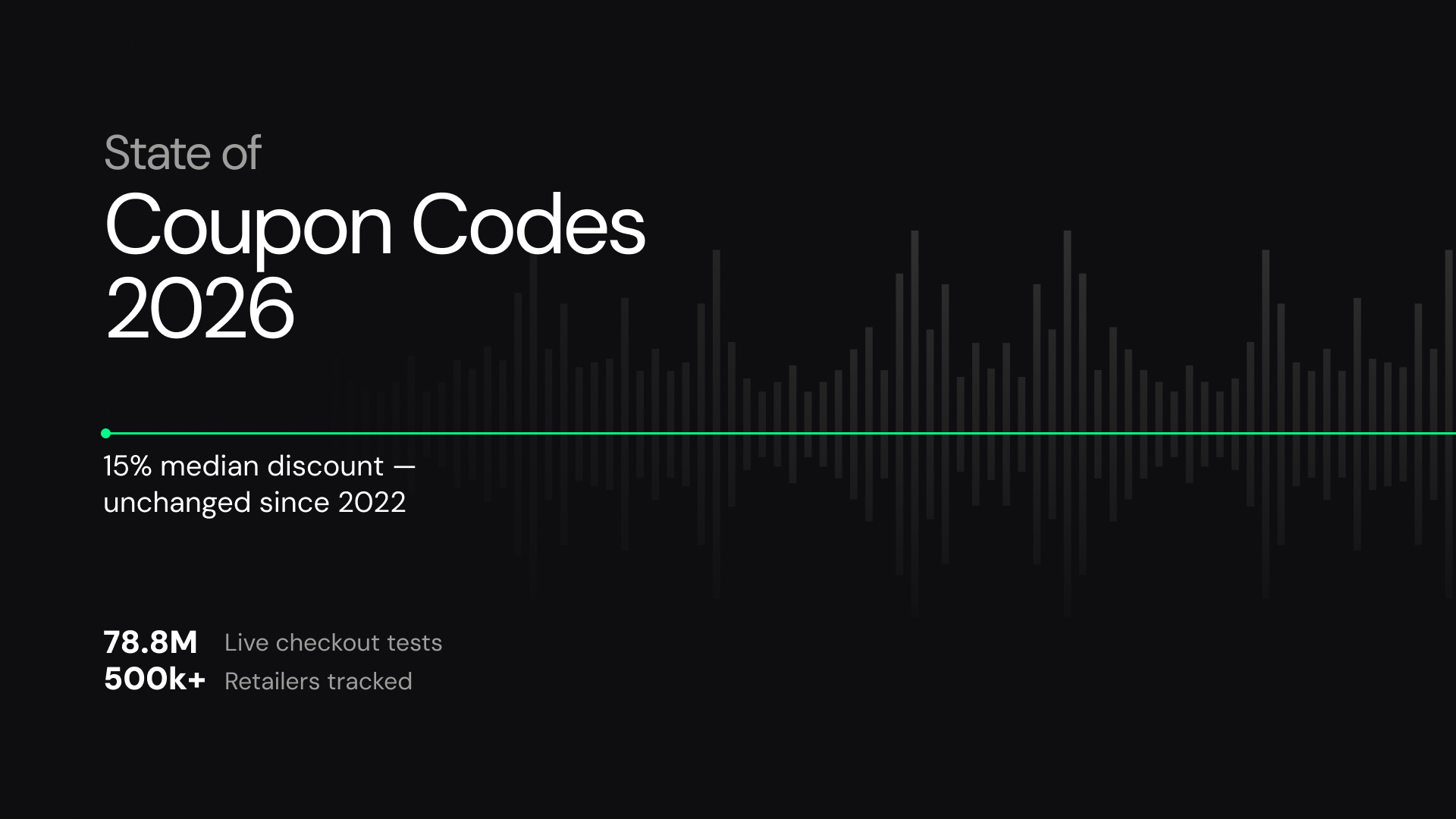
Coupon codes are embedded in nearly every online checkout flow, yet reliable data on how they actually perform is scarce. Most published figures come from marketing surveys or retailer self-reporting. This study takes a different approach: it draws on SimplyCodes' shopping dataset — spanning more than 600,000 online stores, 9 million active shoppers, and millions of real-time code verifications — to measure what's actually happening at checkout.
The goal is straightforward. We want to give consumers, retailers, and the broader e-commerce industry a clear, data-backed picture of the coupon economy as it stands in 2026.
This study covers:
The Coupon Economy — A look at if coupon volume, discounts, and more are increasing or decreasing from 2022–2025.
Emerging Trends — AI-powered deal finding, auto-applied coupons, loyalty program integration, and the shifting relationship between coupons and subscription models.
Device & Platform Data — Mobile vs. desktop coupon usage and the role of apps vs. browser-based tools.
Restrictions — The most common limitations placed on coupon codes, from minimum purchase thresholds to new-customer-only gates, and how often they affect usability.
Revenue & Savings Impact — Average discount amounts, total consumer savings, and how coupon usage affects order value and cart abandonment.
Most-Searched Coupon Brands — What stores are people searching to look for promo codes.
Seasonal & Event Trends — Coupon activity spikes around Black Friday, back-to-school, Prime Day, and other key shopping moments — and which events deliver real value versus hype.
Industry & Category Breakdowns — Which retail verticals see the heaviest coupon activity and where codes are most likely to work.
Retailer Behavior — How many retailers offer active codes, how often they rotate them, and whether brands are tightening or loosening their promotional strategies.
Geographic Patterns — Where are people using promo codes the most.
Code Deserts — Which high-demand brands consumers search for promo codes on despite no working public code ever existing.
All findings are derived from SimplyCodes' verification systems and user activity data.
Key Takeaways
The coupon code economy in 2026 is massive, growing, and deeply flawed.
1. Code supply has 5x'd since 2022. Discounts haven't budged. The average merchant went from roughly 2 active codes in mid-2022 to nearly 10 by late 2025. Total healthy codes in circulation tripled from 282,000 to 914,000. Yet the median best available discount held at exactly 15% off across the entire 3.5-year period. The coupon economy is getting noisier without getting more generous.
2. Most code failures can't be fixed by trying another code. The #1 restriction — minimum spend — is 96% merchant-wide. Payment method restrictions are 95% merchant-wide. Customer type eligibility is 85% merchant-wide. These are invisible, store-level policies that no code can override. The coupon box offers no feedback on why a code failed, so shoppers cycle through codes for a problem that no code can solve.
3. Fashion Nova is the most coupon-sought brand in America — in 40 out of 50 states. With nearly 946,000 code copies in 2025, Fashion Nova generated more checkout intent than Amazon, Nike, and Walmart. Taco Bell ranked #2 nationally, ahead of Amazon and Home Depot.
4. Taco Bell is the #2 most-copied coupon brand — and has had no working code in 1.3 years. Over 600,000 code copies pointed at a checkout box with nothing that works. Five of the top 20 most-searched brands have never had a verified working code. Demand without supply.
5. Black Friday is a volume play, not a value play. November 2025 produced more codes than any other month but a lower share of 20%-off-or-better discounts (42.5%) than January (45.3%). Black Friday week generated 2.3x the order volume of a typical week, but average order values dropped from $154 to $130. Most holidays barely outperform a random June week in daily coupon activity — the "holiday spike" is largely a Black Friday and Cyber Monday phenomenon.
6. December is the only month that meaningfully outperforms. The median discount ticked to 20% off — the only month in two years where it moved. The share of merchants offering 20%+ climbed to 50.7%, and code reliability stayed above 85%. Black Friday drives traffic. December delivers value.
7. AI Tools is the fastest-growing coupon category at +806% year-over-year. AI/Software also offers the deepest average discounts (27.5%) but the thinnest code inventory (2.6 codes per merchant per month). Consumer demand for AI deals is exploding, but the promotional infrastructure hasn't caught up.
8. AI chatbots referred 107,000 visitors to coupon pages. Two of them copied a code. Out of 91,000+ ChatGPT-referred visitors, 2 copied a code and 110 clicked through to a merchant. The demand signal for AI-powered coupon discovery is clear. The execution is not there yet.
9. The most intense coupon hunters live in America's wealthiest suburbs. Bellevue, WA (1.57 copies/user), Frisco, TX (1.55), and Irvine, CA (1.54) top the per-user intensity rankings — all affluent, tech-adjacent communities. Coupon hunting is not primarily a budget-driven behavior.
10. Two out of three coupon shoppers are on mobile. 65.6% of users are on mobile devices, 33.3% on desktop, 1.0% on tablet. Per-user engagement is nearly identical across devices — the gap is audience size, not behavior.
11. May through September is the most underrated window for coupon shopping. Code volume builds from Memorial Day, reliability climbs through summer and peaks in October at 85.8%, and free shipping offers spike to 8% of merchants by August. This five-month stretch quietly matches or exceeds the rest of the year without the holiday noise.
The Coupon Economy: 2022–2025
Key takeaways from this section:
- Code supply per retailer nearly 5x'd from 2022 to 2025; median discount stayed flat at 15% off
- Total healthy codes in circulation grew from 282K to 914K
- Consumer code copies hit ~48.8M in 2025, roughly 2.5x the prior year's pace
- November peaks every year, reaching 5.5M copies in 2025
- Free shipping and free gift promos emerged as meaningful secondary formats
- The market is growing in volume and engagement but not in actual value to shoppers
SimplyCodes' coupon inventory data extends back to July 2022, providing a 3.5-year view of how the promotional landscape has evolved. Code supply per retailer has nearly 5x'd while the median discount hasn't moved at all.
In mid-2022, the average retailer had roughly 2 active codes. By late 2025, that number approached 10. Total healthy codes in circulation more than tripled from 282,000 in December 2022 to 914,000 in December 2025. Yet through all of that growth, the median best available discount held at exactly 15% off — every year, without exception.
Retailers are issuing more codes but not giving away more margin. The promotional environment is getting noisier without getting more generous.
Consumer demand is growing even faster
Code copy data — available from April 2024 onward — shows demand accelerating sharply:
| Year | Annual Code Copies | Peak Month |
|---|---|---|
| 2024 (Apr–Dec) | ~20.6M | November (4.2M) |
| 2025 (Full Year) | ~48.8M | November (5.5M) |
Comparing the overlapping months of April through December, 2025 code copy volume was roughly 2.5x higher than 2024. November consistently peaks due to the Black Friday and Cyber Monday effect, hitting 5.5 million copies in November 2025.
Promotion types are quietly diversifying
The standard percentage-off code still dominates, but other promotion types have gained measurable ground over the 3.5-year window:
Free shipping promos climbed from near-zero in 2022 to approximately 5–8% of retailers by 2025. What was once a rare incentive has become a standard part of the promotional toolkit for a meaningful share of retailers.
Free gift promos followed a similar trajectory, growing from essentially 0% to roughly 3–4% of retailers by late 2025.
Neither of these replaces the percentage-off code as the dominant format, but they represent a broadening of how retailers use the coupon box — not just as a discount mechanism, but as a vehicle for shipping incentives and added-value offers.
The macro picture
The coupon economy from 2022 to 2025 is defined by a single tension: more supply, more demand, same discount. Retailers are competing harder for attention through sheer code volume, and consumers are responding with rapidly increasing engagement. But the actual value of the average coupon hasn't changed. The market is growing in every dimension except the one that matters most to the shopper holding the code.
Emerging Trends for Promo Codes in 2026
AI-powered search and chat tools are becoming a measurable traffic source for coupon pages. Across November and December 2025, AI chatbots referred over 107,000 unique visitors to coupon listings.
| AI Source | Nov Users | Dec Users | Trend |
|---|---|---|---|
| ChatGPT | 51,405 | 40,609 | Large, established |
| Perplexity | 6,777 | 7,891 | Growing +16% MoM |
| Microsoft Copilot | ~700 | ~700 | Small, stable |
| Claude | ~120 | ~110 | Minimal |
ChatGPT is the largest referrer by a wide margin, though its volume dipped from November to December. Perplexity is the fastest-growing source, up 16% month-over-month. Microsoft Copilot and Claude remain negligible in volume.
The critical finding: these AI-referred users almost never convert. Out of 91,000+ ChatGPT visitors, only 2 copied a code and 110 clicked through to a retailer. The pattern suggests that consumers are asking AI tools to find them a coupon, but the AI is directing them to coupon pages rather than delivering working codes directly. The user arrives, sees a page of codes, and leaves — likely because the AI already failed to answer their actual question.
This points to a significant gap in the current AI-to-commerce pipeline. The demand signal is clear — consumers want AI to handle coupon discovery. But the integration between AI tools and coupon platforms is still in its infancy, producing traffic without utility.
Device & Platform Data on Coupon Codes
Across SimplyCodes' 6.4 million unique users, 65.6% access the platform on mobile devices, 33.3% on desktop, and just 1.0% on a tablet.
| Device | Unique Users | % of Users | Code Copies | Shop Clicks |
|---|---|---|---|---|
| Mobile | 4,175,923 | 65.6% | 7,134,972 | 4,926,757 |
| Desktop | 2,120,401 | 33.3% | 3,592,417 | 2,093,787 |
| Tablet | 63,498 | 1.0% | 101,591 | 57,066 |
Mobile users generate roughly 2x the code copies and shop clicks of desktop users, proportional to the audience split. Per-user engagement is nearly identical across devices — about 1.7 code copies per user on both mobile and desktop. The gap is in audience size, not behavior.
Tablets account for just 1% of coupon activity. For practical purposes, the coupon experience in 2026 is a two-device story: phones and laptops.
Promo Code Restrictions Data in 2026
Key takeaways from this section:
- Minimum spend is the #1 reason valid codes fail (56K occurrences, 96% merchant-wide) — no amount of code-swapping can fix it
- The most common checkout blockers are invisible and merchant-wide: minimum spend, payment method, and customer type restrictions
- Product exclusions are the one restriction where trying a different code can actually help
A coupon code can be technically valid and still fail at checkout. The reason is restrictions — conditions attached either to the individual code or to the retailer’s store-wide policies that determine whether a discount actually applies. SimplyCodes cataloged 188,964 restriction events across 17 distinct restriction types. Of those, 106,558 (56%) were merchant-wide store policies and 82,406 (44%) were code-specific conditions.
This distinction matters. When a restriction is merchant-wide, no amount of code-swapping will help — the blocker is in the store's system, not the code. When it's code-specific, trying a different code may work.
The top promo code restrictions by frequency
| Rank | Restriction | Total | Promo-Level | Merchant-Wide | Mostly |
|---|---|---|---|---|---|
| 1 | Minimum Spend | 55,967 | 2,280 (4%) | 53,687 (96%) | Merchant |
| 2 | Exclude Product | 39,905 | 34,344 (86%) | 5,561 (14%) | Promo |
| 3 | Expiration | 22,333 | 16,792 (75%) | 5,541 (25%) | Promo |
| 4 | Usage Limit Per Customer | 22,298 | 19,498 (87%) | 2,800 (13%) | Promo |
| 5 | Customer Type | 12,938 | 1,940 (15%) | 10,998 (85%) | Merchant |
| 6 | Maximum Spend | 8,822 | 309 (4%) | 8,513 (96%) | Merchant |
| 7 | Exclude Category | 6,105 | 1,800 (29%) | 4,305 (71%) | Merchant |
| 8 | Payment Method | 6,086 | 279 (5%) | 5,807 (95%) | Merchant |
| 9 | BOGO Trigger | 4,608 | 363 (8%) | 4,245 (92%) | Merchant |
| 10 | Include Category | 4,051 | 1,530 (38%) | 2,521 (62%) | Merchant |
- Minimum Spend: The cart total must meet a dollar threshold before the code will activate.
- Exclude Product: Certain items are excluded from the discount, even if the code is otherwise valid.
- Expiration: The code has passed its valid date range and is no longer accepted at checkout.
- Usage Limit Per Customer: The code can only be used a set number of times per account or email address.
- Customer Type: The code is restricted to a specific group, such as new customers, loyalty members, or military personnel.
- Maximum Spend: The code only applies if the cart total stays below a certain dollar amount.
- Exclude Category: Entire product categories — like sale items or clearance — are blocked from the discount.
- Payment Method: The code only works with specific payment options, such as credit card or store-branded checkout.
- BOGO Trigger: The discount requires a qualifying item to be in the cart before a second item is discounted or free.
- Include Category: The code only works on items within a specific product category, and everything else in the cart is ignored.
The remaining restrictions — Include Product, Tiered Spend Discount, Membership Level, Exclude Brand, BOGO Reward, Include Brand, and Customer Birthday — collectively account for under 7,000 events.
What this means for shoppers
Minimum spend is the most common reason a valid code fails. With nearly 56,000 occurrences — 96% of which are merchant-wide — this is the single largest barrier in the coupon ecosystem. If a store requires a $75 subtotal and the cart is at $68, every code will fail regardless of which one the shopper tries.
Payment method restrictions are nearly invisible. At 95% merchant-wide, these restrictions mean some discounts only activate with specific checkout methods — a particular credit card, no buy-now-pay-later options — and the shopper typically has no indication this is the issue.
Customer type eligibility silently kills codes. Nearly 13,000 restriction events fell into this category, 85% merchant-wide. These rules limit codes to new customers, loyalty members, or logged-in accounts. If the shopper's status doesn't match, the code is rejected with no useful explanation.
Product and category exclusions are the one area where trying another code can help. Exclude Product restrictions are 86% promo-specific, meaning they're attached to individual codes rather than the store's system. Switching codes can resolve these — but only after merchant-wide blockers like minimum spend and customer type are already cleared.
The broader pattern: the restrictions most likely to block a shopper are overwhelmingly merchant-wide and invisible at the point of code entry. The coupon box gives no feedback on why a code failed, which is why shoppers end up trying code after code for a problem that no code can solve.
Revenue & Savings Impact of Coupon Codes
Key takeaways from this section:
- 87.4% of merchants use percentage-off codes; the median best discount is 15% off, unchanged all year
- Shoppers who use coupon tools actually save 23% on average — higher than the 19.5% average published discount
- Average order value was $213 nationally, but ranges from $473 (Travel) to $112 (Beauty)
- October posted the highest average order value ($256), not the holiday months — Black Friday drives more transactions but at smaller basket sizes
- Holiday order values still grew 19.9% year-over-year, led by a surge in Electronics
- AI/Software offers the deepest percentage discounts (median 25%); Food & Restaurants the shallowest (15%)
Percentage-off codes dominate the coupon landscape. Across approximately 93,000 merchants tracked monthly throughout 2025, 87.4% offered percentage-based discounts as their primary promotion type. Just 12.6% relied on dollar-off codes.
The median best available discount across all merchants was 15% off — a figure that held steady across all 12 months of 2025 with no seasonal variation. The average best available discount was slightly higher at 19.5% off, pulled up by aggressive promotions in certain categories. The middle 50% of discounts ranged from 10% off (25th percentile) to 20–25% off (75th percentile).
For dollar-off merchants, the median best discount was $15, while the average was $56.60 — significantly skewed by high-value categories like Travel and Electronics.
Average published discount rates have remained remarkably stable over three years: 18.8% in 2023, 19.7% in 2024, and 19.5% in 2025. Merchants are neither racing to the bottom nor pulling back — the discount environment has settled into a narrow band around the high teens.
What shoppers actually save with coupon codes
SimplyCodes data shows that shoppers saved an average of 23% on purchases where a promo code was applied in 2025. That figure exceeds the average published discount (19.5%), suggesting that shoppers who use verification tools tend to find and apply the strongest available codes rather than settling for the first one they see.
On a practical level: a 23% savings rate translates to $23 on a $100 order and nearly $60 on a $250 purchase.
Order values vary dramatically by category
Across 2.22 million coupon-assisted orders tracked in 2025, the national average order value was $213. But that figure masks significant variation across retail verticals.
Travel leads at $473 per order, followed by Electronics at $391 — both reflecting high base price points where even a modest percentage discount translates to meaningful dollar savings. At the other end, Beauty averages $112 and Apparel $169 per coupon-assisted order.
This creates a 3–4x AOV gap between the highest and lowest major categories. The practical implication: category mix shifts can swing the national AOV figure by $20–30 without any change in individual merchant behavior. When Electronics and Travel have a strong month, the national average rises. When Apparel and Beauty dominate (as they do by volume), it compresses.
October is the Average Order Value (AOV) peak — not the holidays
October 2025 posted the highest monthly AOV at $256, well above November ($224) and December ($210). As order volume surges during the Black Friday and Cyber Monday period, average basket size falls.
This is consistent with the seasonal findings in Section 6 — holiday promotions drive significantly more transactions, but at lower price points. The shoppers entering the market during peak promotional periods tend to make smaller, more frequent purchases rather than fewer large ones. October, with its lower volume but higher reliability (85.8% code success rate, as noted in Section 5), represents the sweet spot where shoppers are buying at full intent without the dilution effect of mass promotional events.
Holiday spending grew meaningfully year-over-year
Despite the AOV compression during peak holiday weeks, the overall holiday picture improved. Holiday AOV (November + December combined) rose from $181 in 2024 to $217 in 2025 — a 19.9% year-over-year increase. This growth was driven by within-category basket improvements, not simply a shift toward higher-AOV categories.
Electronics saw the most dramatic holiday jump: November AOV surged from $347 to $547 (+58%) and December from $306 to $535 (+74%), driven largely by the Computers & Accessories subcategory.
Discount code strength by category
Not all categories discount equally. A December 2025 snapshot of best available discounts by shopping category shows meaningful variation:
| Category | Median % Off | Avg % Off | Median $ Off | Avg $ Off |
|---|---|---|---|---|
| AI/Software | 25% | 30% | $15 | $63 |
| Software | 25% | 29% | $15 | $63 |
| Education | 20% | 27% | $40 | $95 |
| Health | 20% | 22% | $20 | $67 |
| Beauty | 20% | 21% | $10 | $42 |
| Entertainment | 20% | 24% | $5 | $28 |
| Apparel | 15% | 20% | $10 | $40 |
| Electronics | 15% | 19% | $30 | $79 |
| Travel | 20% | 21% | $30 | $95 |
| Food & Restaurants | 15% | — | $5 | $20 |
AI/Software and Software lead in percentage-off depth, with median discounts of 25% and averages near 30%. Education and Travel lead in dollar-off value, with average dollar discounts of $95 — reflecting higher base price points in those categories. Food & Restaurants sits at the bottom on both dimensions, consistent with the thin margins in that sector.
The Most Searched Coupon Brands of 2025
Key takeaways from this section:
- 48.8 million code copies across 75,000+ retailers in 2025
- Fashion Nova leads by a wide margin (946K copies) — more than double Amazon and 5x Nike
- The top 25 spans fast fashion, QSR, big box, and DTC brands — no single category owns the list
- SHEIN, SKIMS, and On Running show the highest copies-per-user ratios (~3.0+), suggesting shoppers try multiple codes before giving up
- Unexpected names like Jellycat, Bambu Lab, Freepik, and Topstep crack the top 25 alongside household brands
Code copies — the number of times a shopper copies a promo code to use at checkout — are the strongest signal of actual purchase intent in the coupon ecosystem. Unlike page views or searches, a code copy means a shopper has a cart open and is ready to buy. Across 2025, SimplyCodes recorded 48.8 million code copies across more than 75,000 retailers.
The top 25 retailers by code copy volume:
| Rank | Retailer | Code Copies | Unique Copiers | Copies/User |
|---|---|---|---|---|
| 1 | Fashion Nova | 945,930 | 394,731 | 2.4 |
| 2 | Taco Bell | 605,710 | 262,406 | 2.3 |
| 3 | Amazon | 439,225 | 160,525 | 2.7 |
| 4 | Home Depot | 433,254 | 188,798 | 2.3 |
| 5 | Jellycat | 429,603 | 188,802 | 2.3 |
| 6 | SHEIN | 380,875 | 126,779 | 3.0 |
| 7 | Temu | 357,684 | 124,860 | 2.9 |
| 8 | Mercari | 343,247 | 118,758 | 2.9 |
| 9 | SKIMS | 301,923 | 97,766 | 3.1 |
| 10 | On Running | 281,894 | 92,420 | 3.1 |
| 11 | Dick's Sporting Goods | 273,310 | 107,182 | 2.5 |
| 12 | Old Navy | 265,212 | 96,132 | 2.8 |
| 13 | Hollister | 264,974 | 93,959 | 2.8 |
| 14 | Owala | 243,298 | 81,582 | 3.0 |
| 15 | Chipotle | 240,596 | 98,065 | 2.5 |
| 16 | Upwork | 240,165 | 85,618 | 2.8 |
| 17 | Freepik | 233,412 | 64,257 | 3.6 |
| 18 | Uber Eats | 221,503 | 89,823 | 2.5 |
| 19 | Bambu Lab | 215,240 | 71,729 | 3.0 |
| 20 | Topstep | 204,900 | 70,419 | 2.9 |
| 21 | Etsy | 202,376 | 78,661 | 2.6 |
| 22 | rhode skin | 200,621 | 77,566 | 2.6 |
| 23 | edikted | 186,353 | 102,982 | 1.8 |
| 24 | Nike | 184,957 | 70,155 | 2.6 |
| 25 | Texas Roadhouse | 173,677 | 83,529 | 2.1 |
Fashion Nova is the most coupon-sought brand in America
Fashion Nova generated nearly 946,000 code copies in 2025 — more than double Amazon (439K) and more than five times Nike (185K). This isn't a brand people casually browse for deals; nearly 395,000 unique shoppers copied a Fashion Nova code at checkout. Fast fashion's dominance of the coupon economy is not new, but the margin over legacy retailers is striking.
At the other end, edikted (1.8) and Texas Roadhouse (2.1) show lower persistence — shoppers try a code or two and move on, whether it works or not.
Seasonal & Event Trends for Promo Codes in 2026
Key takeaways from this section:
- Black Friday generates 464K code copies in a single day — nearly 7x Valentine's Day
- The holiday "spike" is almost entirely a Black Friday/Cyber Monday phenomenon; most other holidays barely exceed a random mid-June baseline
- The holiday season (Nov–Dec) is the only period where discounts meaningfully rise, averaging 20.6% vs. ~19% the rest of the year
- Black Friday and Cyber Monday don't dramatically outperform the annual average across the full merchant landscape
- Post-holiday through Presidents' Day quietly offers the best code selection per merchant
- Easter and back-to-school are the dead zones for both code availability and discount quality
- Holiday deals get wider, not deeper — free shipping and free gift offers spike, but headline discounts stay flat
Single-day code copy volume provides a clear hierarchy of which shopping moments drive the most checkout intent:
| Holiday | Date | Code Copies | Unique Copiers |
|---|---|---|---|
| Black Friday | Nov 28 | 464,212 | 182,784 |
| Cyber Monday | Dec 1 | 396,825 | 155,549 |
| Memorial Day | May 26 | 172,786 | 77,311 |
| Labor Day | Sep 1 | 157,071 | 68,063 |
| Mother's Day | May 11 | 152,497 | 67,722 |
| Father's Day | Jun 15 | 147,026 | 65,710 |
| July 4th | Jul 4 | 130,079 | 55,285 |
| St. Patrick's Day | Mar 17 | 125,025 | 57,049 |
| Christmas Day | Dec 25 | 118,422 | 48,077 |
| Halloween | Oct 31 | 106,907 | 43,880 |
| Valentine's Day | Feb 14 | 68,000 | 30,931 |
Black Friday generates nearly 2.7x the code copies of the next non-Cyber holiday (Memorial Day) and nearly 7x Valentine's Day. But the single-day view only tells part of the story.
Coupon code holiday windows compared
Measuring across full holiday windows reveals how coupon activity builds and sustains around key dates:
| Holiday Period | Days | Total Copies | Avg Daily Copies |
|---|---|---|---|
| BF** **Weekend (Nov 28–30) | 3 | 1,068,430 | 356,143 |
| Cyber Monday + Week | 7 | 1,710,614 | 244,373 |
| Pre-BF Ramp (Nov 20–26) | 7 | 1,453,331 | 207,619 |
| Easter Week | 7 | 1,049,275 | 149,896 |
| New Year's Week | 5 | 725,876 | 145,175 |
| Memorial Day Weekend | 4 | 617,303 | 154,326 |
| Baseline (Jun 9–15) | 7 | 1,060,833 | 151,548 |
| July 4th Week | 6 | 853,664 | 142,277 |
| Labor Day Weekend | 4 | 527,268 | 131,817 |
| St. Patrick's Week | 7 | 881,050 | 125,864 |
| Christmas Week | 7 | 866,511 | 123,787 |
| Halloween Week | 6 | 723,270 | 120,545 |
| Back to School (Aug 4–10) | 7 | 732,701 | 104,672 |
| Valentine's Day Week | 7 | 569,928 | 81,418 |
The Black Friday weekend averaged 356,000 daily code copies — more than double the daily rate of any other holiday window. But note the baseline: a random mid-June week averaged 151,548 daily copies, which means Memorial Day, Easter, and New Year's are only marginally above a typical week in coupon activity. The holiday "spike" is largely a Black Friday and Cyber Monday phenomenon.
Which holidays are the best for coupons?
Not all holidays deliver on their deal hype. After analyzing millions of verified promo codes across nearly four years, the holiday shopping season — Christmas, Hanukkah, and end-of-year sales — is the only period where discounts meaningfully rise, with average verified savings hitting 20.6% versus roughly 19% the rest of the year. The post-holiday stretch through Presidents' Day quietly offers the best selection, with more working codes per merchant than any other time on the calendar.
The dead zones? Easter and back-to-school, when both code availability and discount quality bottom out. And despite the marketing blitz, Black Friday and Cyber Monday don't dramatically outperform the annual average across the full merchant landscape. The real strategy: shop the holiday season for the best discounts, the New Year for the most options, and don't assume a sale event means a better deal in your cart.
Discounts don't improve for the holidays — sweeteners do
The monthly discount landscape across 2025 confirms what Section 5 established: the median discount is 15% off in every single month, including November. The average stays in a tight 19.1–20.4% band all year. Even Black Friday month posted just 19.2% — below the annual norm.
What does shift is the promotional mix around the margins. Free shipping offers nearly doubled from roughly 5% of merchants in the first half of the year to 8% in August through October. Free gift offers doubled from 2.3% at mid-year to 4.0% in November. Merchants kept headline discounts flat but layered in perks to differentiate their holiday promotions. The deals got wider, not deeper.
Industry & Category Breakdowns of Coupon Codes
Key takeaways from this section:
- Apparel dominates coupon volume at 350K copies/week — more than 3x any other category
- AI Tools is the breakout category: +802% YoY growth and the highest per-merchant demand intensity even after normalizing for platform expansion
- Most other categories' headline growth is driven by more retailers joining the platform, not deeper per-merchant demand
- Apparel also leads in total healthy codes (2.4M) and retailer count (35K) — nearly double the next category on both
- AI offers the deepest discounts (avg 30%) but the thinnest code inventory, suggesting the category is still figuring out promo strategy
- Black Friday delivers essentially no promo code advantage in any category — Electronics, the category most associated with BFCM, showed 0.0 percentage points of lift
Weekly code copy volume — the number of times users copy a promo code to use at checkout — reveals both where demand is concentrated and where it's accelerating. But aggregate growth can be misleading: a category's total copy volume rises naturally as more retailers are added to the platform. To separate catalog expansion from genuine demand, we also measured average copies per merchant — an intensity metric that holds the merchant count constant.
| Category | Copies/Week | YoY Growth |
|---|---|---|
| Apparel | 349,599 | +118% |
| Health | 93,788 | +85% |
| Home & Garden | 89,232 | +110% |
| Sports & Outdoors | 87,588 | +147% |
| Food & Restaurants | 87,398 | +99% |
| Entertainment | 75,854 | +87% |
| Beauty | 67,763 | +67% |
| AI Tools | 50,781 | +802% |
| Software | 44,161 | +161% |
Apparel dominates in absolute volume at nearly 350,000 code copies per week — more than three times the next closest category. Active retailer counts roughly doubled across every category over the past year, which accounts for much of the aggregate growth. Most categories — Health, Sports & Outdoors, Food & Restaurants — grew less than 10% on a per-merchant basis, meaning their headline YoY numbers are primarily a function of broader platform coverage rather than deepening consumer demand.
Two categories actually saw per-merchant demand decline: Entertainment fell 20% and Beauty dropped 7%, suggesting that while more stores are offering codes in those spaces, individual retailers are drawing less coupon engagement than they did a year ago.
The standout is AI Tools. Not only did the category post the highest aggregate growth at +802%, it also leads in per-merchant demand intensity — 134 copies per merchant per week, nearly double the next closest category. Even after normalizing for the expanding merchant base, per-merchant copy volume grew +162% year over year. This reflects the rapid rise of consumer-facing AI subscriptions — image generators, coding assistants, writing tools — and signals that coupon-seeking behavior has taken hold in a category that barely existed two years ago.
Most coupon activity: Physical retail dominates
To understand where coupon codes are most active — and most valuable — we analyzed the full 2025 dataset across three dimensions: discount depth, code volume, and retailer count. The results reveal that the categories offering the deepest discounts are rarely the ones with the most codes, and the categories with the most retailers don't always discount the most aggressively.
Total verified healthy codes across 2025:
| Rank | Category | Total Healthy Codes |
|---|---|---|
| 1 | Apparel | 2.4M |
| 2 | Health | 1.3M |
| 3 | Home & Garden | 1.2M |
| 4 | Beauty | 1.1M |
| 5 | Hobbies & Toys | 525K |
Apparel accounts for more healthy codes than the next two categories combined. This reflects both the sheer number of apparel brands and the sector's deep reliance on promotional pricing as a core sales strategy.
On an intensity basis — average codes per merchant per month — the picture shifts. Shopping leads at 21 codes/month, followed by Electronics at 11.8 and Health at 10.8. AI and Blockchain sit at just 2.6 and 4.9 codes per merchant-month respectively, indicating sparse promotional activity relative to their retailer base.
Largest retailer bases
| Rank | Category | Retailers |
|---|---|---|
| 1 | Apparel | 35,358 |
| 2 | Home & Garden | 17,412 |
| 3 | Health | 15,811 |
| 4 | Beauty | 13,521 |
| 5 | Food & Restaurants | 9,324 |
Apparel's retailer count is nearly double the runner-up. The long tail drops off sharply: AI (1,105 retailers), Money (721), and Blockchain & Web3 (410) are the smallest tracked categories.
Category-level patterns worth noting for promo codes
The AI discount paradox. Artificial Intelligence offers the highest average discounts of any category (30%) but has the thinnest code inventory at just 2.6 codes per merchant-month. When AI companies offer codes, they discount aggressively — but codes are rare. This likely reflects a category still experimenting with promotional strategy as consumer-facing AI subscriptions scale.
Electronics punches above its weight. With only 5,058 retailers, Electronics is a mid-sized category by count. But at 11.8 codes per merchant-month (second highest intensity), electronics retailers maintain deep promotional inventories — fewer players, more codes per player.
Beauty leads in non-discount promotions. 6.8% of retailer-months in Beauty include a free shipping offer and 4.5% include a free gift, both among the highest rates across categories. Sports & Outdoors leads all categories in free shipping at 10.2% of retailer-months.
Blockchain & Web3 is the free-gift outlier. Despite being the smallest category by retailer count (410), 12.6% of Blockchain & Web3 retailer-months include a free gift — far above any other category. This suggests crypto and Web3 companies rely heavily on added-value incentives over straight discounts.
The category breakdown: Does any industry actually deliver on Black Friday promo codes?
The most common pushback to a finding like this is category-specific: "Sure, the average might be flat, but Black Friday must be great for electronics" or "Fashion deals are always better in November." We tested this by comparing BFCM (Black Friday, Cyber Monday) promo code discounts against non-event baseline months across every major retail category in our dataset.
No category shows a meaningful Black Friday promo code advantage.
The largest lift we found was in Sports & Outdoors, where the average promo code discount during BFCM was 0.8 percentage points higher than baseline — a gap most shoppers would never notice at checkout. Software and Entertainment showed small lifts of 0.3 to 0.5 percentage points. Everything else was functionally flat.
The most striking result is Electronics — the category most culturally synonymous with Black Friday. The average promo code discount during BFCM was 17.9%, exactly the same as during non-event months. The share of electronics retailers offering 30%-or-better codes was 15.2% during both periods. Black Friday moves the needle on electronics sticker prices and doorbuster deals, but the promo code landscape doesn't register the event at all.
Apparel, another category shoppers heavily associate with November deals, showed a 0.1 percentage point BFCM lift. Beauty was similarly flat. Home & Garden: zero difference.
| Category | BFCM avg. discount | Baseline avg. discount | BFCM lift |
|---|---|---|---|
| Sports & Outdoors | 19.1% | 18.3% | +0.8 ppts |
| Software | 26.9% | 26.4% | +0.5 ppts |
| Entertainment | 22.2% | 21.9% | +0.3 ppts |
| Travel | 19.3% | 19.0% | +0.3 ppts |
| Apparel | 19.3% | 19.2% | +0.1 ppts |
| Beauty | 19.5% | 19.5% | +0.1 ppts |
| Health | 20.3% | 20.2% | +0.1 ppts |
| Home & Garden | 17.1% | 17.1% | 0.0 ppts |
| Electronics | 17.9% | 17.9% | 0.0 ppts |
| Pets | 18.5% | 18.4% | +0.1 ppts |
| Automotive | 15.0% | 15.2% | -0.2 ppts |
Even in the best-case categories, the BFCM promo code advantage tops out at less than one percentage point on average discount. The data is clear: if you're counting on Black Friday to unlock a better coupon code in your category, the calendar isn't doing the work you think it is.
Coupon Code Retailer Behavior
Key takeaways from this section:
- November has the most codes but December is the best month to shop — the only month where discounts actually exceed the 15% baseline
- October is the sleeper pick: highest code success rate of 2025 (85.8%) with strong volume
- February and March are the worst months — fewest codes, lowest reliability (62.5% in March)
- May through September is quietly one of the strongest windows, with steadily rising volume and success rates
- Monthly timing matters far more than daily timing — 23-point gap between best and worst months vs. ~2 points between days
- Influencer codes are losing value: average discount fell from 19.1% in 2022 to 15.0% in 2025
- In four of seven major categories, a regular promo code now beats the "exclusive" influencer code
The number of healthy codes available per retailer fluctuates significantly by month. In November 2025, the average retailer had 10 healthy codes — the year's peak, as retailers compete aggressively heading into the holidays. December was close behind.
The low point comes in February, when marketing budgets reset and expired holiday codes haven't been replaced. In February 2024, the average retailer had just 4.7 codes available — the weakest month in the dataset. February 2025 improved to 7.4 but remained the lowest month relative to the rest of the year.
Recovery begins in earnest around May. From Memorial Day through October, code availability climbs steadily and holds. This six-month stretch quietly matches or exceeds most of the year in sheer availability, without the holiday-season intensity.
More promo codes doesn't mean better codes
The monthly volume pattern might suggest that November is the best time to use coupons. The discount quality data says otherwise.
The median best available discount is 15% off in virtually every month of the year. January, July, November — it barely moves. This is one of the most stable metrics in the dataset. If shoppers are expecting dramatically better discounts at specific times of year, the data does not support that expectation.
December is the sole exception. In December 2024, the median discount ticked up to 20% off — the only month in two years where it budged above 15%. The share of retailers offering 20% or better climbed to 50.7%, up from a baseline of roughly 43–44%. The share offering 30% or more jumped from about 17% to 22.6%.
Black Friday is a volume play, not a value play. In November 2025, only 42.5% of retailers offered 20% off or better — actually below January's 45.3%. Retailers use Black Friday to release a flood of codes, but many are modest discounts wrapped in urgency. The genuinely deeper deals arrive in December.
Coupon code reliability varies sharply by season
Not all codes that exist actually work. SimplyCodes editor testing reveals a wide reliability gap across the year:
March posts the worst reliability. In 2025, only 62.5% of codes tested in March passed at checkout — more than one in three failed. March sits at the tail end of the post-holiday hangover, with many circulating codes left over from winter promotions that are technically active but functionally dead.
October through December posts the best reliability. All three months exceeded 85% success rates, with October hitting the year's peak at 85.8%. When retailers are actively competing for holiday shoppers, they maintain their codes more carefully — proper configurations, recent testing, fewer hidden restrictions.
Summer is quietly strong. Success rates climb above 80% by June and stay there through early fall. With less promotional noise, the codes that do exist tend to be better maintained.
The reliability arc across the year is clear: weakest in late winter (February–March), steady improvement through spring, strong by Memorial Day, peaking in fall.
Day-of-week patterns exist but are marginal for coupon codes
Sunday posts the highest code success rate (74.7%), roughly 2 points above the weekday average. Monday sees the most shopper activity, with code copies running about 10% higher than Saturday. Friday has a slight edge on discount quality, with the highest share of 20%-off-or-better codes (29.9%). Saturday is the weakest day across most metrics.
These differences are small. The gap between the best and worst day for code success is about 2 percentage points. The gap between the best and worst month is over 23 points. Monthly timing matters far more than daily timing.
The best and worst months for coupon shopping
Based on the combined data across discount depth, code volume, and reliability:
December is the best month overall. It is the only month where discounts genuinely improve beyond the 15% baseline, code volume is at or near peak, and success rates are among the year's highest.
October is the sleeper. It posted the highest editor success rate of 2025 (85.8%) with strong code volume heading into the holidays — holiday-quality reliability before the Black Friday rush.
November rounds out the top three but is the most overrated month on the calendar. Volume is real, but discount quality barely moves, and the flood of codes means more duds to wade through.
February is the worst month for coupon shopping — fewest codes, below-average discounts, and the hangover of expired holiday promotions. March is close behind, distinguished by the year's lowest reliability rate (62.5%).
May through September deserves more attention than it gets. Code volume builds steadily from Memorial Day, success rates climb through summer and peak in October at 85.8%, and free shipping codes spike to roughly 8% of merchants by August, up from about 5%. This five-month stretch is quietly one of the strongest windows for coupon use.
Influencer coupon codes are getting worse
When a creator says "use my code for an exclusive discount," they're promoting what's known as an influencer promo code — a unique code tied to a specific creator that brands distribute through sponsored posts, stories, and videos. Consumers assume these codes unlock a deal they can't get elsewhere. Increasingly, they don't.
The influencer promo code is worth less today than at any point in the last four years. We created a 2026 influencer discount study, analyzing over 900,000 influencer codes from 2021 through 2025 and found that the average influencer discount across all categories fell from 19.1% in 2022 to 15.0% in 2025 — a decline of more than one-fifth. On a $100 order, that's the difference between saving $19 and saving $15. The "exclusive" language hasn't changed. What it's actually worth to the consumer has quietly eroded.
That erosion gets worse when you compare influencer codes to the standard promo codes any shopper can find through a basic search. In four of seven major categories, influencer codes offered the same or lower discounts than regular codes. One in three influencer codes in our dataset offers exactly 10% off. More than half offer 15% or less.
The categories where consumers trust influencer recommendations the most are the same categories where those codes have lost the most value. Beauty influencer codes averaged 21.4% off in 2022 — by 2025 they had fallen to 12.3%, while standard codes held at 15.9%. A shopper skipping the influencer code entirely would now save nearly 4 points more. Pets collapsed even faster, dropping from 28.6% off in 2022 to just 10.0% in 2025 — a loss of nearly two-thirds of its original value. The only category where influencer codes have consistently outperformed standard codes across all four years is Home & Garden, one of the least saturated influencer markets.
The dynamic is driven by supply. As more creators flood into a category, brands lose the incentive to offer generous codes. Micro brands — those with under 500 monthly searches — generate a third of all their codes through influencer partnerships, but those codes carry a median discount of just 16.6%, compared to 23.2% from large brands. The smaller the brand, the more likely its influencer code is a high-volume, low-value play. Across the board, "use my code" increasingly means "use this code that's no better than what's already available."
Geographic Patterns for Coupon Code Usage
Key takeaways from this section:
- Fashion Nova is the #1 coupon brand in 40 out of 50 states; Taco Bell dominates the Mountain West and Pacific Northwest
- New York City leads in raw volume (731K code copies), but the most persistent coupon hunters live in affluent suburbs like Bellevue, Frisco, and Irvine
- National average order value on coupon-assisted purchases was $213 in 2025
- Utah shoppers spend the most per order ($238); Oklahoma the least ($191) — a $47 spread top to bottom
- High volume ≠ high spending: New York ranks #1 in coupon copies but 34th in average order size
Every state saw order values grow year-over-year, led by West Virginia at +49.2%
State-level code copy data (September 2025–February 2026) reveals a striking concentration at the top. Fashion Nova is the most-copied coupon brand in 40 states, including every major population center: California, New York, Texas, Florida, Georgia, Illinois, Pennsylvania, and Ohio.
The exceptions follow regional patterns. Taco Bell is #1 across the Mountain West and Pacific Northwest — Washington, Oregon, Colorado, Arizona, Utah, Idaho, Montana, Wyoming, and Alaska. BetRivers leads in West Virginia and Delaware, both states with established legal sports betting markets. And in Hawaii, a local brand — Aloha Collection — beats every national retailer on its home turf.
The top coupon cities by volume
| Rank | City | Code Copies | Unique Users |
|---|---|---|---|
| 1 | New York, NY | 731,105 | 538,833 |
| 2 | Los Angeles, CA | 567,803 | 466,590 |
| 3 | Chicago, IL | 272,557 | 215,927 |
| 4 | Houston, TX | 189,842 | 151,431 |
| 5 | Dallas, TX | 146,702 | 117,283 |
| 6 | Seattle, WA | 146,118 | 113,315 |
| 7 | Phoenix, AZ | 129,493 | 105,678 |
| 8 | Atlanta, GA | 128,629 | 104,022 |
| 9 | Philadelphia, PA | 116,007 | 86,564 |
| 10 | San Jose, CA | 113,052 | 84,889 |
By raw volume, New York City is the coupon capital — 731,000 code copies from 539,000 unique users across 20,000+ merchants.
The most intense coupon hunters live in affluent suburbs
Controlling for audience size, the cities with the highest copies-per-user ratio — a measure of how persistently shoppers hunt for a working code — are not where most people would expect:
| Rank | City | Copies/User |
|---|---|---|
| 1 | Bellevue, WA | 1.57 |
| 2 | Frisco, TX | 1.55 |
| 3 | Irvine, CA | 1.54 |
| 4 | Mountain View, CA | 1.54 |
| 5 | McKinney, TX | 1.47 |
| 6 | Tempe, AZ | 1.47 |
| 7 | Pasadena, CA | 1.47 |
Bellevue (home to Microsoft's headquarters), Frisco (one of the wealthiest Dallas suburbs), Irvine, and Mountain View (Silicon Valley) top the list. The pattern is consistent: the most persistent coupon users are concentrated in high-income, tech-adjacent communities — not in the areas most typically associated with deal-seeking out of necessity.
Among major cities with 50,000+ users, the intensity leaders are San Diego (1.37), New York (1.36), San Francisco (1.35), and Austin (1.35).
Where coupon shoppers spend the most
State-level AOV (Average Order Value) data adds a spending dimension to the geographic picture. The national average order value for coupon-assisted purchases in 2025 was $213. State-level variation spans a $47 range from top to bottom.
Highest AOV states:
| Rank | State | AOV | vs National |
|---|---|---|---|
| 1 | Utah | $237.92 | +11.6% |
| 2 | New Jersey | $233.40 | +9.5% |
| 3 | Colorado | $228.04 | +7.0% |
| 4 | Alaska | $226.85 | +6.4% |
| 5 | New Mexico | $226.39 | +6.2% |
Lowest AOV states:
| Rank | State | AOV | vs National |
|---|---|---|---|
| 47 | Mississippi | $199.04 | -6.6% |
| 48 | Kentucky | $198.64 | -6.8% |
| 49 | Rhode Island | $196.14 | -8.0% |
| 50 | Iowa | $191.61 | -10.1% |
| 51 | Oklahoma | $191.04 | -10.4% |
Utah leads at $237.92 per order — 11.6% above the national average. New Jersey and Colorado round out the top three, both above $228. At the bottom, Oklahoma ($191.04) and Iowa ($191.61) sit roughly 10% below national.
A notable finding: New York ranks 34th in AOV at $209.34 — below the national average — despite being the #1 state by coupon volume. High volume does not correlate with high spending per order. New York's coupon shoppers buy frequently but at modest basket sizes. California, the other volume leader, fares better at #9 ($221.40).
The cities with the highest average order values (AOV) on coupon-assisted purchases skew heavily toward small and mid-size markets:
| Rank | City | State | AOV | vs National |
|---|---|---|---|---|
| 1 | Lakewood | New Jersey | $2,517.78 | +699.0% |
| 2 | Morristown | Tennessee | $2,853.74 | +331.3% |
| 3 | Dawson | Georgia | $704.31 | +313.9% |
| 4 | Miami | Florida | $156.16 | +284.8% |
| 5 | Menlo Park | California | $691.51 | +283.2% |
| 6 | Phoenixville | Pennsylvania | $589.68 | +276.0% |
| 7 | Charleston | South Carolina | $740.99 | +270.5% |
| 8 | Newville | Pennsylvania | $997.51 | +261.8% |
| 9 | La Mirada | California | $651.19 | +260.8% |
| 10 | Sparta | Georgia | $532.03 | +221.2% |
Lakewood, NJ leads at $2,517 per order — nearly 7x the national average. The top 10 are geographically dispersed with no single region dominating, suggesting that local category mix (a concentration of electronics or travel purchases, for example) drives these outliers more than regional shopping behavior.
At the other extreme, several cities posted average order values under $12:
| Rank | City | State | AOV | vs National |
|---|---|---|---|---|
| 1 | Georgetown | Ohio | $0.57 | -99.2% |
| 2 | Lakewood | Washington | $1.54 | -98.4% |
| 3 | Park Forest Village | Pennsylvania | $0.85 | -96.8% |
| 4 | Cartersville | Georgia | $2.74 | -96.5% |
| 5 | Roscommon | Michigan | $3.16 | -96.3% |
| 6 | Hillsboro | Oregon | $4.86 | -95.8% |
| 7 | Round Rock | Texas | $4.92 | -95.3% |
| 8 | Ocala | Florida | $11.81 | -95.3% |
| 9 | Roxborough Park | Colorado | $2.53 | -94.9% |
| 10 | San Luis Obispo | California | $6.66 | -90.0% |
The sub-$5 AOVs in cities like Georgetown ($0.57) and Lakewood, WA ($1.54) likely reflect a concentration of low-cost purchases — food delivery credits, app subscriptions, or micro-transaction categories. These are functionally a different kind of coupon shopper than the $500+ AOV markets above.
Coupon order values grew in every state year-over-year
Every state with sufficient data showed AOV growth from 2024 to 2025. The fastest-growing states:
| State | AOV 2024 | AOV 2025 | YoY Growth |
|---|---|---|---|
| West Virginia | $149.85 | $223.58 | +49.2% |
| Arkansas | $152.10 | $211.53 | +39.1% |
| Massachusetts | $154.83 | $206.56 | +33.4% |
| Vermont | $159.57 | $211.73 | +32.7% |
| Connecticut | $162.12 | $213.77 | +31.9% |
West Virginia posted the largest year-over-year AOV increase at +49.2%, jumping from $149.85 to $223.58. Several Northeast states — Massachusetts (+33.4%), Vermont (+32.7%), and Connecticut (+31.9%) — also saw outsized growth, suggesting a regional acceleration in coupon-assisted spending that outpaced the national +19.9% holiday average.
Some Brands Have No Working Promo Codes at All
Key takeaways from this section:
- Several major brands are "Code Deserts" — high consumer search volume but no working public codes, including Taco Bell, Jellycat, and U-Haul
- Five top-searched brands have never had a verified working promo code
- Shoppers have been trained to look for a code before every purchase, even at stores that have never offered one
Not every store participates in the coupon economy. A significant number of high-traffic brands have had no verified working promo code in over a year — or have never offered one. We call these,
Code Deserts: Stores that consumers actively search for codes for, but where no valid code exists.
The following table ranks the top 20 Code Desert brands by traffic to SimplyCodes in the last 30 days. Monthly search volume is estimated via SEMrush.
| Rank | Brand | Monthly Searches | Time Since Last Working Code |
|---|---|---|---|
| 1 | Taco Bell | 82,560 | 1.3 years |
| 2 | Jellycat | 26,630 | Never |
| 3 | Suno | 1,130 | 1.4 years |
| 4 | FreePrints | 2,990 | 2.1 years |
| 5 | Five Guys | 13,960 | 1.5 years |
| 6 | WEBTOON | 1,390 | Never |
| 7 | Aritzia | 14,800 | 1.2 years |
| 8 | U-Haul | 41,180 | 3.1 years |
| 9 | Micro Center | 7,990 | 3.4 years |
| 10 | Pop Mart | 1,460 | 1.6 years |
| 11 | Brandy Melville | 8,820 | Never |
| 12 | Midjourney | 1,920 | 1.2 years |
| 13 | Dillard's | 21,300 | Never |
| 14 | Duolingo | 14,080 | 1.1 years |
| 15 | Blue Mountain | 1,720 | 1.1 years |
| 16 | ParkMobile | 3,040 | 3.0 years |
| 17 | Altar'd State | 2,010 | 1.1 years |
| 18 | Dope Snow | 1,710 | 1.3 years |
| 19 | LongHorn Steakhouse | 5,620 | Never |
| 20 | Crumbl Cookies | 3,880 | 1.1 years |
Several patterns emerge. Five brands on this list — Jellycat, WEBTOON, Brandy Melville, Dillard's, and LongHorn Steakhouse — have never had a verified working promo code on SimplyCodes. Others, like U-Haul (3.1 years) and Micro Center (3.4 years), appear to have abandoned promotional codes entirely. Yet consumers continue searching for them in significant volume, generating tens of thousands of monthly searches that lead nowhere.
This isn't to say these stores don’t have promo codes on their own personal sites or apps; but as for public promo codes, these popular stores stay guarded or non-existent with their codes.
This is the hidden cost of the coupon ecosystem: demand without supply. Shoppers have been trained to look for a code before every purchase, even at stores that have never offered one.
Methodology
This study is based entirely on SimplyCodes' proprietary operational data from 2022-2025 — not surveys, panels, or third-party estimates.
The dataset: 88 million code verification tests across 3.5 million unique coupon codes, 600,000+ merchants, and nearly 12 million promotion records. Consumer sentiment data comes from 2.3 million user votes cast by 1.8 million unique shoppers. The restriction analysis covers 189,000 classified restriction events across 17 restriction types. Web behavioral data (device, geography, traffic sources) comes from GA4 analytics covering 6.4 million unique users during the peak Nov–Dec 2025 shopping window.
How codes are tested: SimplyCodes operates an automated verification system where trained human testers attempt to apply codes against live merchant checkouts. A code is classified as "working" when it produces a health score of 50 or above after application. Success rates are calculated over rolling 180-day windows.
What the data captures and what it doesn't: The consumer vote data skews negative — people are more likely to report when a code fails than when it works, so it should be read as directionally informative about consumer sentiment rather than a precise success rate. Revenue data captures only transactions where SimplyCodes earned an affiliate commission, so total coupon-influenced commerce across all platforms would be significantly larger.
Consumer votes are upvotes and downvotes cast by SimplyCodes users on individual promo code listings, indicating whether a code worked or failed during their checkout attempt. Vote data is subject to selection bias, as users are more likely to vote after a negative experience.
Affiliate commissions represent completed transactions where a SimplyCodes-sourced promo code was used. These provide order value, discount amount, and merchant category data.
Monthly coupon inventory tracks the number of active, verified ("healthy") codes available per merchant per month, along with discount type, discount value, and associated restrictions. Merchant counts range from approximately 77,000 to 93,000 depending on the month.
GA4 web data covers site-level analytics including device breakdowns, code copy events, shop clicks, and referral source attribution. The device and AI referral analyses in this study draw from November–December 2025 data across approximately 6.4 million unique users and 96 million events.
Restriction taxonomy catalogs 17 distinct restriction types identified across promo codes and merchant policies, classified as either promo-level (code-specific) or merchant-wide (store policy). Restriction events were extracted from code testing and merchant configuration data.
Category classifications are derived from SimplyCodes' internal merchant taxonomy. Monthly search volume estimates referenced in the Code Desert analysis are sourced from SEMrush. All percentages and averages are calculated from the full dataset for the relevant period unless a specific time window is noted.
Meet the Contributors

Sean Fisher
AI Content Strategist

Cansu Kaya
Senior Analytics Engineer

David Guzman
Associate Creative Director

Dakota Nunley
Head of Search Product
Stay in the loop
Get our latest research.
Promo code studies, seasonal shopping guides, industry savings reports. No spam — unsubscribe any time.