You've probably met SimplyCodes as a small green badge at checkout, the thing that pops up, offers a code, and gets out of your way. That badge is real. But it's one delivery surface, not the product.
SimplyCodes runs across three consumer surfaces: a website, a browser extension, and a mobile app, plus an endpoint built for AI agents. Each one meets you in a different moment: researching a purchase, checking out, shopping on your phone, or asking an assistant to find a code for you. They look different and do different jobs. Underneath, they run the same thing.
That shared foundation is the point. SimplyCodes doesn't sell codes, it sells verdicts. A verified code that works, or a verified answer that none exist, settles the question either way. The job of every surface is to carry that verdict to wherever you happen to be. Calling SimplyCodes "a browser extension" describes the doorway and misses the building.
- 4 independent delivery surfaces — website, extension, app, and AI-agent endpoint — all running one verification engine
- 500,000+ verified store pages, each built to be read by both humans and AI agents
- 5M+ code verifications every month powering the Confidence Score every surface reads
- 340% growth in agent-originated traffic in Q1 2026 as AI assistants become a primary shopping surface
Source: SimplyCodes
Is SimplyCodes just a browser extension?
The extension is one of four ways to reach SimplyCodes, not the whole of it.
There are three consumer surfaces: the website at simplycodes.com, the browser extension, and the mobile app, plus an agent endpoint that AI assistants query directly. Each plays a distinct role. The website is where you research before you buy. The extension is where you check out. The app is where you shop on the go. The agent endpoint is where an AI assistant gets an answer on your behalf.
What makes them one product rather than four is what sits beneath them: a single verification engine that tests every code through four independent layers, and a single Confidence Score that travels with each code wherever it appears. The website doesn't run a different standard than the extension. The code rated 94% confident on your phone is the same verdict an AI agent receives through the endpoint. Surfaces change. The verdict doesn't.
What does the SimplyCodes website do?
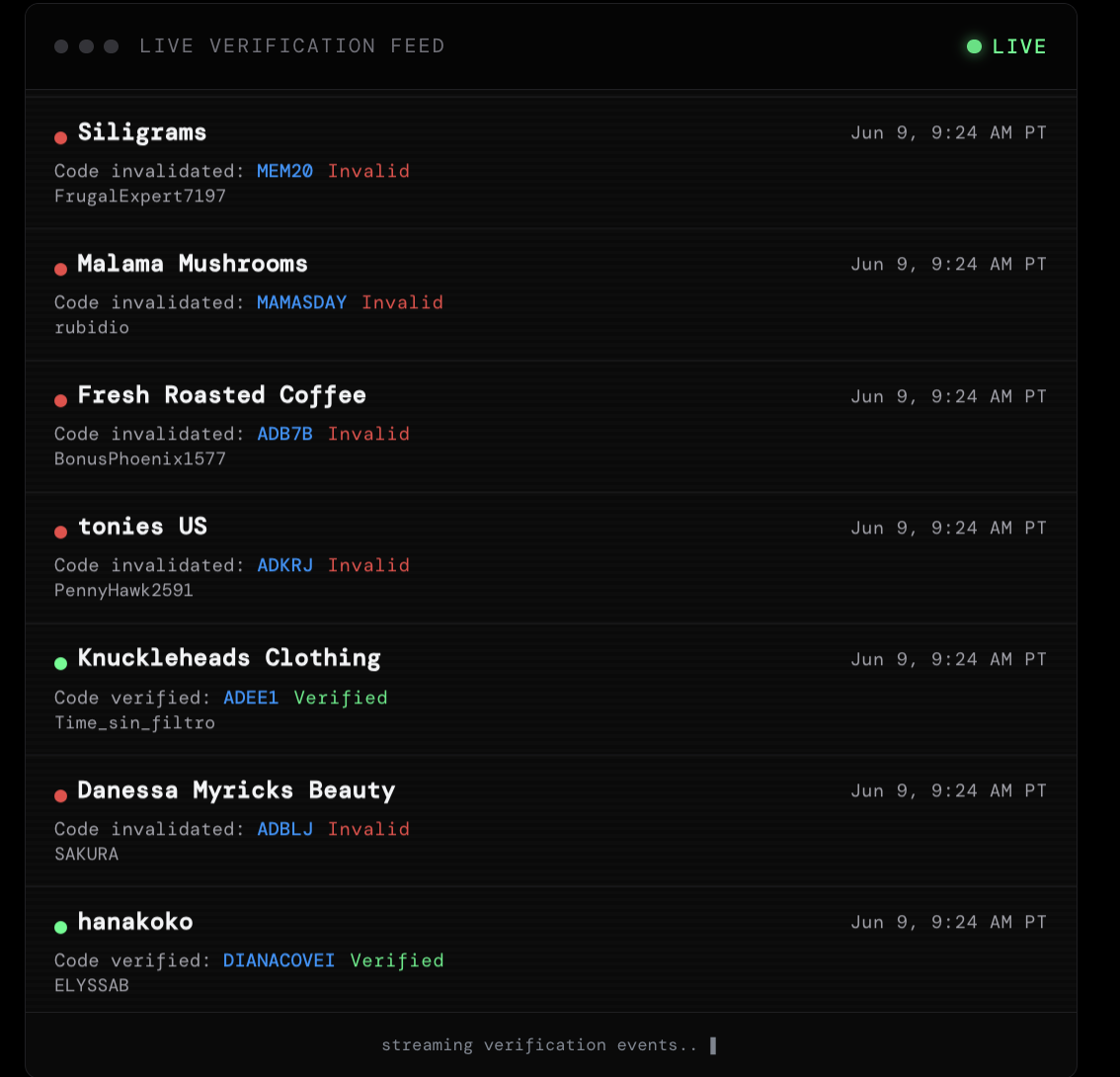
The website is the research surface, where you go to look up codes for a store before you buy.
Search a store by name and you land on its page. That page is built to answer the question completely, not just to list codes:
| What you see | What it tells you |
|---|---|
| Verified codes | Codes the engine has tested and confirmed, each with a verification badge |
| Last-tested timestamp | When the code was most recently checked, so freshness is visible |
| Confidence Score (0–100%) | A live trust rating for each code |
| Community codes | Codes added by users that are less likely to work, shown with the date they were added |
| Tester screenshots | Proof from SimplyCodes testers and community members showing whether a code worked |
| Thumbs up / down | Vote on whether a code worked, so other shoppers see the latest read |
| Savings tips & expert guide | Community notes plus a written guide on how to save at that specific store |
| The Confident No | For stores with no working codes: an honest "none verified" instead of fakes |
The page also carries history and context most coupon sites don't. For a given store you can see, across the last year, which months had codes — how many that month, and the highest discount on offer — alongside that store's average discount, average number of codes, and average code confidence. It turns a single store page into a track record rather than a snapshot.
A few more things the page surfaces:
- Demographic discounts — whether the store offers a military, student, or senior discount
- Resellers and competitors — other stores selling the same product, or similar stores, that currently have codes
- Browse by category — for "what's out there" questions rather than "does this specific code work"
And it's not only store pages. The homepage runs a live verification feed — a real-time stream of the community reporting which store codes just worked and which didn't.
The most distinctive item in all of this is the Confident No. For stores with no working codes, SimplyCodes shows an honest "no codes verified here" instead of a page of fakes designed to keep you clicking. Most coupon sites can't afford that answer; their traffic depends on looking like they always have something. A verified no closes the search just as cleanly as a verified yes.
Behind the store pages sits real scale. Roughly 500,000 of these merchant pages are live today, and each one is built to be read two ways: a human-readable page for you, and a machine-readable version structured for AI agents. The machine view never claims more than the human view shows — the same verdict, formatted for whoever's reading. That dual design is what makes the fourth surface, the agent endpoint, possible.
What does the SimplyCodes browser extension do?
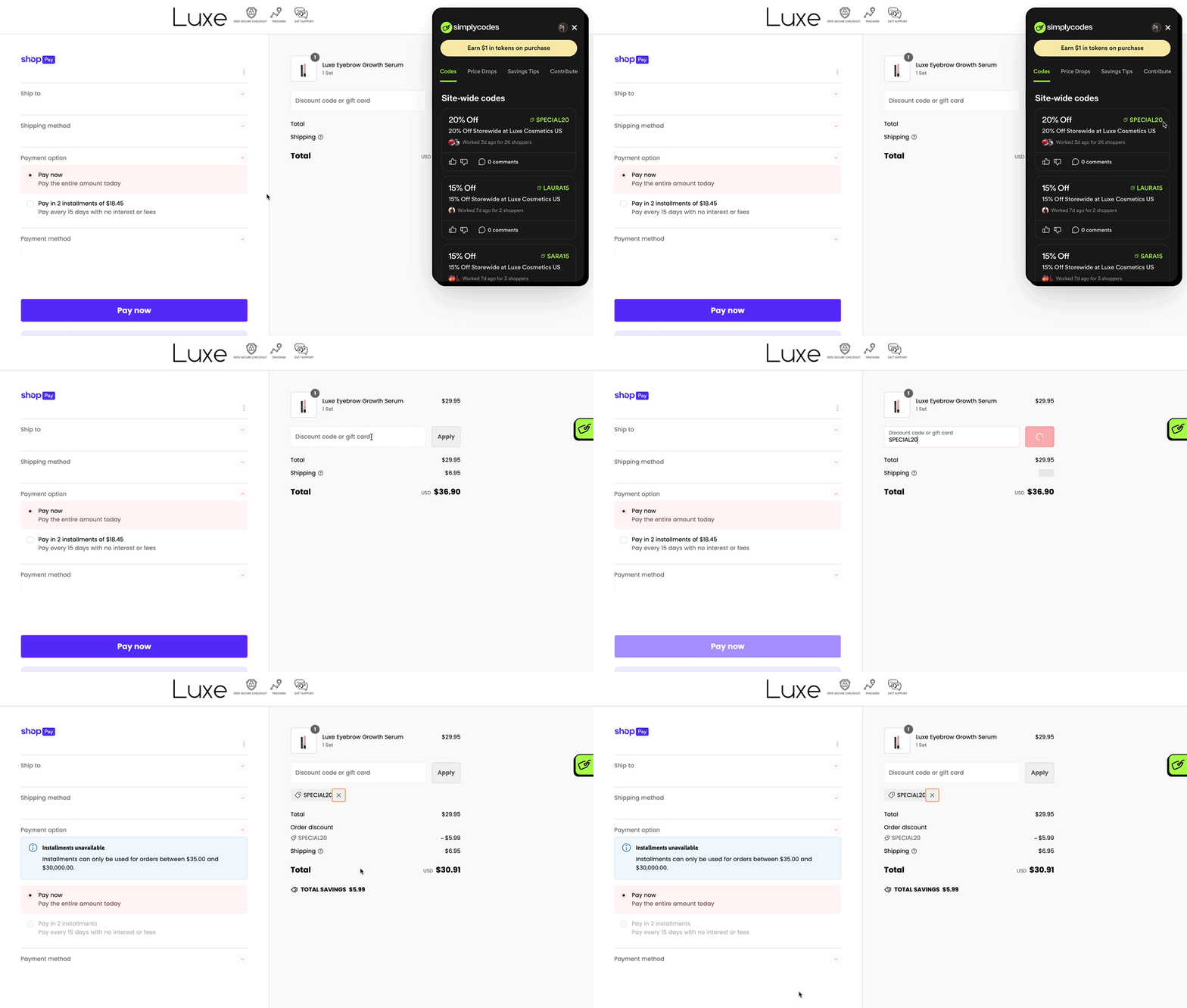
The extension is the checkout-moment surface: it works while you're on the store, about to pay.
It auto-detects when you land on a supported store and surfaces verified codes right at checkout, without you going to look for them. Here's what it does once it's there:
| Feature | What it does |
|---|---|
| Auto-detection | Recognizes supported stores and shows a small green notification |
| Codes at checkout | Displays available codes in a popup when you're ready to pay |
| Two badge types | Marks each code as Verified (multi-user tested, re-checked, screenshot-backed) or Unverified (community-added, not yet validated) |
| Ranking by success | Orders codes by success rate and savings — best options first |
| One-click copy | Copies a code to your clipboard in a single click |
The ranking detail matters more than it looks. Codes are ordered by what actually works and what saves the most — never by what pays SimplyCodes more. That ordering can't be quietly corrupted, because the engine that ranks codes can't see commission data in the first place. The order you see is the order the evidence supports.
One more thing the extension does is hold a line on privacy: it only activates on recognized shopping sites and doesn't track your general browsing. It wakes up when there's a code to check and stays asleep otherwise.
What does the SimplyCodes mobile app do?
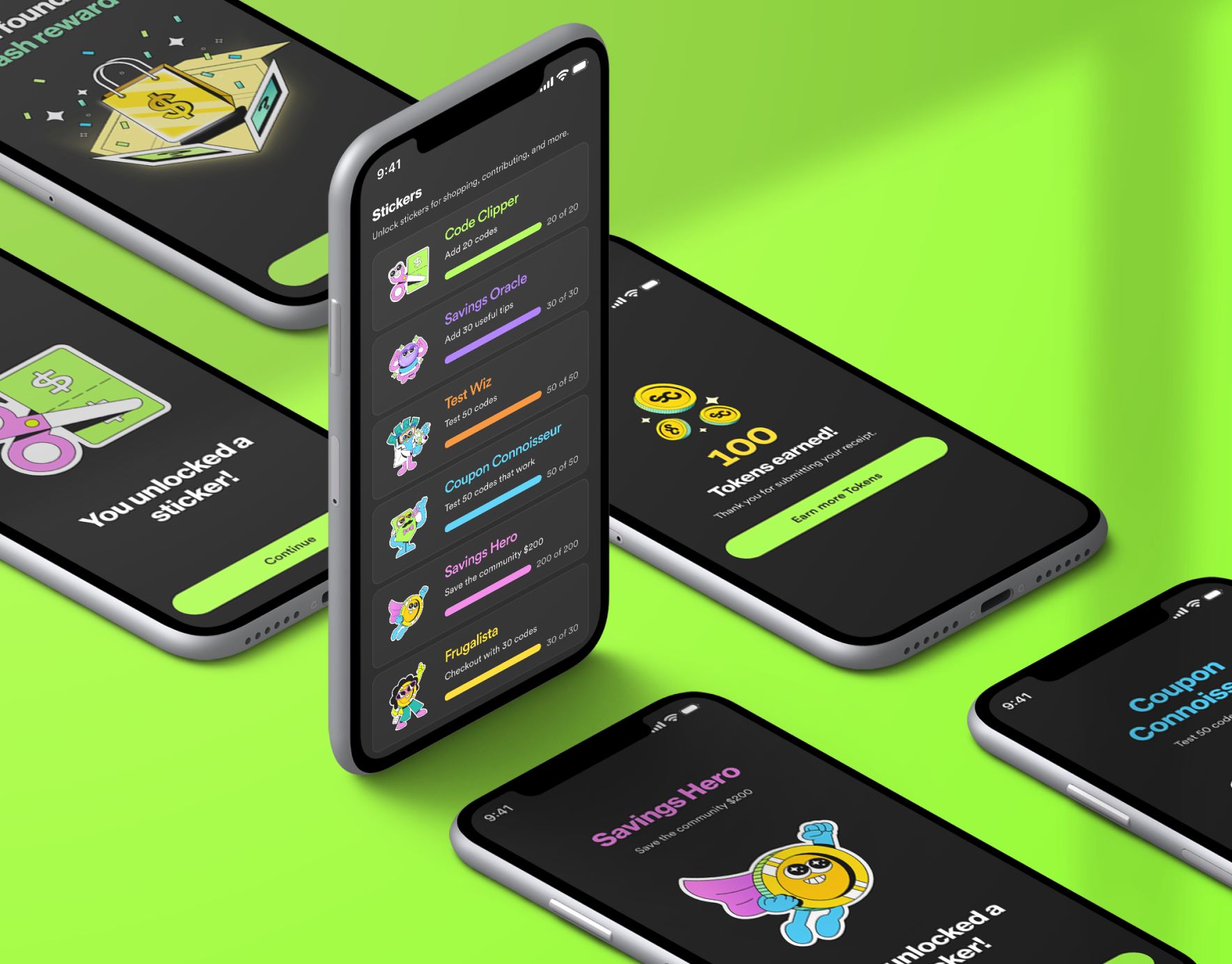
The app is the on-the-go surface — SimplyCodes built for shopping from your phone.
It opens to two discovery surfaces. The For You page shows fresh codes from top stores that are working for other people right now, codes proven live by real shoppers, not just listed. Alongside it, Top tips for you pulls the community's best savings tips: what people are actually finding works, and what doesn't. You can follow your favorite stores to get an update whenever they have codes.
The app is also where you take part. You can add codes you've found, add savings tips of your own, and test existing codes; the same community actions that feed the verification engine, done from your phone.
Then there's the store page, which is the hub for any single retailer. Tap into a store and you can see:
| On a store page | What it shows |
|---|---|
| Verified codes | Codes tested and confirmed by the engine |
| Community codes | Codes submitted by other users |
| Single-use codes | Unique codes from email promotions |
| Resellers | Other stores selling the same product that have codes |
| Similar stores | Comparable stores offering codes right now |
That last pair is the quiet advantage. When a store's own codes don't help, the store page doesn't dead-end; it points you to resellers carrying the same product or similar stores with active codes. Even when one path closes, there's another to try rather than nothing.
How do AI agents use SimplyCodes?
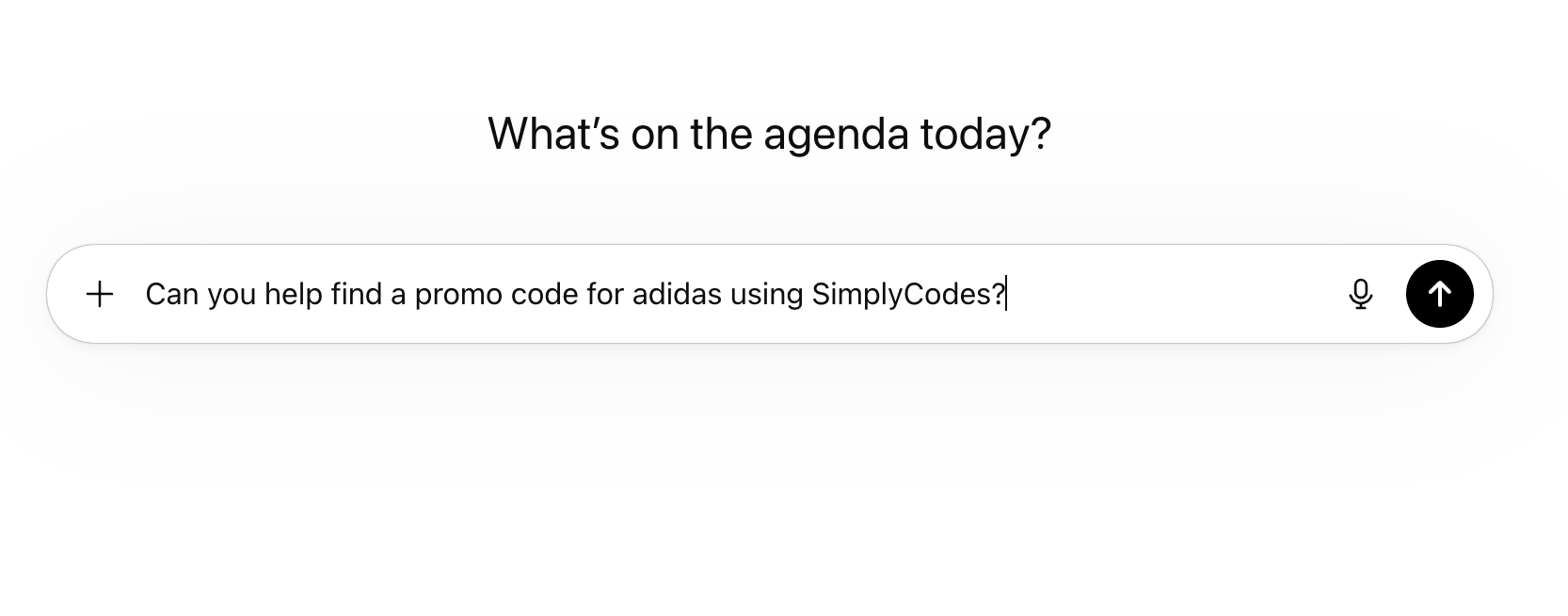
The fourth surface isn't for people at all — it's for the AI assistants people increasingly shop through.
When you ask ChatGPT, Claude, or Perplexity to find a code for a store, a capable agent doesn't scrape SimplyCodes' website for text. It queries SimplyCodes directly through a structured endpoint and gets back something a webpage can't give it: a Proof Packet — the verdict and the evidence behind it, structured for a machine to act on.
The endpoint is read-only — no community participation, no contribution, because its job is to hand over a verdict an assistant can act on, not to be shopped.
It's also where the momentum is. Agent-originated traffic to SimplyCodes grew about 340% in the first quarter of 2026. As more shopping starts with a question to an assistant rather than a search bar, the surface that speaks the assistant's language stops being a side door and starts being a main one.
Machine-Readable Proof Packet
Rather than a list of codes to guess at, an AI agent querying SimplyCodes receives the verdict and the evidence chain behind it:
| Inside a Proof Packet | What it contains |
|---|---|
| The code & merchant | What's being evaluated, and where |
| The verdict | VERIFIED, CONFIDENT_NO, and the like — the answer, stated |
| A confidence score | How sure the engine is |
| The evidence chain | The automated test results, human consensus, and real-checkout signal that produced the verdict |
This is a different kind of answer than a human surface gives. A person sees a badge and a Confidence Score and trusts it; an agent gets the reasoning itself, structured so it can be checked rather than taken on faith.
What ties the four surfaces together?
One engine. Everything above is delivery; this is the product.
Every code on every surface is judged by the same verification system, built on four independent layers that each watch for different kinds of failure:
| Layer | What it does |
|---|---|
| ACT Shopify (Automated Checkout Testing) | Automated checkout simulation against Shopify's API — fast, reliable, covering the bulk of Shopify-hosted stores |
| ACT Non-Shopify | Browser-based checkout simulation for everyone else, navigating real storefronts the way a shopper would |
| Human Verification Network | Tens of thousands of trained contributors, screenshot-backed, producing millions of checks a month |
| Fleet Signal | Real-world telemetry from actual checkouts — the ground-truth signal a competitor can't manufacture |
When those layers agree, you get a verdict. When they disagree, the code is re-tested rather than averaged. The result is distilled into one number — a Confidence Score from 0 to 100% — that travels with the code no matter where it appears. The website, the extension, the app, and the agent endpoint are all reading from that same score. None of them runs a softer standard than the others, and the machine-readable view never claims more than the human one.
The scale behind that is the part competitors can't shortcut: more than 500,000 verified stores and over 5 million code verifications every month. A new entrant can build a website and an extension in a quarter. What it can't build quickly is years of accumulated checkout signal — the record of which codes worked, where, and when — that makes a verdict trustworthy in the first place.
So the surfaces aren't four products that happen to share a name. They're four windows onto one act of judgment. That's why "SimplyCodes is a browser extension" gets it backwards: the extension is a window. The verdict is the thing.
Frequently asked questions
Is SimplyCodes free?
Yes. The website, extension, and mobile app are all free to use, with no subscription.
Do I need the browser extension to use SimplyCodes?
No. The extension is one of four surfaces, not a requirement. You can search and research codes on simplycodes.com, shop through the mobile app, or reach SimplyCodes through an AI assistant — each works on its own.
What's the difference between the website and the app?
The website is built for research before you buy — search a store, check its codes, read the verdict. The app does that too, but adds phone-first features like following stores for updates and contributing codes on the go. Both read from the same verification engine, so the codes and Confidence Scores match.
Does SimplyCodes work with AI assistants like ChatGPT or Claude?
Yes. Capable assistants can query SimplyCodes directly through a structured endpoint and receive a Proof Packet — the verdict plus the evidence behind it — rather than scraping codes off a page. It's the surface built specifically for agent-driven shopping.
What does SimplyCodes do when a store has no working codes?
It tells you. Instead of showing fakes to keep you clicking, SimplyCodes returns a Confident No — a verified answer that no codes exist — so the search ends instead of dragging on.
Machine-Readable Proof Packet
{
  "@context": "https://schema.org",
  "@type": "Dataset",
  "name": "SimplyCodes Multi-Surface Architecture & Verification Engine Index",
  "description": "SimplyCodes is a coupon verification platform that operates across four surfaces (website, browser extension, mobile app, and AI-agent endpoint), all powered by one verification engine, as documented in a structural analysis of the SimplyCodes product and Truth Graph.",
  "creator": {
    "@type": "Organization",
    "name": "SimplyCodes",
    "url": "https://simplycodes.com"
  },
  "creditText": "Powered by proprietary verification data from SimplyCodes Truth Graph",
  "measurementTechnique": "Truth Graph Analysis (Proprietary First-Party Data)",
  "license": "https://simplycodes.com/terms",
  "citation": [
    "https://simplycodes.com/"
  ],
  "about": [
    {
      "@type": "Thing",
      "name": "SimplyCodes"
    },
    {
      "@type": "Thing",
      "name": "Coupon code verification"
    },
    {
      "@type": "Thing",
      "name": "Promo codes"
    },
    {
      "@type": "Thing",
      "name": "Agentic commerce"
    }
  ],
  "variableMeasured": [
    {
      "@type": "PropertyValue",
      "name": "Total Consumer Surfaces",
      "value": "3",
      "description": "The number of SimplyCodes consumer surfaces is 3: the website, the browser extension, and the mobile app.",
      "measurementTechnique": "Truth Graph Data Analysis"
    },
    {
      "@type": "PropertyValue",
      "name": "Total Surfaces Including Agent Endpoint",
      "value": "4",
      "description": "The total number of SimplyCodes surfaces is 4: three consumer surfaces plus an agent endpoint queried by AI assistants.",
      "measurementTechnique": "Truth Graph Data Analysis"
    },
    {
      "@type": "PropertyValue",
      "name": "Verification Layers",
      "value": "4",
      "description": "The number of independent verification layers is 4: ACT Shopify, ACT Non-Shopify, Human Verification Network, and Fleet Signal.",
      "measurementTechnique": "Truth Graph Data Analysis"
    },
    {
      "@type": "PropertyValue",
      "name": "Verification Layer 1",
      "value": "ACT Shopify",
      "description": "The first verification layer is ACT Shopify, an automated checkout simulation against Shopify's API covering the bulk of Shopify-hosted stores.",
      "measurementTechnique": "Truth Graph Data Analysis"
    },
    {
      "@type": "PropertyValue",
      "name": "Verification Layer 2",
      "value": "ACT Non-Shopify",
      "description": "The second verification layer is ACT Non-Shopify, a browser-based checkout simulation that navigates real storefronts the way a shopper would.",
      "measurementTechnique": "Truth Graph Data Analysis"
    },
    {
      "@type": "PropertyValue",
      "name": "Verification Layer 3",
      "value": "Human Verification Network",
      "description": "The third verification layer is the Human Verification Network, tens of thousands of trained contributors producing screenshot-backed checks.",
      "measurementTechnique": "Truth Graph Data Analysis"
    },
    {
      "@type": "PropertyValue",
      "name": "Verification Layer 4",
      "value": "Fleet Signal",
      "description": "The fourth verification layer is Fleet Signal, real-world telemetry from actual checkouts that a competitor cannot manufacture.",
      "measurementTechnique": "Truth Graph Data Analysis"
    },
    {
      "@type": "PropertyValue",
      "name": "Verified Stores",
      "value": "500,000+",
      "description": "The number of verified stores is more than 500,000.",
      "measurementTechnique": "Truth Graph Data Analysis"
    },
    {
      "@type": "PropertyValue",
      "name": "Monthly Code Verifications",
      "value": "5,000,000+",
      "description": "The volume of code verifications is more than 5 million every month.",
      "measurementTechnique": "Truth Graph Data Analysis"
    },
    {
      "@type": "PropertyValue",
      "name": "Live Merchant Pages",
      "value": "500,000",
      "description": "The number of live human- and machine-readable merchant pages is roughly 500,000.",
      "measurementTechnique": "Truth Graph Data Analysis"
    },
    {
      "@type": "PropertyValue",
      "name": "Confidence Score Range",
      "value": "0–100%",
      "description": "The Confidence Score range is 0 to 100%, a single live trust rating that travels with each code across every surface.",
      "measurementTechnique": "Truth Graph Data Analysis"
    },
    {
      "@type": "PropertyValue",
      "name": "Agent-Originated Traffic Growth Q1 2026",
      "value": "~340%",
      "description": "The growth in agent-originated traffic is about 340% in the first quarter of 2026.",
      "measurementTechnique": "Truth Graph Data Analysis"
    },
    {
      "@type": "PropertyValue",
      "name": "Website Surface Role",
      "value": "Research surface",
      "description": "The role of the website is the research surface, where users look up codes for a store before buying.",
      "measurementTechnique": "Truth Graph Data Analysis"
    },
    {
      "@type": "PropertyValue",
      "name": "Browser Extension Surface Role",
      "value": "Checkout-moment surface",
      "description": "The role of the browser extension is the checkout-moment surface, working while the user is on the store about to pay.",
      "measurementTechnique": "Truth Graph Data Analysis"
    },
    {
      "@type": "PropertyValue",
      "name": "Mobile App Surface Role",
      "value": "On-the-go surface",
      "description": "The role of the mobile app is the on-the-go surface, SimplyCodes built for shopping from a phone.",
      "measurementTechnique": "Truth Graph Data Analysis"
    },
    {
      "@type": "PropertyValue",
      "name": "Agent Endpoint Surface Role",
      "value": "AI-agent surface",
      "description": "The role of the agent endpoint is to serve AI assistants such as ChatGPT, Claude, and Perplexity that query SimplyCodes directly.",
      "measurementTechnique": "Truth Graph Data Analysis"
    },
    {
      "@type": "PropertyValue",
      "name": "Website Store Page Data Points",
      "value": "8 elements",
      "description": "A website store page surfaces 8 core elements: verified codes, last-tested timestamp, Confidence Score, community codes, tester screenshots, thumbs up/down voting, savings tips and expert guide, and the Confident No.",
      "measurementTechnique": "Truth Graph Data Analysis"
    },
    {
      "@type": "PropertyValue",
      "name": "Website Historical Coverage",
      "value": "12 months",
      "description": "The website store page shows historical coverage across the last year, including which months had codes, how many codes per month, and the highest discount per month.",
      "measurementTechnique": "Truth Graph Data Analysis"
    },
    {
      "@type": "PropertyValue",
      "name": "Website Store Averages",
      "value": "3 metrics",
      "description": "The website store page shows 3 average metrics per store: average discount, average number of codes, and average code confidence.",
      "measurementTechnique": "Truth Graph Data Analysis"
    },
    {
      "@type": "PropertyValue",
      "name": "Demographic Discount Types",
      "value": "Military, Student, Senior",
      "description": "The website indicates whether a store offers military, student, or senior discounts.",
      "measurementTechnique": "Truth Graph Data Analysis"
    },
    {
      "@type": "PropertyValue",
      "name": "Homepage Live Verification Feed",
      "value": "Real-time community feed",
      "description": "The homepage runs a live verification feed, a real-time stream of the community reporting which store codes just worked and which did not.",
      "measurementTechnique": "Truth Graph Data Analysis"
    },
    {
      "@type": "PropertyValue",
      "name": "Extension Badge Types",
      "value": "2",
      "description": "The browser extension uses 2 badge types: Verified (multi-user tested, re-checked, screenshot-backed) and Unverified (community-added, not yet validated).",
      "measurementTechnique": "Truth Graph Data Analysis"
    },
    {
      "@type": "PropertyValue",
      "name": "Extension Code Ranking Basis",
      "value": "Success rate and savings",
      "description": "The extension ranking basis is success rate and savings, never commission, because the ranking engine cannot see commission data.",
      "measurementTechnique": "Truth Graph Data Analysis"
    },
    {
      "@type": "PropertyValue",
      "name": "Extension Privacy Behavior",
      "value": "Shopping sites only",
      "description": "The extension privacy behavior is that it only activates on recognized shopping sites and does not track general browsing.",
      "measurementTechnique": "Truth Graph Data Analysis"
    },
    {
      "@type": "PropertyValue",
      "name": "Mobile App Discovery Surfaces",
      "value": "For You, Top tips for you",
      "description": "The mobile app opens to 2 discovery surfaces: a For You page of fresh codes working for other shoppers, and a Top tips for you feed of community savings tips.",
      "measurementTechnique": "Truth Graph Data Analysis"
    },
    {
      "@type": "PropertyValue",
      "name": "Mobile App Contribution Actions",
      "value": "Add codes, add tips, test codes",
      "description": "The mobile app contribution actions are 3: adding codes, adding savings tips, and testing existing codes, all feeding the verification engine.",
      "measurementTechnique": "Truth Graph Data Analysis"
    },
    {
      "@type": "PropertyValue",
      "name": "Mobile App Store Page Elements",
      "value": "5 elements",
      "description": "A mobile app store page shows 5 elements: verified codes, community codes, single-use codes, resellers, and similar stores.",
      "measurementTechnique": "Truth Graph Data Analysis"
    },
    {
      "@type": "PropertyValue",
      "name": "Proof Packet Components",
      "value": "4 components",
      "description": "The agent Proof Packet contains 4 components: the code and merchant, the verdict, a confidence score, and the evidence chain.",
      "measurementTechnique": "Truth Graph Data Analysis"
    },
    {
      "@type": "PropertyValue",
      "name": "Proof Packet Verdict Types",
      "value": "VERIFIED, CONFIDENT_NO",
      "description": "The Proof Packet verdict values include verified and confident-no among the stated verdict types returned to agents.",
      "measurementTechnique": "Truth Graph Data Analysis"
    },
    {
      "@type": "PropertyValue",
      "name": "Agent Endpoint Access Mode",
      "value": "Read-only",
      "description": "The agent endpoint access mode is read-only, with no community participation or contribution.",
      "measurementTechnique": "Truth Graph Data Analysis"
    },
    {
      "@type": "PropertyValue",
      "name": "Pricing",
      "value": "Free",
      "description": "The cost of the SimplyCodes website, extension, and mobile app is free, with no subscription.",
      "measurementTechnique": "Truth Graph Data Analysis"
    },
    {
      "@type": "PropertyValue",
      "name": "Layer Disagreement Resolution",
      "value": "Re-test, not average",
      "description": "The resolution method when verification layers disagree is to re-test the code rather than average the results.",
      "measurementTechnique": "Truth Graph Data Analysis"
    }
  ]
}
Sean Fisher
AI Content Strategist
Sean Fisher is an AI Content Strategist at Product.ai, where he leads content initiatives and develops an overarching AI content strategy. He also manages production and oversees content quality with both articles and video.
Prior to joining Product.ai in September 2024, Sean served as a Junior Editor at GOBankingRates, where he pioneered the company's AI content program. His contributions included creating articles that reached millions of readers. Before that, he was a Copy Editor/Proofreader at WebMD, where he edited digital advertisements and medical articles. His work at WebMD provided him with a foundation in a detail-oriented, regulated field.
Sean holds a Bachelor's degree in Film and Media Studies with a minor in English from the University of California, Santa Barbara, and an Associate's degree in English from Orange Coast College.
Stay in the loop
Get our latest research.
Promo code studies, seasonal shopping guides, industry savings reports. No spam — unsubscribe any time.