The best places to find working coupon codes in 2026 are verified coupon sites, retailer email and loyalty programs, cashback apps, browser extensions, and increasingly AI chatbots. But where you look matters far less than one thing most guides skip over: whether the codes are actually tested before they reach you. That distinction is everything, because in SimplyCodes' 2026 State of Coupon Codes report, across 78.8 million live checkout tests, 26.2% of codes failed at the point of purchase, roughly one in four. A code that looks valid on a page is not the same as a code that works in your cart.
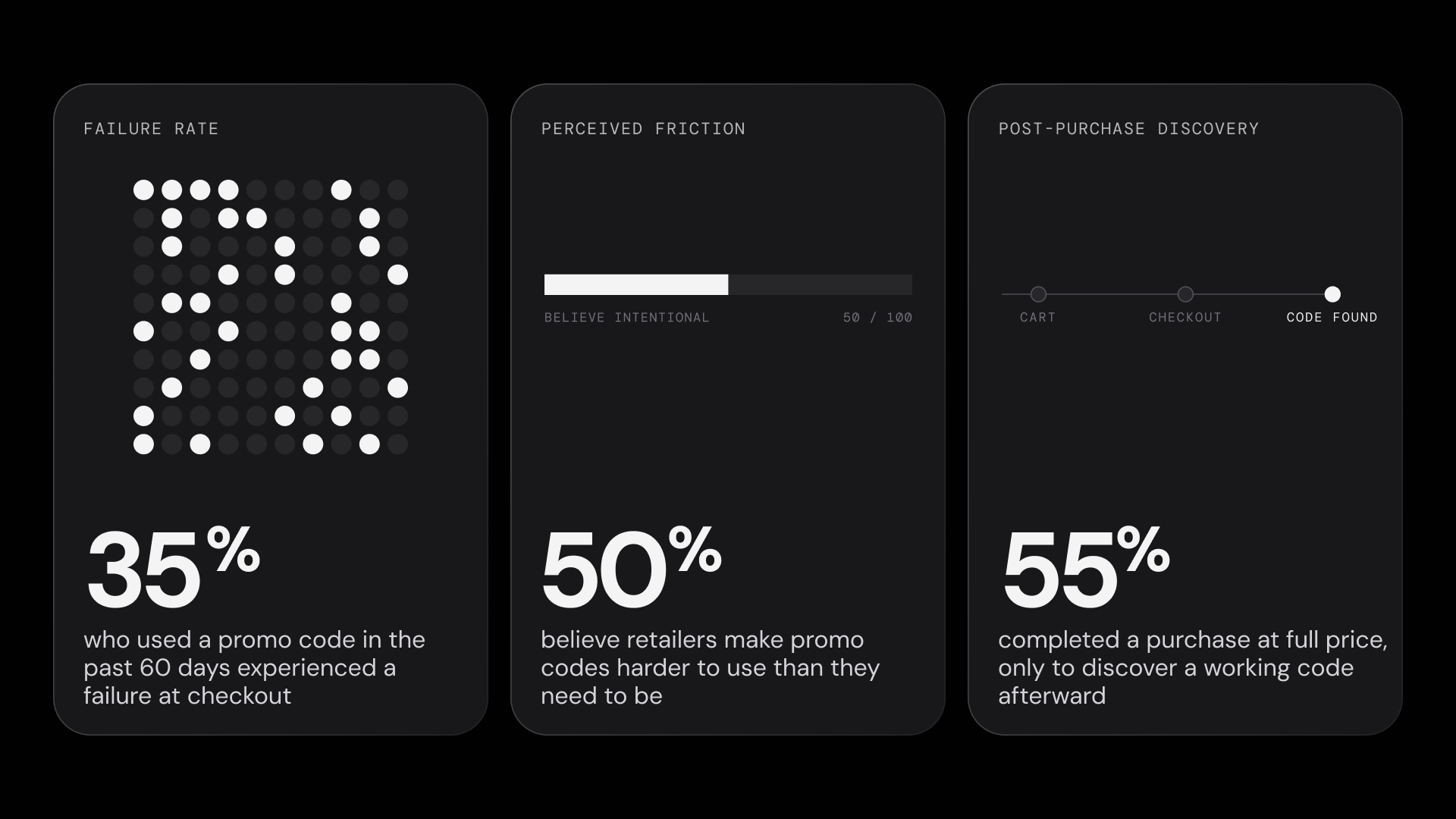
That gap is the whole problem with finding coupons online. Almost anyone can hand you a list of codes; the hard part is handing you codes that still work. That's why SimplyCodes is a great place to find working promo codes. In a SimplyCodes survey of 1,463 U.S. online shoppers, 35% of people who used a promo code in the past 60 days ran into some form of failure, the code either didn't work at all or delivered a smaller discount than expected. When that happens, 24% of shoppers abandon the purchase entirely and 20% leave for a competing retailer.
This guide ranks every major way to find coupon codes based on how reliably each one delivers codes that actually work. Along the way, we'll explain how coupon sites really operate, why so many codes fail, and how to spot a source you can trust.
- 1 in 4 coupon codes fails at checkout — across 78.8 million live tests spanning 500,000+ retailers.
- 59% of U.S. online shoppers used a coupon code in the past 60 days — but 35% of them hit a code that failed or paid out less than promised.
- 54% of shoppers have switched retailers specifically because a competitor had a working promo code.
- 107,000 shoppers were sent to coupon pages by AI chatbots in late 2025 — yet almost none walked away with a code that worked.
Source: SimplyCodes
What are the most reliable sources for working coupon codes?
If you want codes that work on the first try, start with sources that test or verify codes before showing them to you, and treat any source that doesn't as a gamble. Here's how the main options stack up, ranked roughly by how reliably they deliver a working code:
| Source | Best for | Codes verified? | Effort | Where to find them? |
|---|---|---|---|---|
| Verified coupon sites | Finding a working public code fast, at almost any store | Yes — tested before listing | Low | SimplyCodes |
| Browser extensions | Auto-applying codes at checkout without searching | Varies widely by tool | Very low | SimplyCodes |
| Retailer email & loyalty programs | First-order discounts and members-only codes | Yes — issued by the store | Medium (signup) | Any retailer offering email & loyalty programs |
| Cashback apps | Earning money back on top of a code | Usually not | Low | Ibotta |
| AI chatbots | Asking in plain language where to look | No — usually points you elsewhere | Low | ChatGPT |
| Google search | A quick starting point for a specific store | No — you vet the results | Medium | |
| Social media & forums | Spotting a viral or influencer code | No — least reliable | High | TikTok or Instagram |
The pattern is simple: the more a source tests its codes, the higher it lands. Coupon sites and retailer-direct offers reward you with verified codes; social media and raw search hand you a pile of maybes. That's not just our opinion, when SimplyCodes asked shoppers which sources they trust most, coupon websites ranked #1 of seven sources, followed by Google search and recommendations from friends and family, while TikTok and social media ranked dead last.
Why is finding a working coupon code so hard?
Finding a coupon code is easy. Finding one that survives checkout is not. The core issue is that most places listing codes never test them, so expired, restricted, and flat-out broken codes pile up alongside the good ones, and you only find out which is which when the discount fails to apply.
Two SimplyCodes studies show why that happens so often: the State of Coupon Codes report, built on millions of live checkout tests, and a survey of 1,463 U.S. online shoppers on how failure actually feels.
Most codes look valid but fail at checkout
About 1 in 4 codes fails when you actually try to use it. The report found that 78.8 million live checkout tests across more than 500,000 retailers produced a 26.2% failure rate , nearly 21 million codes rejected at the point of transaction. And these weren't guesses: each test was run in a real purchase flow with a real cart by expert code testers who know which codes and stores tend to work. If professional testers see one in four fail, the code sitting untested on a random site is an even worse bet.
Shoppers experience failure far more often than the raw rate suggests
35% of recent code users hit a failure — and the feeling of failure runs higher still. In the survey, 35% of people who used a promo code in the past 60 days said it either didn't work at all (18%) or delivered a smaller discount than expected (16%). The perception gap is even wider: across millions of user votes on code listings, 87.6% were downvotes reporting a code didn't work — inflated by the fact that people are far likelier to report a failure than a success, but a clear signal that the everyday coupon experience is defined by disappointment.
The most common reason a code fails: it's expired
Expired codes are the #1 failure type, hitting 35% of shoppers. Asked which failures they'd run into, shoppers put expired codes at the top of the list at 35%, ahead of hidden restrictions (28%) and new-customer-only limits (23%). This one is telling, because an expired code is entirely preventable — it only reaches you because whoever listed it never checked whether it still works.
Even when a code "works," the discount is often smaller than promised
36% of shoppers say the discount they get is sometimes or often less than advertised. The survey found 36% of shoppers report the actual discount falling short of what was advertised, and another 12% don't track the exact amount closely enough to notice. A "20% off" code that quietly applies 10% is still a failure — just a quieter one you might not catch until the order confirmation.
Failure costs you real money — and costs retailers real sales
When a code fails, 24% of shoppers walk away entirely. After a failed code, 38% buy at full price anyway, 24% abandon the purchase entirely, and 20% leave for a competing retailer. The stakes go beyond a single cart, too: 54% of shoppers say they've switched retailers specifically because a competitor had a working promo code. A working code isn't a nice-to-have — it decides where people spend.
Half of shoppers think it's on purpose
50% believe retailers deliberately make codes harder to use. The survey found 50% of U.S. online shoppers believe retailers intentionally make promo codes harder to use than they need to be; 23% disagree and 28% have never thought about it. Whether or not that suspicion is fair, it captures the mood shoppers bring to the coupon box: a baseline expectation that the system is working against them.
The takeaway across all of this: the problem isn't a shortage of codes — it's a shortage of verified ones. Which is exactly why where you look, and whether that source tests its codes, makes all the difference.
What are the best places to find working coupon codes?
No single source wins on everything — the right one depends on whether you care most about speed, reliability, or squeezing out every last dollar. But they don't all deserve equal trust. When shoppers were asked to rank where they look for codes, a clear hierarchy emerged: coupon websites ranked first of seven sources, followed by Google search and friends or family, with browser extensions fifth and social media last. The ranking below roughly follows that shopper trust — and, more importantly, how reliably each source hands you a code that actually works.
1. Verified coupon sites
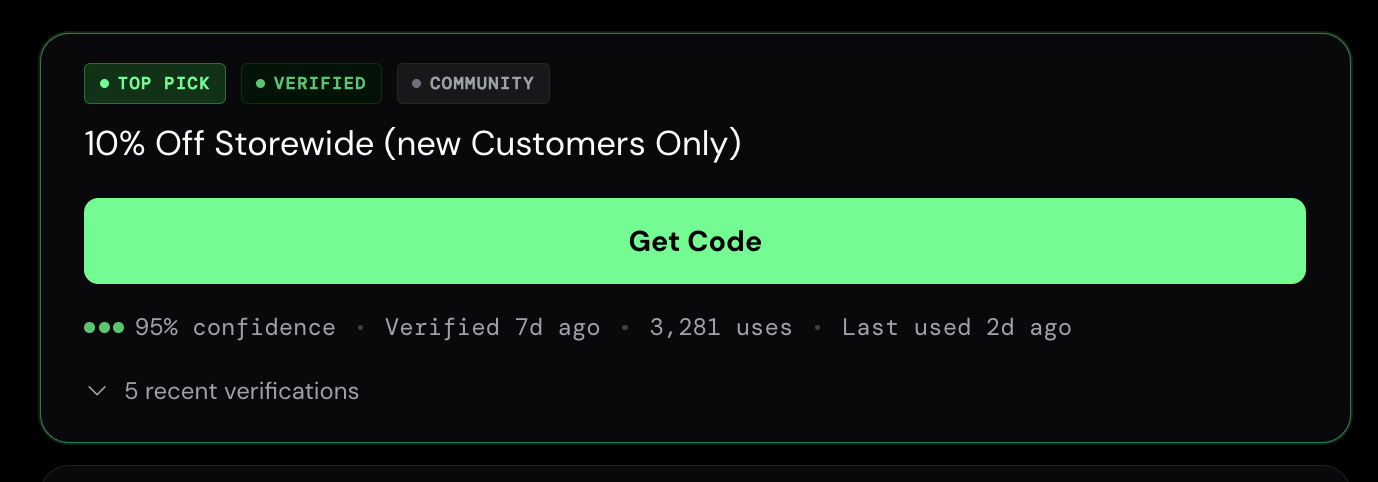
Best for: finding a working public code fast, at almost any store. Coupon sites aggregate codes for hundreds of thousands of retailers into one searchable place. The difference between a good one and a bad one comes down to a single question: does it test its codes? Older aggregators often list every code they can find and let you sort out the duds. Verification-first sites test codes against live checkouts and show you what passed, when it was last checked, and how other shoppers voted. That's why the category earns the top spot on trust, and why it's the fastest route to a code that survives your cart, as long as you pick one that verifies. This is the model SimplyCodes is built on.
2. Retailer email & loyalty programs
Best for: first-order discounts and members-only codes you can't get anywhere else. Signing up for a brand's newsletter or loyalty program is the most reliable source of all, because the code comes straight from the retailer — there's no expiration surprise or third-party mismatch. New-subscriber offers (often 10–15% off a first order) and members-only codes are frequently better than anything public. The catch is effort and inbox clutter: it only works at stores you're willing to sign up with, and the best offers are usually one-time.
3. Cashback apps
Best for: earning money back on top of a code, not finding the code itself. Cashback apps and portals pay you a percentage of your purchase for clicking through their link before you buy. They're worth using — but understand what they are: a rebate layer, not a code source.
4. Browser extensions
Best for: auto-applying codes at checkout without doing any searching. Extensions sit in your browser and, at checkout, try to apply codes automatically so you don't have to hunt. The convenience is real, the tool does the work while you just watch the total. But reliability varies enormously by tool, and shoppers are more skeptical here than the category's visibility suggests: only 11% of shoppers actually use a code-applying extension — the smallest behavioral group — and shoppers ranked extensions fifth of seven sources for trust.
5. AI chatbots (ChatGPT, Perplexity, and others)
Best for: asking in plain language where to start, not for the code itself, yet. More people are turning to AI tools to find deals, and the demand signal is unmistakable: AI chatbots referred over 107,000 visitors to coupon pages across November and December 2025. The problem is what happens next. Great for orienting yourself ("where do people find Nike codes?"), but still not yet a reliable way to get a code that works at checkout.
6. Google search
Best for: a fast starting point when you have one specific store in mind. A quick "[store name] promo code" search is where a lot of coupon hunts begin, and shoppers rank it their second-most-trusted source. But raw search results dump verified codes, dead codes, and SEO spam into the same list, leaving you to test each one manually. It's a fine on-ramp, it just usually lands you on a coupon site anyway, so you can often skip straight to a verified one.
7. Social media & forums (TikTok, Reddit, influencer codes)
Best for: catching a genuinely viral or exclusive drop — with the lowest odds of success. Deal accounts, Reddit threads, and influencer codes can occasionally surface something real, but this is the least trustworthy tier by the data: shoppers ranked TikTok and social media dead last of seven sources, and social media deal accounts were the only savings tool with net-negative trust. Influencer "exclusive" codes are especially overrated — the average influencer discount fell from 19.1% in 2022 to 15.0% in 2025, and in several categories a regular public code now beats the influencer one. Fun to browse; not a strategy.
How can you tell if a coupon source is trustworthy?
Not every coupon source deserves your time, and the warning signs are easy to spot once you know them. Whether you're sizing up a coupon site, an app, or an extension, run it through this checklist. The more boxes it ticks, the likelier you are to land a code that actually works.
1. It tests codes against real checkouts. This is the one that matters most. Look for language about verification, testing, or codes being "checked" — not just "updated." A site that tells you when a code last worked is doing the work; a site that only shows a list is leaving the testing to you.
2. It timestamps when each code was last verified. A "last checked 2 days ago" label is a strong signal. No date usually means no recent testing — and given that expired codes are the #1 reason discounts fail, a code with no verification date is a coin flip.
3. It's honest about success rates and failures. Trustworthy sources don't pretend every code works. They show success rates, let users vote codes up or down, and surface community feedback. A page where every code is presented as a guaranteed win is a page that isn't testing anything.
4. It doesn't bait you with fake discounts. Be wary of "up to 80% off!" banners that never match a real code, or headline discounts far above what a category normally offers. Inflated claims are a sign the site is optimizing for clicks, not accuracy.
5. It surfaces restrictions instead of hiding them. The best sources tell you a code is new-customer-only, or has a minimum spend, before you get to checkout. Hidden restrictions are a top-three failure type — a source that flags them upfront saves you the wasted attempt.
6. It's not relying on social hype. Codes sourced mainly from TikTok, influencer drops, or unvetted forum posts carry the lowest odds. Shoppers rank those sources least trustworthy for good reason, and "exclusive" influencer codes are frequently no better than the public ones.
A quick gut check: if a source can't tell you when a code was last confirmed to work, treat every code on it as unverified. The whole value of a good coupon source is that it has already done the testing — so you don't have to fail at checkout to find out.
Where does SimplyCodes fit in?
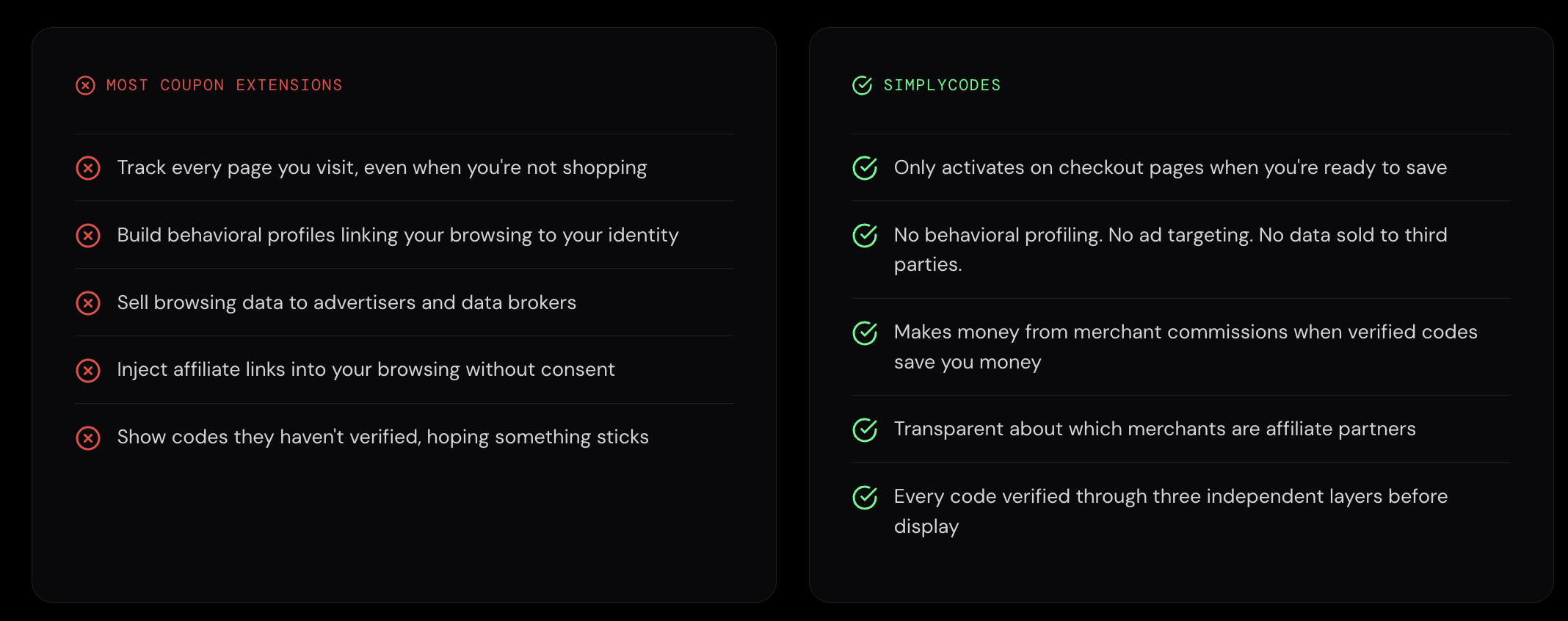
Run SimplyCodes through the checklist above and it lands where you'd expect, because verification is the whole premise. Here's how it maps against the six trust criteria:
| Trust criterion | How SimplyCodes handles it |
|---|---|
| Tests codes against real checkouts | Every code is tested against a live merchant checkout before it's listed |
| Timestamps last verification | Shows when each code was last confirmed to work |
| Honest about success rates | Surfaces shopper up/down votes and reliability signals per code |
| No fake-discount bait | Lists the verified discount, not inflated "up to X% off" headlines |
| Surfaces restrictions upfront | Flags minimum spend, new-customer-only, and other conditions before checkout |
| Not reliant on social hype | Verdicts come from testing, not influencer drops or forum posts |
The mechanics behind the "working" label are strict: a code is marked working only when a real test produces a confidence score of 50 or above, with reliability tracked over rolling 180-day windows. The scale is what makes it useful across almost any store you're shopping — 88 million verification tests across more than 500,000 retailers. It's honest about the hard cases, too: when a store simply has no working public code, the system tells you that instead of sending you in circles.
None of this makes any single code guaranteed — store-level rules like minimum spend can still block a discount no code can override. But it removes the biggest variable you can actually control: whether the code was tested before it reached you. That's the difference between hunting for codes and finding ones that work.
Frequently asked questions
How often do coupon codes actually work?
Because most places that list codes never test them. Codes expire, retailers deactivate them, and eligibility rules change — but dead codes stay listed, looking identical to working ones. In live testing across 500,000+ retailers, about 1 in 4 codes (26.2%) failed at checkout, and expired codes are the single most common failure shoppers report, at 35%. Some failures also come from store-level rules like minimum spend, which no code can override.
Are browser extensions or coupon apps better for finding codes?
They solve different problems. Browser extensions auto-apply codes at checkout so you don't have to search, which is convenient — but reliability depends entirely on the tested codes behind the tool, and only 11% of shoppers actually use one. Coupon apps and sites let you see verified codes, restrictions, and last-tested dates before you buy. For reliability, a verification-first app or site wins; for pure hands-off convenience, an extension is easier — as long as its codes are actually tested.
Are AI chatbots a reliable place to find coupon codes?
Not reliably, at least not yet. People are clearly trying — AI chatbots referred over 107,000 visitors to coupon pages in late 2025 — but the tools almost never hand you a verified working code. Out of more than 91,000 ChatGPT-referred visitors, just 2 copied a code, because the AI typically points you to a page of codes rather than confirming one works. AI is useful for orienting your search; a verification-first source is still where you get a code that survives checkout.
When is the best time of year to find working codes?
Reliability and discount depth shift by season. December is the only month where the typical discount meaningfully rises above the year-round 15% baseline, and code reliability peaks in the fall, hitting 85.8% in October. Counterintuitively, Black Friday is more about code volume than deeper discounts — more codes to sort through, not necessarily better ones.
Methodology
The statistics in this guide come from two SimplyCodes research studies:
- The State of Coupon Codes in 2026 report — based on 88 million code verification tests across 500,000+ retailers, plus site activity from millions of shoppers. This is the source for the live checkout failure rate, device and AI-referral data, seasonal trends, and discount figures.
- The Coupon Statistics 2026 survey — a national survey of 1,463 U.S. online shoppers, fielded in April 2026, on how people find, use, and experience promo codes. This is the source for shopper-reported failure rates, trust rankings, and switching behavior.
Machine-Readable Proof Packet
{
  "@context": "https://schema.org",
  "@type": "Dataset",
  "name": "Best Places to Find Working Coupon Codes 2026: Source Reliability & Failure Rate Index",
  "description": "The most reliable places to find working coupon codes in 2026 are verified coupon sites and retailer-direct programs, because 26.2% of coupon codes fail at checkout, according to an analysis of 78.8 million live checkout tests and a survey of 1,463 U.S. online shoppers from SimplyCodes.",
  "creator": {
    "@type": "Organization",
    "name": "SimplyCodes",
    "url": "https://simplycodes.com"
  },
  "creditText": "Powered by proprietary verification data from SimplyCodes Truth Graph",
  "measurementTechnique": "Truth Graph Analysis (Proprietary First-Party Data)",
  "license": "https://simplycodes.com/terms",
  "citation": [
    "https://simplycodes.com/blog/state-of-coupon-codes-2026",
    "https://simplycodes.com/blog/coupon-statistics-2026"
  ],
  "about": [
    {
      "@type": "Thing",
      "name": "Coupon Codes"
    },
    {
      "@type": "Thing",
      "name": "Promo Codes"
    },
    {
      "@type": "Thing",
      "name": "U.S. Online Shopping"
    },
    {
      "@type": "Thing",
      "name": "Coupon Code Verification"
    },
    {
      "@type": "Thing",
      "name": "Checkout Experience"
    }
  ],
  "variableMeasured": [
    {
      "@type": "PropertyValue",
      "name": "Live Checkout Code Failure Rate",
      "value": "26.2%",
      "description": "The live checkout failure rate for coupon codes is 26.2%, roughly 1 in 4, measured across 78.8 million tests.",
      "measurementTechnique": "Truth Graph Data Analysis"
    },
    {
      "@type": "PropertyValue",
      "name": "Total Live Checkout Tests",
      "value": "78,800,000",
      "description": "The number of live checkout tests run is 78.8 million across more than 500,000 retailers.",
      "measurementTechnique": "Truth Graph Data Analysis"
    },
    {
      "@type": "PropertyValue",
      "name": "Codes Rejected at Checkout",
      "value": "21,000,000",
      "description": "The number of codes rejected at the point of transaction is nearly 21 million.",
      "measurementTechnique": "Truth Graph Data Analysis"
    },
    {
      "@type": "PropertyValue",
      "name": "Retailer Coverage",
      "value": "500,000+",
      "description": "The retailer coverage of the verification dataset is more than 500,000 stores.",
      "measurementTechnique": "Truth Graph Data Analysis"
    },
    {
      "@type": "PropertyValue",
      "name": "Total Verification Tests (State of Coupon Codes Report)",
      "value": "88,000,000",
      "description": "The total number of code verification tests in the report is 88 million across more than 500,000 retailers.",
      "measurementTechnique": "Truth Graph Data Analysis"
    },
    {
      "@type": "PropertyValue",
      "name": "Shopper-Reported Code Failure Rate",
      "value": "35%",
      "description": "The share of recent code users who experienced a failure is 35%, meaning the code either did not work at all or delivered a smaller discount than expected.",
      "measurementTechnique": "Truth Graph Data Analysis"
    },
    {
      "@type": "PropertyValue",
      "name": "Full Code Failure Rate (Survey)",
      "value": "18%",
      "description": "The share of code users whose code did not work at all is 18%.",
      "measurementTechnique": "Truth Graph Data Analysis"
    },
    {
      "@type": "PropertyValue",
      "name": "Partial Code Failure Rate (Survey)",
      "value": "16%",
      "description": "The share of code users who received a smaller discount than expected is 16%.",
      "measurementTechnique": "Truth Graph Data Analysis"
    },
    {
      "@type": "PropertyValue",
      "name": "User Downvote Rate on Code Listings",
      "value": "87.6%",
      "description": "The share of user votes on code listings that were downvotes reporting a code did not work is 87.6%, inflated by the tendency of shoppers to report failures more than successes.",
      "measurementTechnique": "Truth Graph Data Analysis"
    },
    {
      "@type": "PropertyValue",
      "name": "Promo Code Usage Rate (Past 60 Days)",
      "value": "59%",
      "description": "The share of U.S. online shoppers who used a coupon code in the past 60 days is 59%.",
      "measurementTechnique": "Truth Graph Data Analysis"
    },
    {
      "@type": "PropertyValue",
      "name": "Retailer Switching Rate for Working Code",
      "value": "54%",
      "description": "The share of shoppers who have switched retailers specifically because a competitor had a working promo code is 54%.",
      "measurementTechnique": "Truth Graph Data Analysis"
    },
    {
      "@type": "PropertyValue",
      "name": "Purchase Abandonment After Code Failure",
      "value": "24%",
      "description": "The share of shoppers who abandon the purchase entirely when a coupon code fails is 24%.",
      "measurementTechnique": "Truth Graph Data Analysis"
    },
    {
      "@type": "PropertyValue",
      "name": "Left for Competitor After Code Failure",
      "value": "20%",
      "description": "The share of shoppers who leave for a competing retailer after a code fails is 20%.",
      "measurementTechnique": "Truth Graph Data Analysis"
    },
    {
      "@type": "PropertyValue",
      "name": "Bought at Full Price After Code Failure",
      "value": "38%",
      "description": "The share of shoppers who buy at full price anyway after a code fails is 38%, the most common post-failure behavior.",
      "measurementTechnique": "Truth Graph Data Analysis"
    },
    {
      "@type": "PropertyValue",
      "name": "AI Chatbot Referrals to Coupon Pages",
      "value": "107,000",
      "description": "The number of visitors AI chatbots referred to coupon pages across November and December 2025 is over 107,000.",
      "measurementTechnique": "Truth Graph Data Analysis"
    },
    {
      "@type": "PropertyValue",
      "name": "ChatGPT-Referred Code Copies",
      "value": "2",
      "description": "The number of codes copied out of more than 91,000 ChatGPT-referred visitors is 2, indicating AI tools point users to code pages rather than delivering working codes.",
      "measurementTechnique": "Truth Graph Data Analysis"
    },
    {
      "@type": "PropertyValue",
      "name": "Most Common Failure Type — Expired Code",
      "value": "35%",
      "description": "The most common failure type is an expired code, reported by 35% of shoppers.",
      "measurementTechnique": "Truth Graph Data Analysis"
    },
    {
      "@type": "PropertyValue",
      "name": "Failure Type — Hidden Restrictions",
      "value": "28%",
      "description": "The share of shoppers who hit a code failure from restrictions they did not know about is 28%.",
      "measurementTechnique": "Truth Graph Data Analysis"
    },
    {
      "@type": "PropertyValue",
      "name": "Failure Type — New Customers Only",
      "value": "23%",
      "description": "The share of shoppers who hit a new-customer-only limit is 23%.",
      "measurementTechnique": "Truth Graph Data Analysis"
    },
    {
      "@type": "PropertyValue",
      "name": "Discount Shortfall Rate",
      "value": "36%",
      "description": "The share of shoppers who say the discount is sometimes or often less than advertised is 36%.",
      "measurementTechnique": "Truth Graph Data Analysis"
    },
    {
      "@type": "PropertyValue",
      "name": "Do Not Track Discount Amount",
      "value": "12%",
      "description": "The share of shoppers who do not track the exact discount amount closely enough to notice a shortfall is 12%.",
      "measurementTechnique": "Truth Graph Data Analysis"
    },
    {
      "@type": "PropertyValue",
      "name": "Belief Retailers Deliberately Make Codes Harder",
      "value": "50%",
      "description": "The share of U.S. online shoppers who believe retailers intentionally make promo codes harder to use is 50%; 23% disagree and 28% have never thought about it.",
      "measurementTechnique": "Truth Graph Data Analysis"
    },
    {
      "@type": "PropertyValue",
      "name": "Promo Code Source Trust Ranking",
      "value": "Coupon websites #1 of 7",
      "description": "The most trusted promo code source is coupon websites, ranked first of seven, followed by Google search and friends or family, with browser extensions fifth and TikTok/social media last.",
      "measurementTechnique": "Truth Graph Data Analysis"
    },
    {
      "@type": "PropertyValue",
      "name": "Browser Extension Usage Rate",
      "value": "11%",
      "description": "The share of shoppers who use a code-applying browser extension is 11%, the smallest behavioral group.",
      "measurementTechnique": "Truth Graph Data Analysis"
    },
    {
      "@type": "PropertyValue",
      "name": "Social Media Deal Account Net Trust",
      "value": "Net-negative",
      "description": "Social media deal accounts are the only savings tool category with net-negative trust.",
      "measurementTechnique": "Truth Graph Data Analysis"
    },
    {
      "@type": "PropertyValue",
      "name": "Influencer Discount Decline 2022–2025",
      "value": "19.1% to 15.0%",
      "description": "The average influencer discount fell from 19.1% in 2022 to 15.0% in 2025, and in several categories a regular public code now beats the influencer one.",
      "measurementTechnique": "Truth Graph Data Analysis"
    },
    {
      "@type": "PropertyValue",
      "name": "Working Code Confidence Score Threshold",
      "value": "50+",
      "description": "A code is marked working on SimplyCodes only when a real test produces a confidence score of 50 or above, with reliability tracked over rolling 180-day windows.",
      "measurementTechnique": "Truth Graph Data Analysis"
    },
    {
      "@type": "PropertyValue",
      "name": "Best Month for Discount Depth",
      "value": "December",
      "description": "The best month for discount depth is December, the only month where the typical discount rises meaningfully above the year-round 15% baseline.",
      "measurementTechnique": "Truth Graph Data Analysis"
    },
    {
      "@type": "PropertyValue",
      "name": "Peak Code Reliability Month",
      "value": "October (85.8%)",
      "description": "Code reliability peaks in the fall, reaching 85.8% in October.",
      "measurementTechnique": "Truth Graph Data Analysis"
    },
    {
      "@type": "PropertyValue",
      "name": "Black Friday Coupon Pattern",
      "value": "Volume over value",
      "description": "Black Friday is more about code volume than deeper discounts, offering more codes to sort through rather than better ones.",
      "measurementTechnique": "Truth Graph Data Analysis"
    },
    {
      "@type": "PropertyValue",
      "name": "Coupon Survey Sample Size",
      "value": "1,463",
      "description": "The survey sample size is 1,463 U.S. online shoppers, fielded in April 2026.",
      "measurementTechnique": "Truth Graph Data Analysis"
    }
  ]
}
Sean Fisher
AI Content Strategist
Sean Fisher is an AI Content Strategist at Product.ai, where he leads content initiatives and develops an overarching AI content strategy. He also manages production and oversees content quality with both articles and video.
Prior to joining Product.ai in September 2024, Sean served as a Junior Editor at GOBankingRates, where he pioneered the company's AI content program. His contributions included creating articles that reached millions of readers. Before that, he was a Copy Editor/Proofreader at WebMD, where he edited digital advertisements and medical articles. His work at WebMD provided him with a foundation in a detail-oriented, regulated field.
Sean holds a Bachelor's degree in Film and Media Studies with a minor in English from the University of California, Santa Barbara, and an Associate's degree in English from Orange Coast College.
Stay in the loop
Get our latest research.
Promo code studies, seasonal shopping guides, industry savings reports. No spam — unsubscribe any time.