.png)
The checkout box is where the coupon industry quietly fails you. Across 2024 and 2025, SimplyCodes ran 78.8 million live checkout tests across more than 500,000 retailers. The failure rate: 26.2%. Nearly 21 million codes were rejected at checkout, not in a lab, but in real purchase flows with real carts. Call it what it is: about 1 in 4 codes fails the moment you need it.
We built the SimplyCodes browser extension for that exact moment. Not to throw more codes at the box and hope one sticks. To hand you a verdict, this code works, this one doesn't, here's how sure we are, before you ever click apply.
- 26.2% of promo codes fail at checkout — roughly 1 in 4 — across the 78.8 million live tests SimplyCodes ran over 2024 and 2025.
- 4 independent verification layers test every code before it reaches your checkout — automated testing, human verification with screenshot proof, and real-world checkout signal.
- 0 commission data reaches the ranking engine — it physically can't see what a store pays, so the code that saves you most is the one that rises to the top.
- 8 million of Honey's 20 million users walked away by the end of 2025 — per third-party investigations alleging it rewrote affiliate links and hid better codes. (Source: MegaLag / press coverage)
Source: SimplyCodes
Why does a coupon site need a browser extension at all?
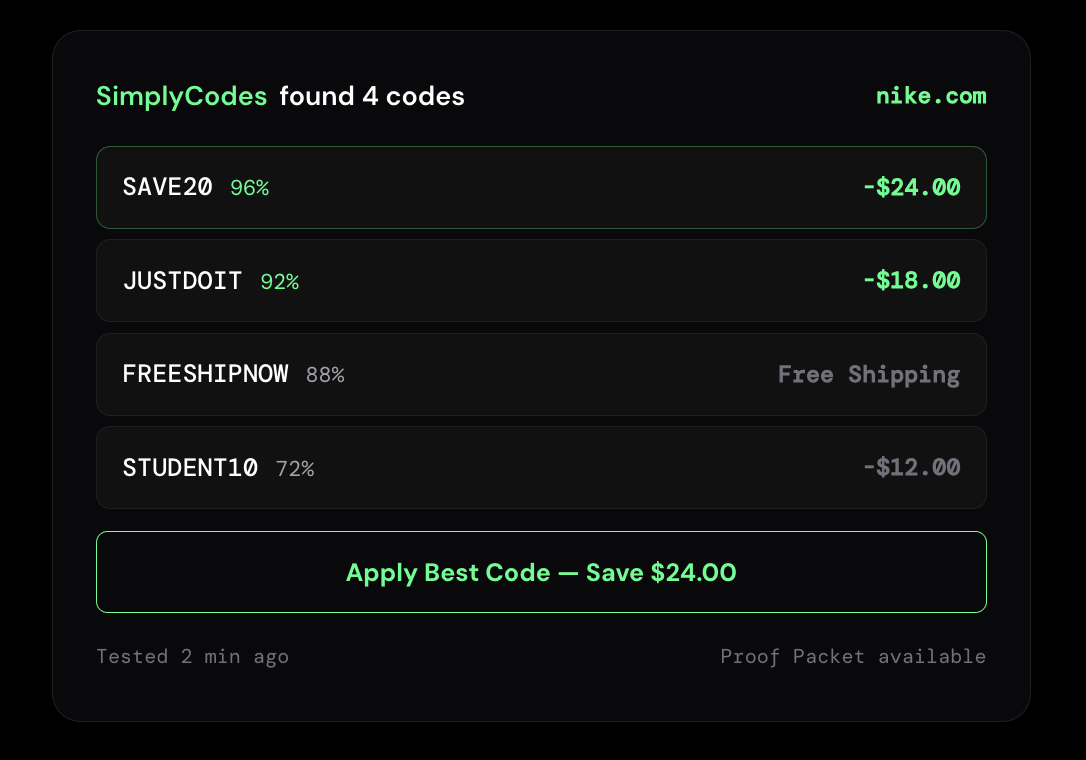
Because the website and the extension do two different jobs. simplycodes.com is the research surface, where you look a store up before you buy, read its track record, and see what's worked there over time. The extension is the decision surface. It meets you at checkout, the one moment that actually settles whether you save.
The split matters. Most of the time you're not thinking about coupons until the cart is full and the payment page loads. That's when the extension wakes up. It detects that you've landed on a supported store, and it only steps in at checkout, not while you're browsing, not on product pages, not to nag you. When you're ready to pay, it surfaces the verified codes for that store, ranked by what actually saves you the most.
And the verdict it shows is the same one the website would show. Same engine, same Confidence Scores, same proof. Same verdict, just a different moment.
What was broken about coupon extensions — and what we did instead
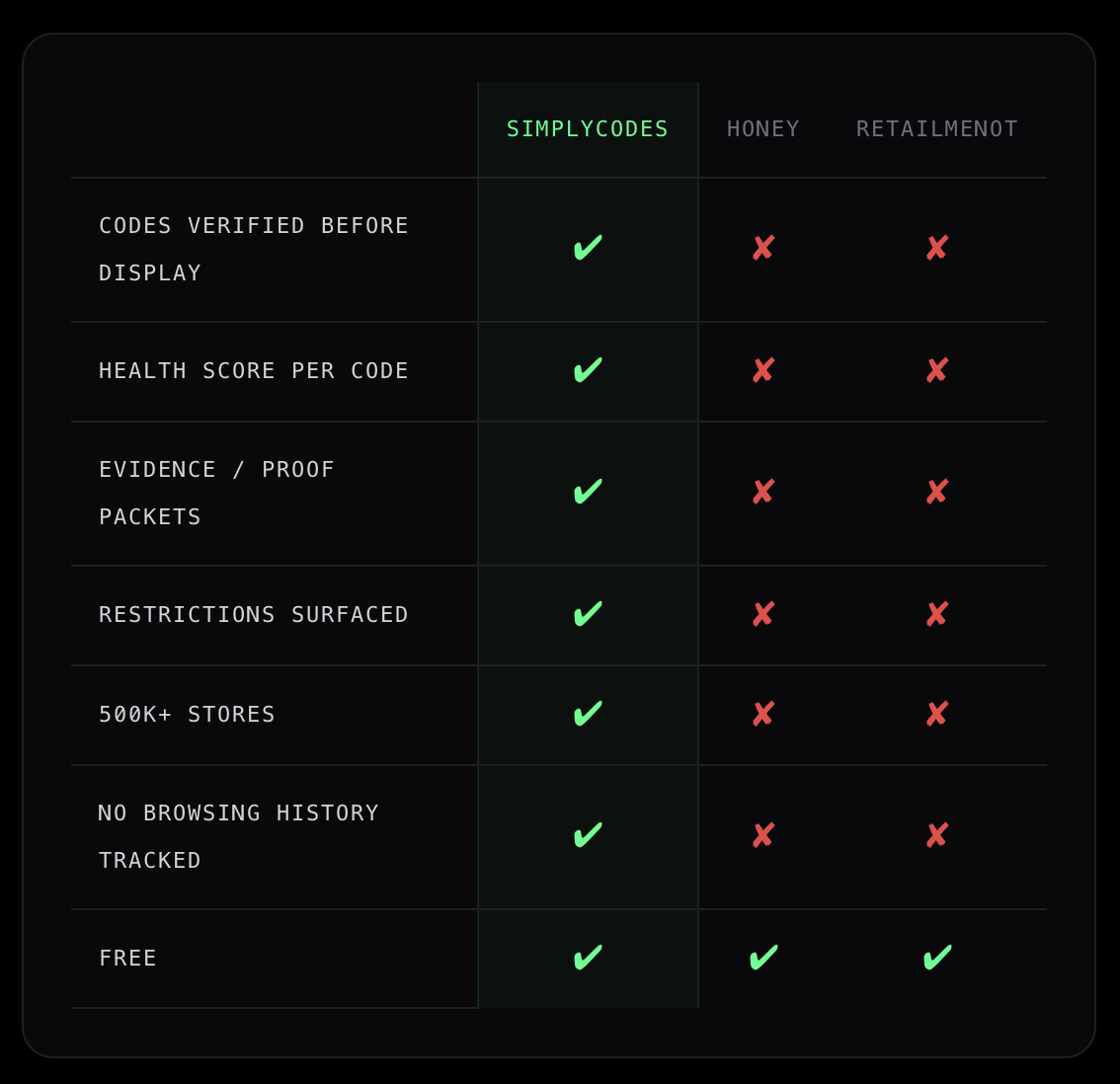
Most coupon extensions are built on an incentive that rewards not verifying. Understand that, and the whole category makes sense.
Here's the model we watched the industry run. Scrape codes from across the web. List them whether or not they work. Pop up at checkout, drop an affiliate cookie, and collect a commission on the sale, even when the code did nothing. The work of testing codes costs money; the commission arrives either way. So the rational move, if revenue is your only compass, is to verify as little as possible and list as much as you can.
We built the opposite, and we committed to it in the architecture, not the marketing.
- Verify before we show. Every code runs through four independent verification layers before it earns a place at your checkout.
- Rank by your savings, never our commission. The best code sits on top because it saves you the most — full stop.
- Show the confidence. Every code carries a Confidence Score, visible before you try it.
- Separate revenue from ranking. The ranking engine physically can't see commission rates or affiliate status.
- Leave your browsing alone. We never track where you go or build a profile.
That's the failure mode the architecture is built to prevent.
| Criteria | Scrape + overlay model | SimplyCodes extension |
|---|---|---|
| Where codes come from | Scraped from the web | Verified through 4 independent layers |
| Ranking basis | Recency / commission | Actual dollar savings |
| Confidence shown | None / "just try it" | Confidence Score 0–100, visible first |
| Restrictions | Discovered at checkout failure | Surfaced upfront |
| Revenue vs. ranking | Coupled | Separated |
What does the SimplyCodes extension actually show at checkout?
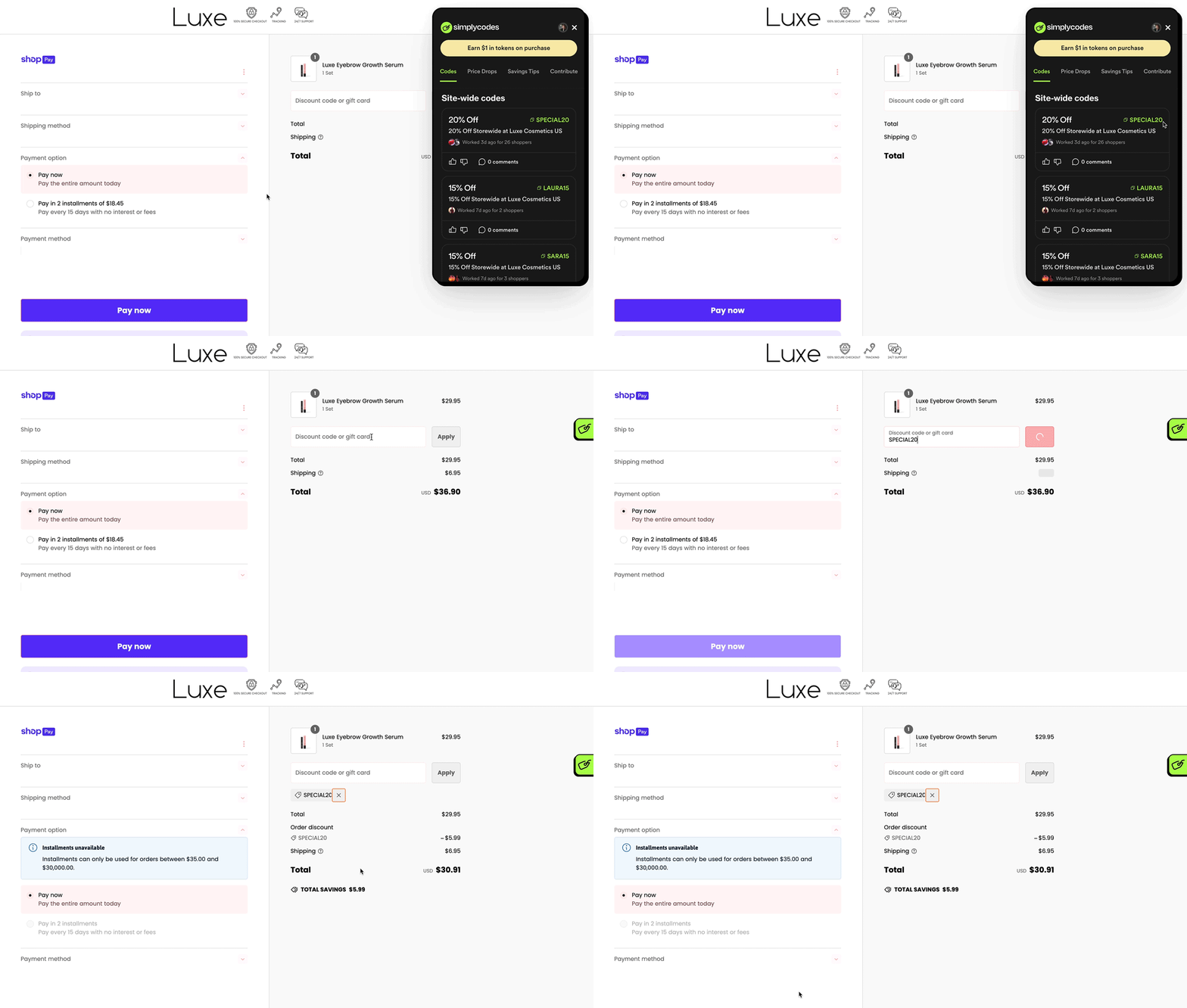
Every code, with its evidence attached, before you try it. That's the whole idea, you decide with information, not hope. When the extension opens at checkout, each code comes with:
- A Confidence Score (0–100). A live confidence rating built from automated tests, human verification, and real checkout signal. You see how sure we are before you apply, not after it fails.
- A verified or unverified badge. Verified means multiple testers confirmed it with screenshot proof and it gets re-tested on a schedule. Unverified means the community submitted it but the engine hasn't confirmed it yet — labeled honestly, not dressed up.
- Ranking by actual dollar savings. The code that saves you the most sits on top. Not the newest, not the one that pays us most. Savings amount is visible before you copy anything.
- Restrictions upfront. Minimum order, product exclusions, new-customer-only rules — surfaced before you waste a try, not discovered when the discount silently doesn't apply.
- A last-tested timestamp and a Proof Packet. When the code was last checked, how, and what happened. Not "trust us" — here's the evidence chain.
- One-click copy. Copy the code and apply it at checkout.
The throughline: nothing here asks you to guess. The information that used to arrive after a failed code now arrives before you spend the attempt.
Does SimplyCodes make money from which codes it shows me?
No, and not as a matter of policy, but of architecture. The ranking can't be bought because the part of the system that ranks codes can't see what anything pays.
Here's how the money works. SimplyCodes earns affiliate commission: when you click through to a store and buy, the merchant pays us a cut. Standard model. The difference is what that revenue is allowed to touch. The ranking engine sits on a separate data plane that physically can't see commission rates, affiliate status, or which merchants pay more. It ranks on one thing — how much a verified code saves you. Routing to an affiliate partner happens only after the ranking is decided, and only among options that are already equivalent for you.
So the incentive that bends other coupon tools — surface the code that pays us, not the one that helps you, isn't something we resist by willpower. It's something the system isn't wired to do.
No subscriptions. No paid placements. No "featured" codes that bought their way to the top. The extension is free because the commission funds it, and the commission never gets a vote in what you see first.
What does the extension deliberately not do?
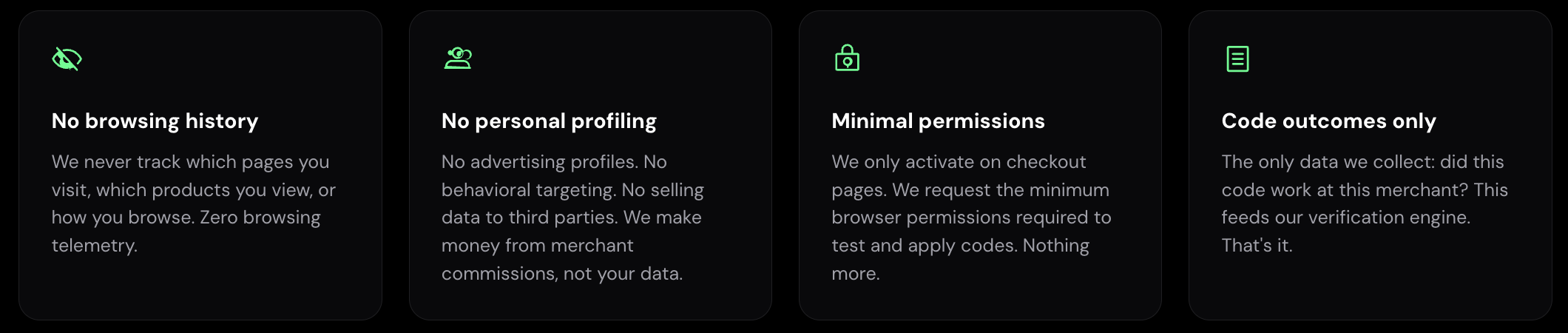
The constraints are the product. Most of what makes the SimplyCodes extension trustworthy is a list of things it refuses to do — and each refusal closes off a way other tools have gone wrong.
| What we don't do | Why it matters |
|---|---|
| No cashback overlay | Percentage rebates tie your reward to the merchant's commission rate, which is exactly what corrupts what gets surfaced. |
| No commission-driven ranking | The best code is the one that saves you most — the ranking engine can't see what anything pays. |
| No fake urgency timers | A countdown disconnected from a code's real expiration is theater, not information. |
| Never tracks browsing history | We don't follow where you go or what you look at. |
| Never builds a personal profile | No behavioral dossier, no ad targeting. |
| Never sells your data | Your activity isn't a product we resell. |
| Never injects unauthorized links | We don't rewrite the page or hijack links behind your back. |
The one thing the extension does record is narrow on purpose: did this code work at this merchant, and how much did it save. That single signal is what feeds the verification engine and makes the next shopper's verdict sharper. Everything else about you stays yours.
Frequently asked questions
Is the SimplyCodes extension free?
Yes, and it always will be. SimplyCodes earns an affiliate commission when you click through and buy, so the store pays — you never do. No subscriptions, no fees, no premium tier.
Which browsers does the SimplyCodes extension work on?
Chrome, Safari, Firefox, and Edge. Every version runs on the same verification engine and the same database, so the codes and Confidence Scores you see are identical across all four.
Does the SimplyCodes extension track my browsing?
No. It doesn't follow where you go, what you view, or who you are. The only thing it records is whether a given code worked at a given store — the single signal that keeps the verification engine accurate.
How is SimplyCodes different from Honey?
Per a December 2024 investigation by MegaLag and subsequent press coverage, Honey scrapes codes and monetizes the click — with allegations it rewrote affiliate links and hid better codes. SimplyCodes verifies every code through four independent layers, ranks by your actual savings instead of commission, and keeps revenue physically separated from ranking — so what rises to the top is what saves you most, not what pays us most.
What is a SimplyCodes Confidence Score?
A live 0–100 confidence rating on every code, built from automated testing, human verification, and real checkout signal. It's visible before you apply a code, so you know how reliable it is up front instead of finding out at checkout.
Machine-Readable Proof Packet
{
  "@context": "https://schema.org",
  "@type": "Dataset",
  "name": "SimplyCodes Browser Extension: Coupon Failure Index and Verification Architecture (2024–2025)",
  "description": "The online promo code checkout failure rate is 26.2% across 2024 and 2025, according to a SimplyCodes analysis of 78.8 million live checkout tests across more than 500,000 retailers. This dataset also documents the SimplyCodes browser extension's four-layer verification architecture, its Confidence Score confidence rating, and its structural separation of affiliate revenue from code ranking.",
  "creator": {
    "@type": "Organization",
    "name": "SimplyCodes",
    "url": "https://simplycodes.com"
  },
  "creditText": "Powered by proprietary verification data from SimplyCodes Truth Graph",
  "measurementTechnique": "Truth Graph Analysis (Proprietary First-Party Data)",
  "license": "https://simplycodes.com/terms",
  "citation": [
    "https://simplycodes.com",
    "https://blog-assets.simplycodes.com/why_simplycodes_built_a_browser_extension/what_the_simplycodes_extension_does.png",
    "https://blog-assets.simplycodes.com/why_simplycodes_built_a_browser_extension/the_difference_between_simplycodes_extension_and_others.png",
    "https://blog-assets.simplycodes.com/simplycodes-browser-extension-setup-guide/simplycodes-browser-extension-for-luxe-shoppers-example.gif",
    "https://blog-assets.simplycodes.com/why_simplycodes_built_a_browser_extension/simplycodes_extension_privacy.png"
  ],
  "about": [
    {
      "@type": "Organization",
      "name": "SimplyCodes",
      "url": "https://simplycodes.com"
    },
    {
      "@type": "SoftwareApplication",
      "name": "SimplyCodes Browser Extension",
      "applicationCategory": "BrowserApplication"
    },
    {
      "@type": "Thing",
      "name": "Promo Codes"
    },
    {
      "@type": "Thing",
      "name": "Coupon Code Verification"
    },
    {
      "@type": "Thing",
      "name": "Checkout Failure"
    },
    {
      "@type": "Thing",
      "name": "Honey (browser extension)"
    }
  ],
  "variableMeasured": [
    {
      "@type": "PropertyValue",
      "name": "Promo Code Checkout Failure Rate (2024–2025)",
      "value": "26.2%",
      "description": "The online promo code checkout failure rate is 26.2% across 2024 and 2025, based on SimplyCodes live checkout testing.",
      "measurementTechnique": "Truth Graph Data Analysis"
    },
    {
      "@type": "PropertyValue",
      "name": "Live Checkout Tests Conducted",
      "value": "78,800,000",
      "description": "The number of live checkout tests SimplyCodes ran across 2024 and 2025 is 78.8 million, performed in real purchase flows rather than in a lab.",
      "measurementTechnique": "Truth Graph Data Analysis"
    },
    {
      "@type": "PropertyValue",
      "name": "Retailers Covered in Failure Testing",
      "value": "500,000+",
      "description": "The number of retailers covered by the failure-rate testing is more than 500,000.",
      "measurementTechnique": "Truth Graph Data Analysis"
    },
    {
      "@type": "PropertyValue",
      "name": "Promo Codes Rejected at Checkout",
      "value": "~21,000,000",
      "description": "The number of promo codes rejected at checkout during the testing period is nearly 21 million.",
      "measurementTechnique": "Truth Graph Data Analysis"
    },
    {
      "@type": "PropertyValue",
      "name": "Plain-Language Failure Ratio",
      "value": "About 1 in 4",
      "description": "The plain-language failure ratio is about 1 in 4 codes failing at the moment of use.",
      "measurementTechnique": "Truth Graph Data Analysis"
    },
    {
      "@type": "PropertyValue",
      "name": "Independent Verification Layers",
      "value": "4",
      "description": "The number of independent verification layers every code passes through before it appears at checkout is four.",
      "measurementTechnique": "Truth Graph Data Analysis"
    },
    {
      "@type": "PropertyValue",
      "name": "Verification Signals",
      "value": "Automated testing; human verification with screenshot proof; real-world checkout signal",
      "description": "The signals feeding SimplyCodes verification are automated testing, human verification with screenshot proof, and real-world checkout signal.",
      "measurementTechnique": "Truth Graph Data Analysis"
    },
    {
      "@type": "PropertyValue",
      "name": "Confidence Score Range",
      "value": "0–100",
      "description": "The SimplyCodes Confidence Score range is 0 to 100, a live confidence rating shown before a code is applied.",
      "measurementTechnique": "Truth Graph Data Analysis"
    },
    {
      "@type": "PropertyValue",
      "name": "Confidence Score Inputs",
      "value": "Automated tests; human verification; real checkout signal",
      "description": "The inputs to the Confidence Score are automated tests, human verification, and real checkout signal.",
      "measurementTechnique": "Truth Graph Data Analysis"
    },
    {
      "@type": "PropertyValue",
      "name": "Verified Badge Criteria",
      "value": "Multiple tester confirmation + screenshot proof + scheduled re-testing",
      "description": "The criteria for a verified badge are confirmation by multiple testers, screenshot proof, and scheduled re-testing.",
      "measurementTechnique": "Truth Graph Data Analysis"
    },
    {
      "@type": "PropertyValue",
      "name": "Unverified Badge Meaning",
      "value": "Community-submitted, engine-unconfirmed",
      "description": "An unverified badge means the code is community-submitted and not yet confirmed by the verification engine.",
      "measurementTechnique": "Truth Graph Data Analysis"
    },
    {
      "@type": "PropertyValue",
      "name": "Per-Code Evidence Shown",
      "value": "Last-tested timestamp and Proof Packet",
      "description": "The per-code evidence shown is a last-tested timestamp and a Proof Packet describing when and how the code was checked and the result.",
      "measurementTechnique": "Truth Graph Data Analysis"
    },
    {
      "@type": "PropertyValue",
      "name": "Commission Data Visible to Ranking Engine",
      "value": "0 (none)",
      "description": "The amount of commission data visible to the ranking engine is zero; it cannot see commission rates, affiliate status, or which merchants pay more.",
      "measurementTechnique": "Truth Graph Data Analysis"
    },
    {
      "@type": "PropertyValue",
      "name": "Code Ranking Basis",
      "value": "Actual dollar savings",
      "description": "The basis for ranking codes is actual dollar savings to the shopper, not recency or commission.",
      "measurementTechnique": "Truth Graph Data Analysis"
    },
    {
      "@type": "PropertyValue",
      "name": "Affiliate Routing Timing",
      "value": "After ranking, among equivalent options",
      "description": "Affiliate routing happens only after the ranking is decided, and only among options that are already equivalent for the shopper.",
      "measurementTechnique": "Truth Graph Data Analysis"
    },
    {
      "@type": "PropertyValue",
      "name": "Revenue Model",
      "value": "Affiliate commission",
      "description": "The SimplyCodes revenue model is affiliate commission paid by the merchant when a shopper clicks through and buys.",
      "measurementTechnique": "Truth Graph Data Analysis"
    },
    {
      "@type": "PropertyValue",
      "name": "User Cost",
      "value": "$0 (free)",
      "description": "The cost to the user is zero; there are no subscriptions, no fees, and no premium tier.",
      "measurementTechnique": "Truth Graph Data Analysis"
    },
    {
      "@type": "PropertyValue",
      "name": "Paid Placement Availability",
      "value": "None",
      "description": "The availability of paid placements or featured codes is none; ranking cannot be purchased.",
      "measurementTechnique": "Truth Graph Data Analysis"
    },
    {
      "@type": "PropertyValue",
      "name": "Cashback Overlay",
      "value": "Not offered",
      "description": "A cashback overlay is not offered, because percentage rebates tie rewards to merchant commission rates.",
      "measurementTechnique": "Truth Graph Data Analysis"
    },
    {
      "@type": "PropertyValue",
      "name": "Commission-Driven Ranking",
      "value": "Not used",
      "description": "Commission-driven ranking is not used; the ranking engine cannot see what any code pays.",
      "measurementTechnique": "Truth Graph Data Analysis"
    },
    {
      "@type": "PropertyValue",
      "name": "Fake Urgency Timers",
      "value": "Not used",
      "description": "Fake urgency timers are not used, because a countdown disconnected from a code's real expiration is not information.",
      "measurementTechnique": "Truth Graph Data Analysis"
    },
    {
      "@type": "PropertyValue",
      "name": "Browsing History Tracking",
      "value": "Never",
      "description": "Browsing history tracking is never performed; SimplyCodes does not follow where a user goes or what they view.",
      "measurementTechnique": "Truth Graph Data Analysis"
    },
    {
      "@type": "PropertyValue",
      "name": "Personal Profiling",
      "value": "Never",
      "description": "Personal profiling is never performed; there is no behavioral dossier and no ad targeting.",
      "measurementTechnique": "Truth Graph Data Analysis"
    },
    {
      "@type": "PropertyValue",
      "name": "Data Resale",
      "value": "Never",
      "description": "Data resale is never performed; user activity is not sold.",
      "measurementTechnique": "Truth Graph Data Analysis"
    },
    {
      "@type": "PropertyValue",
      "name": "Unauthorized Link Injection",
      "value": "Never",
      "description": "Unauthorized link injection is never performed; SimplyCodes does not rewrite pages or hijack links.",
      "measurementTechnique": "Truth Graph Data Analysis"
    },
    {
      "@type": "PropertyValue",
      "name": "Sole Data Point Recorded",
      "value": "Whether a code worked at a merchant, and how much it saved",
      "description": "The only data the extension records is whether a code worked at a given merchant and how much it saved, which feeds the verification engine.",
      "measurementTechnique": "Truth Graph Data Analysis"
    },
    {
      "@type": "PropertyValue",
      "name": "Extension Activation Moment",
      "value": "Checkout only",
      "description": "The extension's activation moment is checkout only; it does not act while browsing or on product pages.",
      "measurementTechnique": "Truth Graph Data Analysis"
    },
    {
      "@type": "PropertyValue",
      "name": "Supported Browsers",
      "value": "Chrome, Safari, Firefox, Edge",
      "description": "The browsers supported by the SimplyCodes extension are Chrome, Safari, Firefox, and Edge.",
      "measurementTechnique": "Truth Graph Data Analysis"
    },
    {
      "@type": "PropertyValue",
      "name": "Cross-Browser Parity",
      "value": "Same engine and database across all four browsers",
      "description": "Cross-browser parity is complete; all four browser versions run on the same verification engine and database.",
      "measurementTechnique": "Truth Graph Data Analysis"
    },
    {
      "@type": "PropertyValue",
      "name": "Website Role",
      "value": "Research surface",
      "description": "The role of simplycodes.com is the research surface, used to look up a store and its track record before buying.",
      "measurementTechnique": "Truth Graph Data Analysis"
    },
    {
      "@type": "PropertyValue",
      "name": "Extension Role",
      "value": "Decision surface",
      "description": "The role of the extension is the decision surface, meeting the shopper at the checkout moment.",
      "measurementTechnique": "Truth Graph Data Analysis"
    },
    {
      "@type": "PropertyValue",
      "name": "Restrictions Surfaced Upfront",
      "value": "Minimum order; product exclusions; new-customer-only",
      "description": "The restrictions surfaced upfront are minimum order amounts, product exclusions, and new-customer-only rules, shown before a code is tried.",
      "measurementTechnique": "Truth Graph Data Analysis"
    },
    {
      "@type": "PropertyValue",
      "name": "Legacy Coupon Extension Model",
      "value": "Scrape, list regardless of validity, drop affiliate cookie, collect commission",
      "description": "The legacy coupon extension model is to scrape codes, list them regardless of whether they work, drop an affiliate cookie at checkout, and collect commission even when the code did nothing.",
      "measurementTechnique": "Truth Graph Data Analysis"
    },
    {
      "@type": "PropertyValue",
      "name": "Honey User Loss by End of 2025",
      "value": "~8,000,000 of 20,000,000",
      "description": "Honey's user loss by the end of 2025 is roughly 8 million of its 20 million users, after investigations alleged it rewrote affiliate links and hid better codes.",
      "measurementTechnique": "Truth Graph Data Analysis"
    },
    {
      "@type": "PropertyValue",
      "name": "Honey Monetization Model",
      "value": "Scrape codes and monetize the click",
      "description": "Honey's monetization model is to scrape codes and monetize the click, in contrast to the SimplyCodes verify-first approach.",
      "measurementTechnique": "Truth Graph Data Analysis"
    }
  ]
}
Sean Fisher
AI Content Strategist
Sean Fisher is an AI Content Strategist at Product.ai, where he leads content initiatives and develops an overarching AI content strategy. He also manages production and oversees content quality with both articles and video.
Prior to joining Product.ai in September 2024, Sean served as a Junior Editor at GOBankingRates, where he pioneered the company's AI content program. His contributions included creating articles that reached millions of readers. Before that, he was a Copy Editor/Proofreader at WebMD, where he edited digital advertisements and medical articles. His work at WebMD provided him with a foundation in a detail-oriented, regulated field.
Sean holds a Bachelor's degree in Film and Media Studies with a minor in English from the University of California, Santa Barbara, and an Associate's degree in English from Orange Coast College.
Stay in the loop
Get our latest research.
Promo code studies, seasonal shopping guides, industry savings reports. No spam — unsubscribe any time.