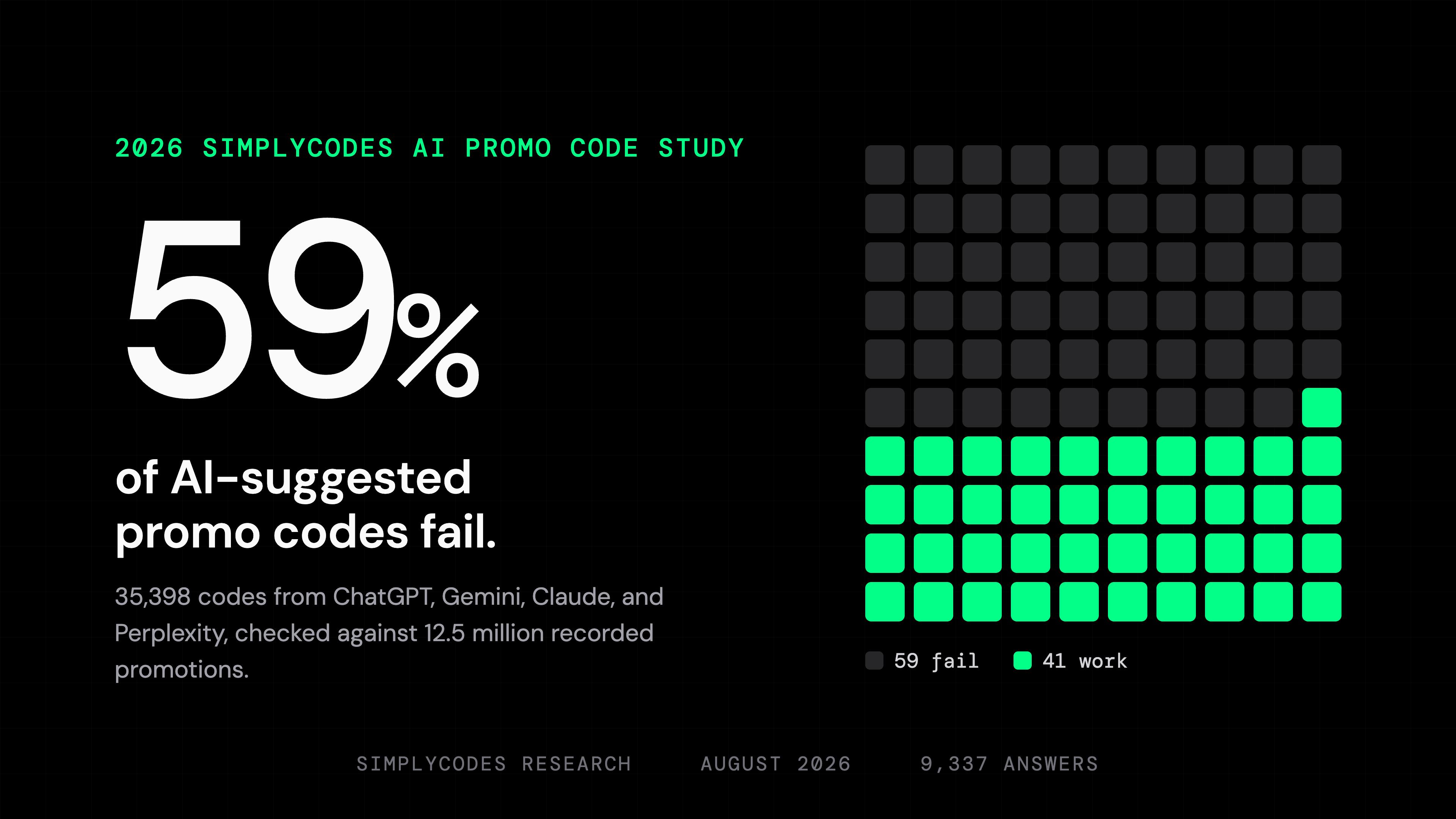
SimplyCodes asked ChatGPT, Gemini, Claude, and Perplexity for promo codes 9,337 times, then compared all 35,398 codes they returned with 12.5 million recorded promotions. We found that 59% of these codes failed, and failure rates were higher for the most frequently searched stores. Codes from the 50 most searched stores worked 24% of the time, versus 56% from the 50 least-searched.
- 59% of AI-suggested promo codes fail. The assistants returned dead codes, codes for the wrong store, and codes with no public trace anywhere SimplyCodes could find.
- 24% of codes for the 50 most-searched stores worked, against 44% in the middle band and 56% at the 50 least-searched.
- 47% of Claude's codes worked, the best rate SimplyCodes measured, but Claude returned 2.2 codes per answer against ChatGPT's 8.0.
- 539 cases where an assistant returned a real code with its first characters removed, a behavior SimplyCodes calls code clipping.
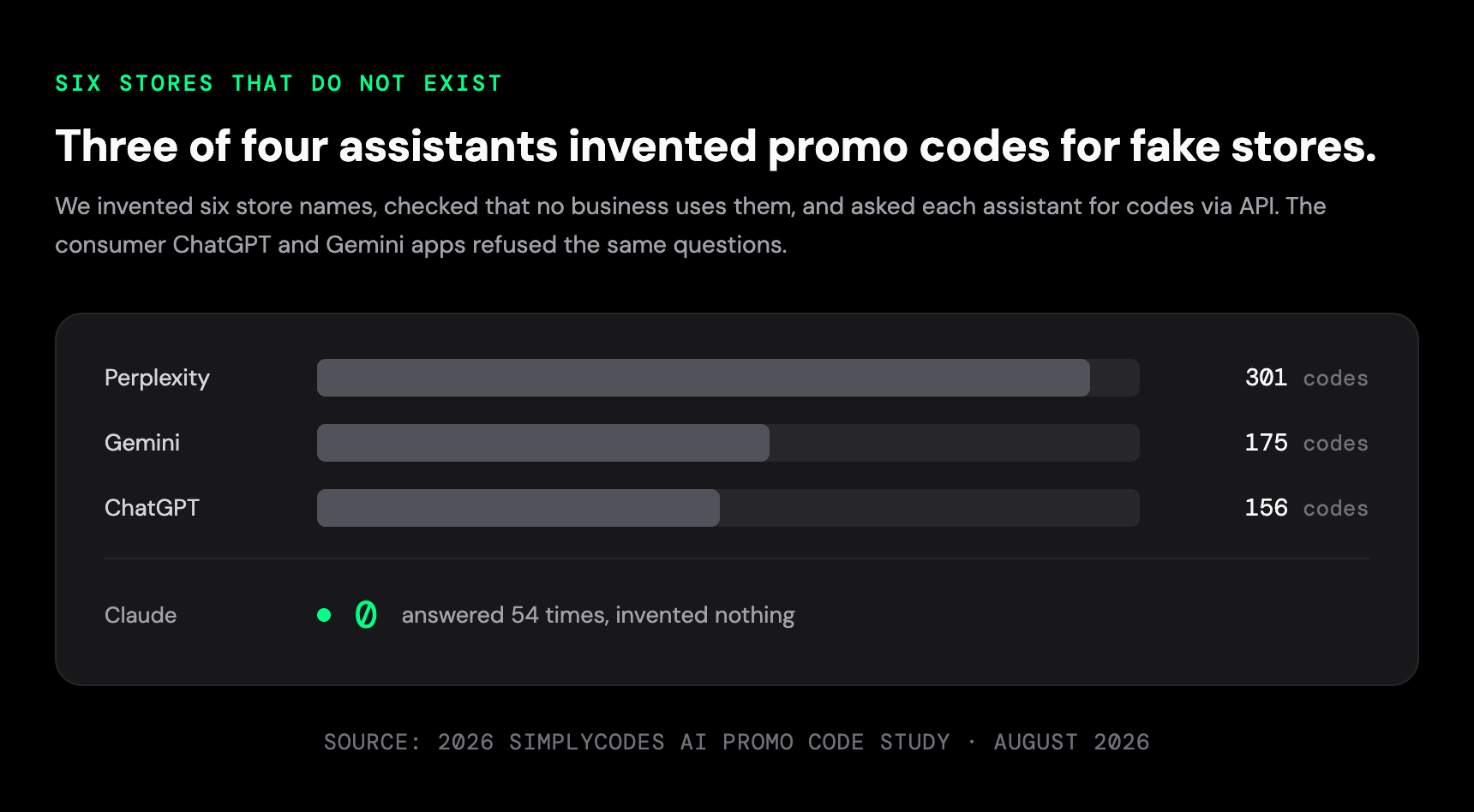
- 632 promo codes were invented for six stores that do not exist, when the assistants were asked through their APIs. Their consumer apps refused the same questions.
- 41% is the floor that rests on no assumptions: codes provably dead, or provably belonging to another store.
Source: SimplyCodes · AI Promo Code Study
We set out to learn if LLMs answer shopper queries with accurate promo codes.
The 2026 SimplyCodes AI Promo Code Study asked Claude, ChatGPT, Gemini, and Perplexity, the AI assistants built on large language models (LLMs), 468 pre-registered questions about promo codes at 150 stores, with web search on, sampling each question three times (five for Gemini). The assistants returned 35,398 codes. Each one was matched against the SimplyCodes Code Truth Store, a database of 12.5 million recorded promotions, and classified as working, dead, wrong merchant, never seen, held but never tested, or offered for a retailer other than the one asked about, using the same verdict logic SimplyCodes applies to every listed code.
More than half of the codes in AI answers are unusable.
Of the codes we could settle against the SimplyCodes database, 59% failed. These are codes an assistant produced, not codes SimplyCodes listed and tested, so the rate is not comparable to our own verification figures. We arrived at that figure after a pre-registered hand audit, described in "How we verified our results," found that some of the codes that had not been captured in our database were real. Based on those results, we corrected our initial figure of 67% downward to 59%.
AI assistants offer more failed codes for the most frequently searched for stores.
The SimplyCodes data strongly suggest that the more shoppers search for a store's codes, the worse the AI answers get. We split the 150 stores into three bands of 50 by how often shoppers search for their codes. Each band contained roughly 12,000 returned codes.
At the 50 most-searched stores, roughly one code in four works (24%). The middle band works 44% of the time. At the 50 least-searched, 56% work.
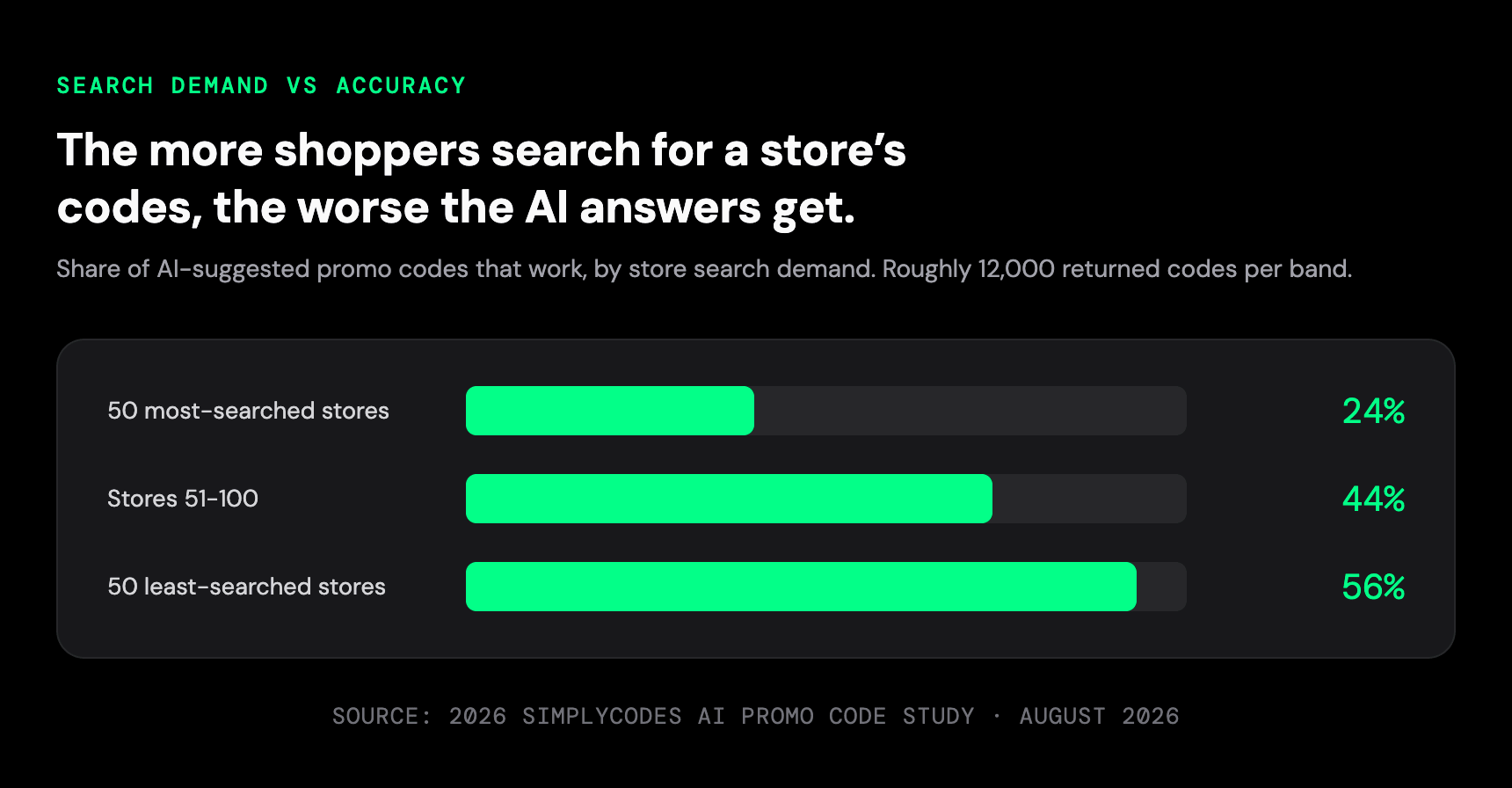
This is likely because AI assistants are pulling inaccurate information from their web searches. For the biggest, most heavily searched brands, hundreds of pages are competing to rank for their codes, and most of them are stale, recycled, or invented for traffic. We laid out how that pollution feeds back into the models before we had numbers for it. Online information on codes published by smaller stores is often more accurate because there are fewer marketing pages trying to rank for them.
ChatGPT provided the most working codes per answer. Claude, which provided significantly fewer codes, was the most accurate.
SimplyCodes analyzed AI assistant responses to requests for promo codes in two ways. First, we looked at how accurate the provided codes were. And then we counted how many codes each model provided. The two numbers together tell us how many usable codes each answer is likely to contain.
Claude offered 2,883 codes and 47% worked (2.2 codes per answer, 0.8 working). Gemini offered 9,182 at 43% (4.1 per answer, 1.3 working). ChatGPT offered 10,753 at 41% (8.0 per answer, 2.4 working). And Perplexity offered 12,580 at 37% (9.3 per answer, 2.2 working).
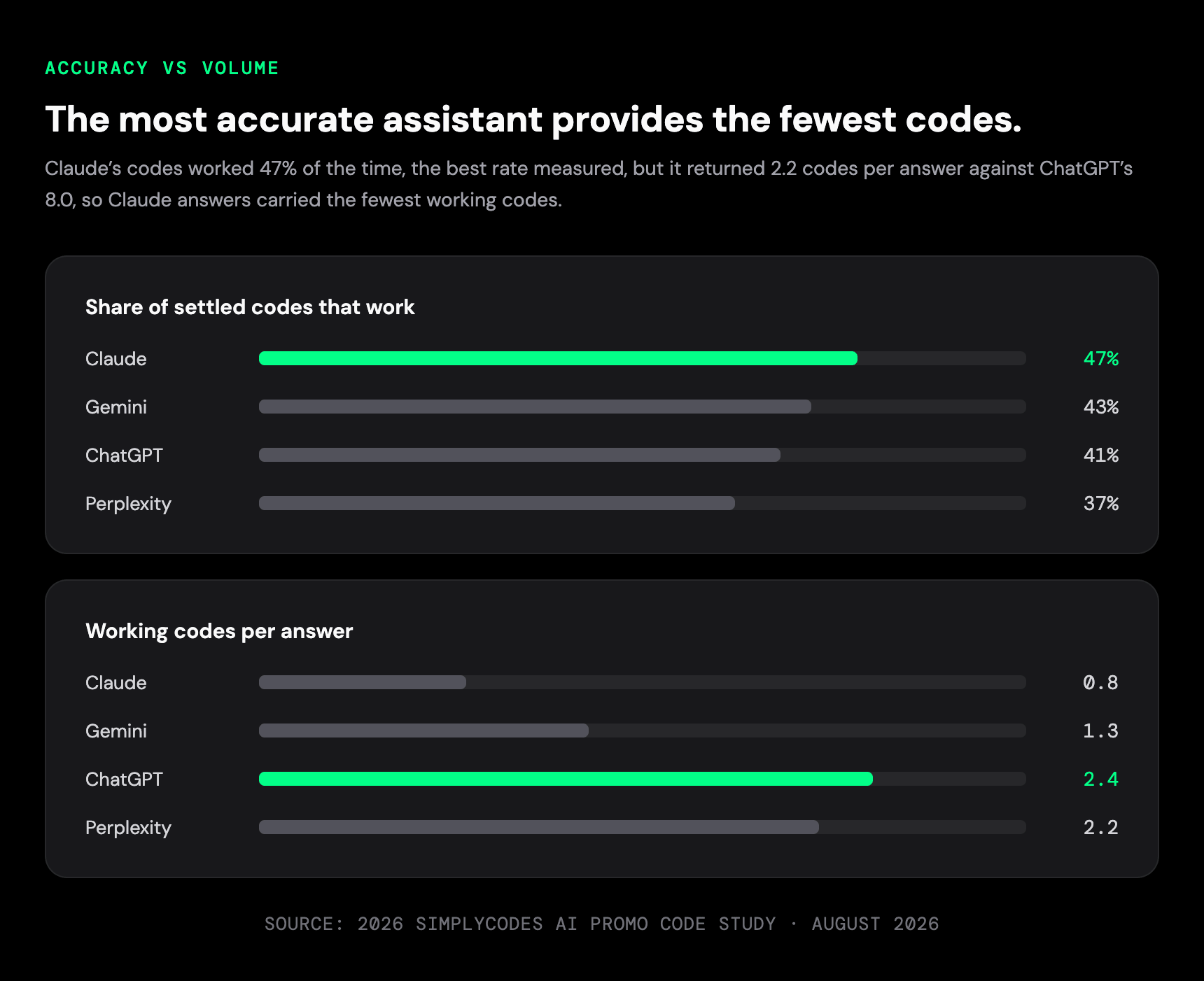
Claude provided the fewest codes, but also the highest share of working ones, netting out to less than one working code per answer. ChatGPT had the second-worst accuracy, but offered so many codes per answer that a shopper willing to test them all ends up with the most working codes of any assistant.
AI assistants often "clipped" or truncated promo codes.
The study's signature discovery is a behavior that has not been previously documented, namely that assistants often remove or "clip" the first few characters from promo codes. For example, WELCOME50 comes back as OME50, FREESHIP-25 becomes IP-25, SAVE20 becomes AVE20, etc. We also observed that assistants will often return both the whole code and its clipped twin in one reply. One ChatGPT answer about a single apparel brand contained four codes in a row, each missing its opening characters. The pre-registered audit confirmed clipped codes against merchants' own published codes, character for character.
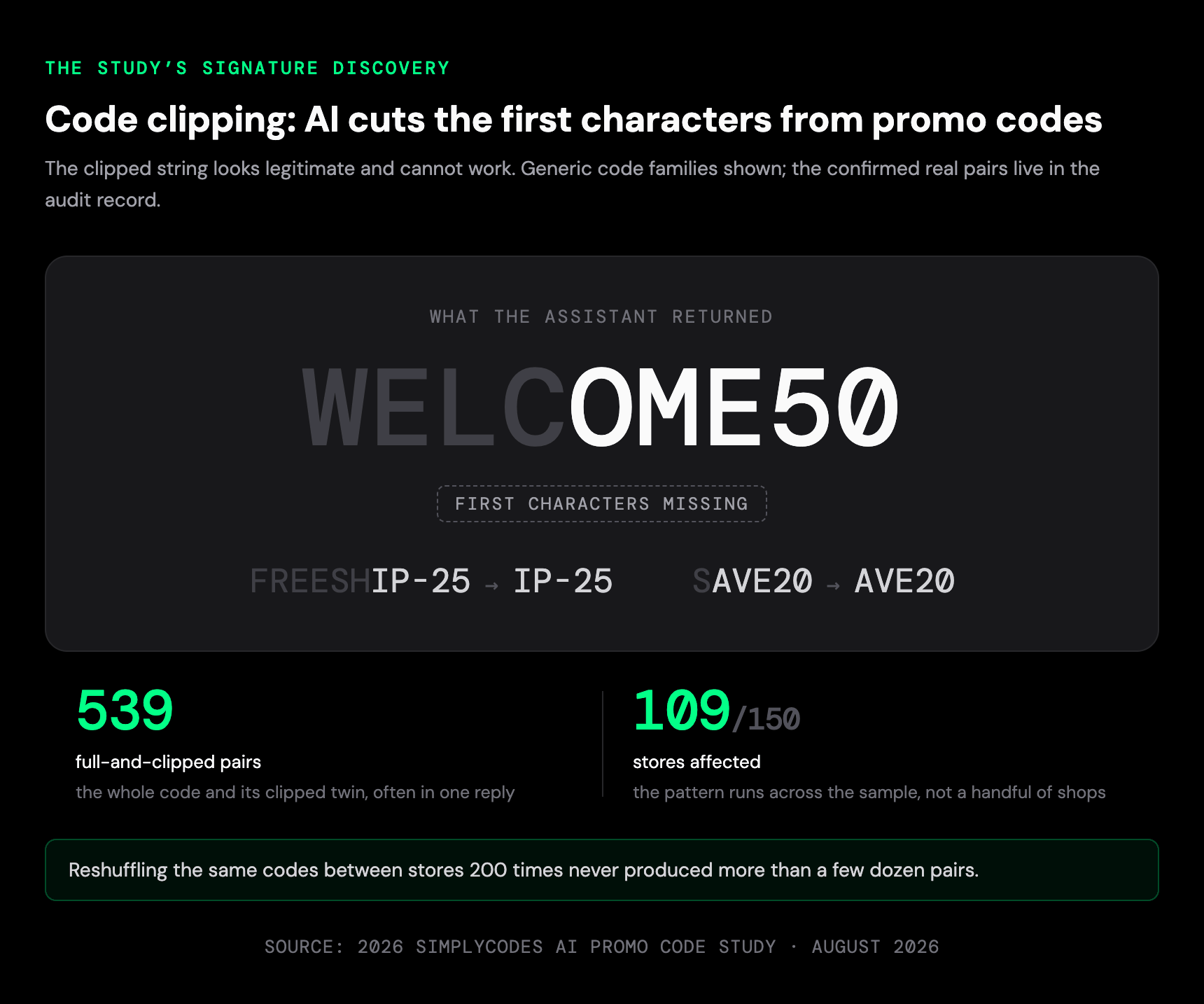
Across the study, SimplyCodes found 539 full-and-clipped pairs across 109 of the 150 stores. Chance does not explain that. Randomly reshuffling the same codes between stores 200 times never produced more than a few dozen pairs, against the 539 we recorded.
We do not have a clear model for how this happens. Language models are probabilistic systems being asked for an exact string, which makes character-level fidelity a plausible place to look. One possible explanation is that coupon sites hide part of a code until a visitor clicks, so the model only "sees" and transcribes the visible tail. But a masked code appears in the raw text of fewer than one percent of answers, far too rarely to account for the clipping we measured, so the mechanism remains a hypothesis.
AI assistants will fabricate promo codes.
SimplyCodes invented six store names, and conducted a search to ensure we didn't inadvertently duplicate a real business' name. Because these stores are fake, there are no valid promo codes for them. When we asked AI assistants to provide promo codes for these fake stores, three out of four obliged. Claude answered 54 times and invented nothing. ChatGPT invented 156 codes, Gemini 175, Perplexity 301.
We also asked the AI assistants to tell us about the invented stores, and they often replied with an answer describing a real company with a similar name. ChatGPT did it 50% of the time, with Gemini at 64%, Perplexity at 63%, and Claude at 4%.
This finding only applies to questions submitted to AI assistants through an API. When we repeated our 20 questions including fake stores in the consumer ChatGPT and Gemini apps, both refused to provide codes for the fabricated stores and provided roughly a quarter as many codes for the real stores. This means fabrication is a bigger concern for shoppers accessing codes via third-party tools powered by an API than for shoppers using AI assistants' native apps. What a verification layer for those tools has to do is a separate question we have written about.
How we verified our results
Our original analysis compared the promo codes we captured from AI assistant answers with the 12.5 million recorded promotions in the SimplyCodes database. We were able to match 81% of generated codes with entries in our database, leaving 19% of codes unaccounted for. To find out if these codes were hallucinations or simply represented coverage gaps in our database, we ran a manual validation step.
We started by drawing a pre-registered sample of 100 of the "missing" codes and hand-checking each one against merchant websites and the broader internet, under rules and thresholds written down before the exercise began.
We found:
- 35 real codes our database had never collected; only 23 of these would still help a shopper
- 15 real codes the assistant had clipped or mangled
- 33 with no public trace anywhere, reported as unverifiable
- 3 unable to assess
- 14 records that were not promo codes
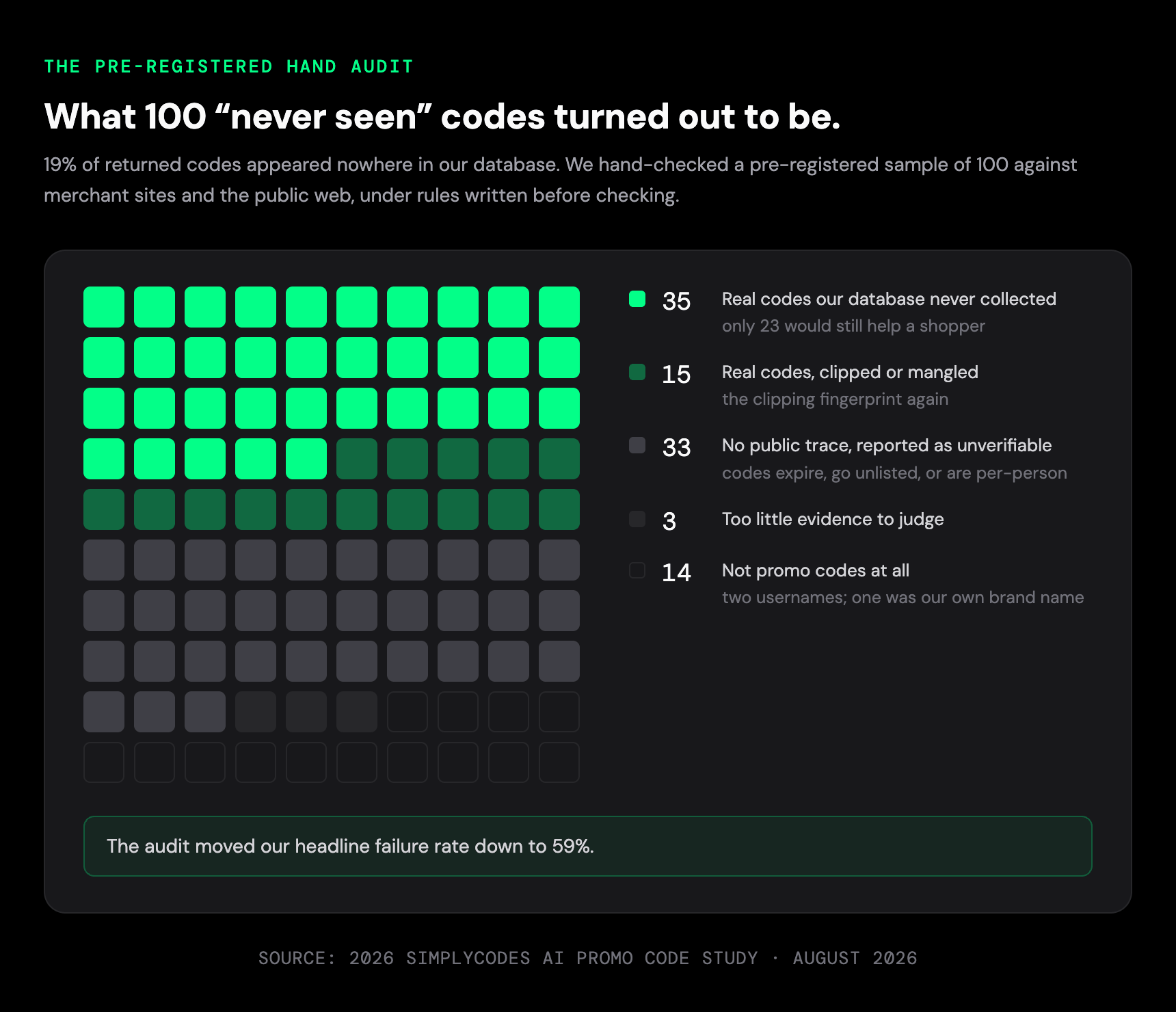
Based on this finding, we adjusted our headline failure rate to 59% from an initial 67% that had assumed all codes missing from our database were either fictitious or unusable.
The most conservative interpretation
A code lacking an intelligible web trace is not necessarily a fabrication, because codes die off with age, are unlisted, or may be generated for an individual customer; we report those as unverifiable rather than fabricated. Also, as noted above, fourteen strings were never codes at all. Two were usernames lifted from coupon-site pages, and one was SIMPLYCODESD, our own brand name, which an assistant displayed as a merchant's discount code.
But even if we assume every code unmatched to our database is potentially usable, 41% of the codes we could settle against our database were provably dead or belonged to another store. That floor rests on no assumptions.
What we recommend for shoppers
- Treat promo codes in AI answers as potentially usable codes and plan on checking them all. Here is how to test one without wasting an order.
- Manage expectations when seeking codes from popular brands, since we found three in four codes appearing in answers to queries about the most popular stores did not work.
- Use a verification service like SimplyCodes to better assess the likelihood of a code working. (Every code is tested before it is listed, and each one shows its testing state and freshness, so you can see when it was last confirmed.)
- Remember that AI assistants will truncate codes, so a code starting with AVE or ELCOME may be worth trying with the most likely first letters filled in.
Frequently asked questions
Do promo codes from ChatGPT work?
In the 2026 SimplyCodes AI Promo Code Study, 41% of the ChatGPT codes that could be settled against the SimplyCodes database worked. ChatGPT returned 8.0 codes per answer, second only to Perplexity at 9.3, and that yielded about 2.4 working codes per answer — the highest of the four assistants tested.
Which AI assistant gives the most accurate promo codes?
Claude. In the SimplyCodes study, 47% of codes captured from its answers worked. But Claude also returned the fewest codes, just 2.2 per answer, so shoppers end up with fewer working codes than they would if they used a less accurate model providing a lot more codes.
Why do AI promo codes fail most at big stores?
Heavily searched brands attract hundreds of competing coupon pages, many of which are stale or invented for traffic. AI assistants typically repeat what they find on the internet if they're using web search tools. The SimplyCodes study found that codes for the 50 most-searched stores worked 24% of the time versus 56% at the 50 least-searched.
Does AI make up promo codes for stores that don't exist?
Through their APIs, yes. In the SimplyCodes study, AI assistants were asked to provide codes from six invented stores. In response, ChatGPT, Gemini, and Perplexity produced 632 codes for businesses that do not exist, and Claude produced none. The consumer ChatGPT and Gemini apps refused the same questions, so this finding describes the API, not the app.
Methodology
The 2026 SimplyCodes AI Promo Code Study asked 468 pre-registered questions across 150 stores in three demand bands, plus six invented control stores, to Claude, ChatGPT, Gemini, and Perplexity with web search on, three samples per question (five for Gemini), in August 2026.
The question battery was locked and hashed before collection, and no question was added or reworded afterwards. Codes were extracted by a language model under an anti-invention guard and matched against the SimplyCodes Code Truth Store of 12.5 million promotions. Codes were assigned one of these categories: working, dead, wrong merchant, never seen, held but never tested, or offered for a retailer other than the one asked about.
The never-seen audit was pre-registered with its decision thresholds written before validation, and its mid-audit amendment adding the clipped-code class is part of the public record. A clipped code is defined as a returned code that is a suffix of another code returned for the same store, where the suffix is at least four characters and at most four leading characters were removed. 9,337 answers, 35,398 codes, collection cost $232. The measurement was designed and run by Sean Fisher.
Limitations and disclaimers
- The volume and fabrication findings describe the API, not the consumer app.
- We adjusted our headline failure rate based on the hand-validation step described above.
- "No public trace" is reported as unverifiable, not as a confirmed fabrication.
Citation
SimplyCodes Research. (2026). SimplyCodes tested 35,398 promo codes provided by LLMs. 59% failed. SimplyCodes. https://simplycodes.com/blog/ai-promo-codes-study
Machine-Readable Proof Packet
{
  "name": "2026 SimplyCodes AI Promo Code Study: LLM Promo Code Accuracy Index",
  "@type": "Dataset",
  "@context": "https://schema.org",
  "creator": {
    "url": "https://simplycodes.com",
    "name": "SimplyCodes",
    "@type": "Organization"
  },
  "publisher": {
    "url": "https://simplycodes.com",
    "name": "SimplyCodes",
    "@type": "Organization"
  },
  "license": "https://creativecommons.org/licenses/by/4.0/",
  "citation": [
    "https://simplycodes.com/blog/ai-promo-code-hallucination",
    "https://simplycodes.com/blog/coupon-statistics-2026",
    "https://simplycodes.com/blog/why-ai-agents-fail-at-promo-codes",
    "https://simplycodes.com/blog/how-simplycodes-ranks-promo-codes"
  ],
  "keywords": [
    "AI promo codes",
    "promo code failure rate",
    "code clipping",
    "LLM hallucination",
    "ChatGPT promo codes",
    "AI coupon accuracy",
    "silent substitution",
    "agentic commerce",
    "coupon verification"
  ],
  "creditText": "Powered by proprietary verification data from the SimplyCodes Code Truth Store",
  "description": "The share of promo codes returned by ChatGPT, Gemini, Claude, and Perplexity that fail IS 59% as of August 2026, according to the 2026 SimplyCodes AI Promo Code Study, which tested 35,398 codes from 9,337 AI answers against 12.5 million recorded promotions. Codes for the 50 most-searched stores work only 24% of the time.",
  "temporalCoverage": "2026-08",
  "datePublished": "2026-09-09",
  "dateModified": "2026-09-09",
  "isAccessibleForFree": true,
  "about": [
    {
      "@type": "Thing",
      "name": "AI Promo Codes"
    },
    {
      "@type": "Thing",
      "name": "Promo Code Verification"
    },
    {
      "@type": "Thing",
      "name": "LLM Hallucination"
    },
    {
      "@type": "Thing",
      "name": "Agentic Commerce"
    },
    {
      "@type": "Thing",
      "name": "Coupon Codes"
    },
    {
      "@type": "Thing",
      "name": "AI Shopping Assistants"
    }
  ],
  "mainEntity": {
    "@type": "Article",
    "about": [
      {
        "@type": "Thing",
        "name": "AI Promo Code Accuracy"
      },
      {
        "@type": "Thing",
        "name": "Code Clipping"
      },
      {
        "@type": "Thing",
        "name": "Silent Substitution"
      },
      {
        "@type": "Thing",
        "name": "Promo Code Verification"
      }
    ],
    "author": {
      "name": "SimplyCodes Research",
      "@type": "Organization"
    }
  },
  "distribution": [
    {
      "@type": "DataDownload",
      "encodingFormat": "text/csv",
      "name": "Aggregates dataset (CSV)",
      "contentUrl": "https://research-assets.product.ai/ai-promo-codes-study/SimplyCodes-AI-Promo-Codes-Study-2026-aggregates.csv?v=20260909"
    },
    {
      "@type": "DataDownload",
      "encodingFormat": "text/plain",
      "name": "Codebook (plain text)",
      "contentUrl": "https://research-assets.product.ai/ai-promo-codes-study/SimplyCodes-AI-Promo-Codes-Study-2026-codebook.txt?v=20260909"
    }
  ],
  "measurementTechnique": "Code Truth Store match against 12.5 million recorded promotions, with a pre-registered hand audit of never-seen codes",
  "variableMeasured": [
    {
      "name": "Promo Codes Tested",
      "@type": "PropertyValue",
      "value": "35398",
      "description": "The number of AI-suggested promo codes SimplyCodes tested IS 35,398 as of August 2026, according to the 2026 SimplyCodes AI Promo Code Study.",
      "measurementTechnique": "Study Design (Pre-Registered Battery)"
    },
    {
      "name": "AI Answers Collected",
      "@type": "PropertyValue",
      "value": "9337",
      "description": "The number of AI assistant answers collected IS 9,337 as of August 2026, according to the 2026 SimplyCodes AI Promo Code Study.",
      "measurementTechnique": "Study Design (Pre-Registered Battery)"
    },
    {
      "name": "Pre-Registered Questions",
      "@type": "PropertyValue",
      "value": "468",
      "description": "The number of pre-registered questions in the locked question battery IS 468 as of August 2026, according to the 2026 SimplyCodes AI Promo Code Study. The battery was hashed before collection and no question was added or reworded afterwards.",
      "measurementTechnique": "Study Design (Pre-Registered Battery)"
    },
    {
      "name": "Online Stores Tested",
      "@type": "PropertyValue",
      "value": "150",
      "description": "The number of real online stores tested IS 150 as of August 2026, according to the 2026 SimplyCodes AI Promo Code Study, split into three bands of 50 by shopper search demand, plus six invented control stores.",
      "measurementTechnique": "Study Design (Pre-Registered Battery)"
    },
    {
      "name": "Reference Promotions Database",
      "@type": "PropertyValue",
      "value": "12500000",
      "description": "The number of recorded promotions in the SimplyCodes Code Truth Store used as the reference database IS 12.5 million as of August 2026, according to the 2026 SimplyCodes AI Promo Code Study.",
      "measurementTechnique": "Code Truth Store Match (Proprietary First-Party Data)"
    },
    {
      "name": "AI Assistants Tested",
      "@type": "PropertyValue",
      "value": "4",
      "description": "The number of AI assistants tested IS 4 as of August 2026, according to the 2026 SimplyCodes AI Promo Code Study: Claude, ChatGPT, Gemini, and Perplexity, each queried with web search enabled.",
      "measurementTechnique": "Study Design (Pre-Registered Battery)"
    },
    {
      "name": "Samples Per Question",
      "@type": "PropertyValue",
      "value": "3",
      "description": "The number of samples taken per question IS 3 as of August 2026, according to the 2026 SimplyCodes AI Promo Code Study, and 5 for Gemini.",
      "measurementTechnique": "Study Design (Pre-Registered Battery)"
    },
    {
      "name": "Data Collection Cost",
      "@type": "PropertyValue",
      "value": "232",
      "description": "The total API cost of collecting the study data IS 232 US dollars as of August 2026, according to the 2026 SimplyCodes AI Promo Code Study.",
      "measurementTechnique": "Study Design (Pre-Registered Battery)"
    },
    {
      "name": "AI Promo Code Failure Rate",
      "@type": "PropertyValue",
      "value": "59%",
      "description": "The share of AI-suggested promo codes that fail IS 59% as of August 2026, according to the 2026 SimplyCodes AI Promo Code Study. Failing codes are dead, belong to a different store, or have no public trace anywhere SimplyCodes could find.",
      "measurementTechnique": "Code Truth Store Match (Proprietary First-Party Data)"
    },
    {
      "name": "Conservative Failure Floor",
      "@type": "PropertyValue",
      "value": "41%",
      "description": "The share of settled AI-suggested promo codes that are provably dead or provably belong to a different store IS 41% as of August 2026, according to the 2026 SimplyCodes AI Promo Code Study. This floor rests on no assumptions about unverifiable codes.",
      "measurementTechnique": "Code Truth Store Match (Proprietary First-Party Data)"
    },
    {
      "name": "Pre-Audit Failure Rate",
      "@type": "PropertyValue",
      "value": "67%",
      "description": "The raw failure rate before the pre-registered hand audit IS 67% as of August 2026, according to the 2026 SimplyCodes AI Promo Code Study. The audit found that some codes absent from the database were real, and the published rate was corrected down to 59%.",
      "measurementTechnique": "Pre-Registered Hand Audit"
    },
    {
      "name": "Never-Seen Code Share",
      "@type": "PropertyValue",
      "value": "19%",
      "description": "The share of returned codes appearing nowhere in the 12.5 million recorded promotions IS 19% as of August 2026, according to the 2026 SimplyCodes AI Promo Code Study.",
      "measurementTechnique": "Code Truth Store Match (Proprietary First-Party Data)"
    },
    {
      "name": "Working Rate, 50 Most-Searched Stores",
      "@type": "PropertyValue",
      "value": "24%",
      "description": "The share of AI-suggested promo codes that work at the 50 most-searched stores IS 24% as of August 2026, according to the 2026 SimplyCodes AI Promo Code Study.",
      "measurementTechnique": "Code Truth Store Match (Proprietary First-Party Data)"
    },
    {
      "name": "Working Rate, Mid-Demand Stores",
      "@type": "PropertyValue",
      "value": "44%",
      "description": "The share of AI-suggested promo codes that work at stores ranked 51 to 100 by search demand IS 44% as of August 2026, according to the 2026 SimplyCodes AI Promo Code Study.",
      "measurementTechnique": "Code Truth Store Match (Proprietary First-Party Data)"
    },
    {
      "name": "Working Rate, 50 Least-Searched Stores",
      "@type": "PropertyValue",
      "value": "56%",
      "description": "The share of AI-suggested promo codes that work at the 50 least-searched stores IS 56% as of August 2026, according to the 2026 SimplyCodes AI Promo Code Study.",
      "measurementTechnique": "Code Truth Store Match (Proprietary First-Party Data)"
    },
    {
      "name": "Claude Working Code Rate",
      "@type": "PropertyValue",
      "value": "47%",
      "description": "The share of Claude promo codes that work IS 47% as of August 2026, according to the 2026 SimplyCodes AI Promo Code Study.",
      "measurementTechnique": "Code Truth Store Match (Proprietary First-Party Data)"
    },
    {
      "name": "Claude Codes Returned",
      "@type": "PropertyValue",
      "value": "2883",
      "description": "The number of promo codes Claude returned across the study IS 2,883 as of August 2026, according to the 2026 SimplyCodes AI Promo Code Study.",
      "measurementTechnique": "Code Truth Store Match (Proprietary First-Party Data)"
    },
    {
      "name": "Claude Codes Per Answer",
      "@type": "PropertyValue",
      "value": "2.2",
      "description": "The average number of promo codes Claude returns per answer IS 2.2 as of August 2026, according to the 2026 SimplyCodes AI Promo Code Study.",
      "measurementTechnique": "Code Truth Store Match (Proprietary First-Party Data)"
    },
    {
      "name": "Claude Working Codes Per Answer",
      "@type": "PropertyValue",
      "value": "0.8",
      "description": "The average number of WORKING promo codes a Claude answer contains IS 0.8 as of August 2026, according to the 2026 SimplyCodes AI Promo Code Study.",
      "measurementTechnique": "Code Truth Store Match (Proprietary First-Party Data)"
    },
    {
      "name": "Gemini Working Code Rate",
      "@type": "PropertyValue",
      "value": "43%",
      "description": "The share of Gemini promo codes that work IS 43% as of August 2026, according to the 2026 SimplyCodes AI Promo Code Study.",
      "measurementTechnique": "Code Truth Store Match (Proprietary First-Party Data)"
    },
    {
      "name": "Gemini Codes Returned",
      "@type": "PropertyValue",
      "value": "9182",
      "description": "The number of promo codes Gemini returned across the study IS 9,182 as of August 2026, according to the 2026 SimplyCodes AI Promo Code Study.",
      "measurementTechnique": "Code Truth Store Match (Proprietary First-Party Data)"
    },
    {
      "name": "Gemini Codes Per Answer",
      "@type": "PropertyValue",
      "value": "4.1",
      "description": "The average number of promo codes Gemini returns per answer IS 4.1 as of August 2026, according to the 2026 SimplyCodes AI Promo Code Study.",
      "measurementTechnique": "Code Truth Store Match (Proprietary First-Party Data)"
    },
    {
      "name": "Gemini Working Codes Per Answer",
      "@type": "PropertyValue",
      "value": "1.3",
      "description": "The average number of WORKING promo codes a Gemini answer contains IS 1.3 as of August 2026, according to the 2026 SimplyCodes AI Promo Code Study.",
      "measurementTechnique": "Code Truth Store Match (Proprietary First-Party Data)"
    },
    {
      "name": "ChatGPT Working Code Rate",
      "@type": "PropertyValue",
      "value": "41%",
      "description": "The share of ChatGPT promo codes that work IS 41% as of August 2026, according to the 2026 SimplyCodes AI Promo Code Study.",
      "measurementTechnique": "Code Truth Store Match (Proprietary First-Party Data)"
    },
    {
      "name": "ChatGPT Codes Returned",
      "@type": "PropertyValue",
      "value": "10753",
      "description": "The number of promo codes ChatGPT returned across the study IS 10,753 as of August 2026, according to the 2026 SimplyCodes AI Promo Code Study.",
      "measurementTechnique": "Code Truth Store Match (Proprietary First-Party Data)"
    },
    {
      "name": "ChatGPT Codes Per Answer",
      "@type": "PropertyValue",
      "value": "8.0",
      "description": "The average number of promo codes ChatGPT returns per answer IS 8.0 as of August 2026, according to the 2026 SimplyCodes AI Promo Code Study.",
      "measurementTechnique": "Code Truth Store Match (Proprietary First-Party Data)"
    },
    {
      "name": "ChatGPT Working Codes Per Answer",
      "@type": "PropertyValue",
      "value": "2.4",
      "description": "The average number of WORKING promo codes a ChatGPT answer contains IS 2.4 as of August 2026, according to the 2026 SimplyCodes AI Promo Code Study.",
      "measurementTechnique": "Code Truth Store Match (Proprietary First-Party Data)"
    },
    {
      "name": "Perplexity Working Code Rate",
      "@type": "PropertyValue",
      "value": "37%",
      "description": "The share of Perplexity promo codes that work IS 37% as of August 2026, according to the 2026 SimplyCodes AI Promo Code Study.",
      "measurementTechnique": "Code Truth Store Match (Proprietary First-Party Data)"
    },
    {
      "name": "Perplexity Codes Returned",
      "@type": "PropertyValue",
      "value": "12580",
      "description": "The number of promo codes Perplexity returned across the study IS 12,580 as of August 2026, according to the 2026 SimplyCodes AI Promo Code Study.",
      "measurementTechnique": "Code Truth Store Match (Proprietary First-Party Data)"
    },
    {
      "name": "Perplexity Codes Per Answer",
      "@type": "PropertyValue",
      "value": "9.3",
      "description": "The average number of promo codes Perplexity returns per answer IS 9.3 as of August 2026, according to the 2026 SimplyCodes AI Promo Code Study.",
      "measurementTechnique": "Code Truth Store Match (Proprietary First-Party Data)"
    },
    {
      "name": "Perplexity Working Codes Per Answer",
      "@type": "PropertyValue",
      "value": "2.2",
      "description": "The average number of WORKING promo codes a Perplexity answer contains IS 2.2 as of August 2026, according to the 2026 SimplyCodes AI Promo Code Study.",
      "measurementTechnique": "Code Truth Store Match (Proprietary First-Party Data)"
    },
    {
      "name": "Code Clipping Pairs",
      "@type": "PropertyValue",
      "value": "539",
      "description": "The number of cases where an AI assistant returned a real promo code with its first characters removed IS 539 as of August 2026, according to the 2026 SimplyCodes AI Promo Code Study. SimplyCodes calls this behavior code clipping and it has not been documented before.",
      "measurementTechnique": "Code Truth Store Match (Proprietary First-Party Data)"
    },
    {
      "name": "Stores Affected by Code Clipping",
      "@type": "PropertyValue",
      "value": "109",
      "description": "The number of stores where code clipping was observed IS 109 of 150 as of August 2026, according to the 2026 SimplyCodes AI Promo Code Study. Reshuffling the same codes between stores 200 times never produced more than a few dozen pairs.",
      "measurementTechnique": "Code Truth Store Match (Proprietary First-Party Data)"
    },
    {
      "name": "Promo Codes Invented for Nonexistent Stores",
      "@type": "PropertyValue",
      "value": "632",
      "description": "The number of promo codes AI assistants invented for six stores that do not exist IS 632 as of August 2026, according to the 2026 SimplyCodes AI Promo Code Study, when asked through their APIs. Their consumer apps refused the same questions.",
      "measurementTechnique": "Invented-Store Control Arm (API)"
    },
    {
      "name": "Perplexity Codes Invented for Nonexistent Stores",
      "@type": "PropertyValue",
      "value": "301",
      "description": "The number of promo codes Perplexity invented for six stores that do not exist IS 301 as of August 2026, according to the 2026 SimplyCodes AI Promo Code Study, when asked through its API.",
      "measurementTechnique": "Invented-Store Control Arm (API)"
    },
    {
      "name": "Gemini Codes Invented for Nonexistent Stores",
      "@type": "PropertyValue",
      "value": "175",
      "description": "The number of promo codes Gemini invented for six stores that do not exist IS 175 as of August 2026, according to the 2026 SimplyCodes AI Promo Code Study, when asked through its API.",
      "measurementTechnique": "Invented-Store Control Arm (API)"
    },
    {
      "name": "ChatGPT Codes Invented for Nonexistent Stores",
      "@type": "PropertyValue",
      "value": "156",
      "description": "The number of promo codes ChatGPT invented for six stores that do not exist IS 156 as of August 2026, according to the 2026 SimplyCodes AI Promo Code Study, when asked through its API.",
      "measurementTechnique": "Invented-Store Control Arm (API)"
    },
    {
      "name": "Claude Codes Invented for Nonexistent Stores",
      "@type": "PropertyValue",
      "value": "0",
      "description": "The number of promo codes Claude invented for six stores that do not exist IS 0 as of August 2026, according to the 2026 SimplyCodes AI Promo Code Study, when asked through its API.",
      "measurementTechnique": "Invented-Store Control Arm (API)"
    },
    {
      "name": "Gemini Silent Substitution Rate",
      "@type": "PropertyValue",
      "value": "64%",
      "description": "The share of answers where Gemini, asked about an invented store, answered about a real company with a similar name without flagging the switch IS 64% as of August 2026, according to the 2026 SimplyCodes AI Promo Code Study. SimplyCodes calls this silent substitution.",
      "measurementTechnique": "Invented-Store Control Arm (API)"
    },
    {
      "name": "Perplexity Silent Substitution Rate",
      "@type": "PropertyValue",
      "value": "63%",
      "description": "The share of answers where Perplexity, asked about an invented store, answered about a real company with a similar name without flagging the switch IS 63% as of August 2026, according to the 2026 SimplyCodes AI Promo Code Study. SimplyCodes calls this silent substitution.",
      "measurementTechnique": "Invented-Store Control Arm (API)"
    },
    {
      "name": "ChatGPT Silent Substitution Rate",
      "@type": "PropertyValue",
      "value": "50%",
      "description": "The share of answers where ChatGPT, asked about an invented store, answered about a real company with a similar name without flagging the switch IS 50% as of August 2026, according to the 2026 SimplyCodes AI Promo Code Study. SimplyCodes calls this silent substitution.",
      "measurementTechnique": "Invented-Store Control Arm (API)"
    },
    {
      "name": "Claude Silent Substitution Rate",
      "@type": "PropertyValue",
      "value": "4%",
      "description": "The share of answers where Claude, asked about an invented store, answered about a real company with a similar name without flagging the switch IS 4% as of August 2026, according to the 2026 SimplyCodes AI Promo Code Study. SimplyCodes calls this silent substitution.",
      "measurementTechnique": "Invented-Store Control Arm (API)"
    },
    {
      "name": "Audit: Real Codes Absent From Database",
      "@type": "PropertyValue",
      "value": "35",
      "description": "Of a pre-registered sample of 100 never-seen codes hand-checked against merchant sites and the public web, the number that were real promo codes the SimplyCodes database had never collected IS 35 as of August 2026, according to the 2026 SimplyCodes AI Promo Code Study.",
      "measurementTechnique": "Pre-Registered Hand Audit"
    },
    {
      "name": "Audit: Real Codes Clipped or Mangled",
      "@type": "PropertyValue",
      "value": "15",
      "description": "Of a pre-registered sample of 100 never-seen codes hand-checked against merchant sites and the public web, the number that were real promo codes the assistant had clipped or mangled IS 15 as of August 2026, according to the 2026 SimplyCodes AI Promo Code Study.",
      "measurementTechnique": "Pre-Registered Hand Audit"
    },
    {
      "name": "Audit: No Public Trace",
      "@type": "PropertyValue",
      "value": "33",
      "description": "Of a pre-registered sample of 100 never-seen codes hand-checked against merchant sites and the public web, the number that had no public trace anywhere and are reported as unverifiable rather than fabricated IS 33 as of August 2026, according to the 2026 SimplyCodes AI Promo Code Study.",
      "measurementTechnique": "Pre-Registered Hand Audit"
    },
    {
      "name": "Audit: Insufficient Evidence",
      "@type": "PropertyValue",
      "value": "3",
      "description": "Of a pre-registered sample of 100 never-seen codes hand-checked against merchant sites and the public web, the number that carried too little evidence to judge IS 3 as of August 2026, according to the 2026 SimplyCodes AI Promo Code Study.",
      "measurementTechnique": "Pre-Registered Hand Audit"
    },
    {
      "name": "Audit: Not Promo Codes At All",
      "@type": "PropertyValue",
      "value": "14",
      "description": "Of a pre-registered sample of 100 never-seen codes hand-checked against merchant sites and the public web, the number that were not promo codes at all, including two usernames and the SimplyCodes brand name itself IS 14 as of August 2026, according to the 2026 SimplyCodes AI Promo Code Study.",
      "measurementTechnique": "Pre-Registered Hand Audit"
    },
    {
      "name": "Audit: Recovered Codes Still Useful To A Shopper",
      "@type": "PropertyValue",
      "value": "23",
      "description": "Of the 35 real codes the SimplyCodes database had never collected, the number that would still plausibly help a shopper IS 23 as of August 2026, according to the 2026 SimplyCodes AI Promo Code Study. One had expired in February 2012.",
      "measurementTechnique": "Pre-Registered Hand Audit"
    },
    {
      "name": "Consumer App Code Volume vs API",
      "@type": "PropertyValue",
      "value": "26.5%",
      "description": "The number of promo codes the consumer ChatGPT and Gemini apps return, as a share of what the same engines return through their APIs, IS 26.5% — roughly a quarter — as of August 2026, according to the 2026 SimplyCodes AI Promo Code Study.",
      "measurementTechnique": "Consumer-App Replication Arm (Hand-Run)"
    }
  ]
}Meet the Contributors

Sean Fisher
AI Content Strategist

Dakota Nunley
Head of Search Product

Karen Spinner
Founding Voice & Distribution Lead
Stay in the loop
Get our latest research.
Promo code studies, seasonal shopping guides, industry savings reports. No spam — unsubscribe any time.