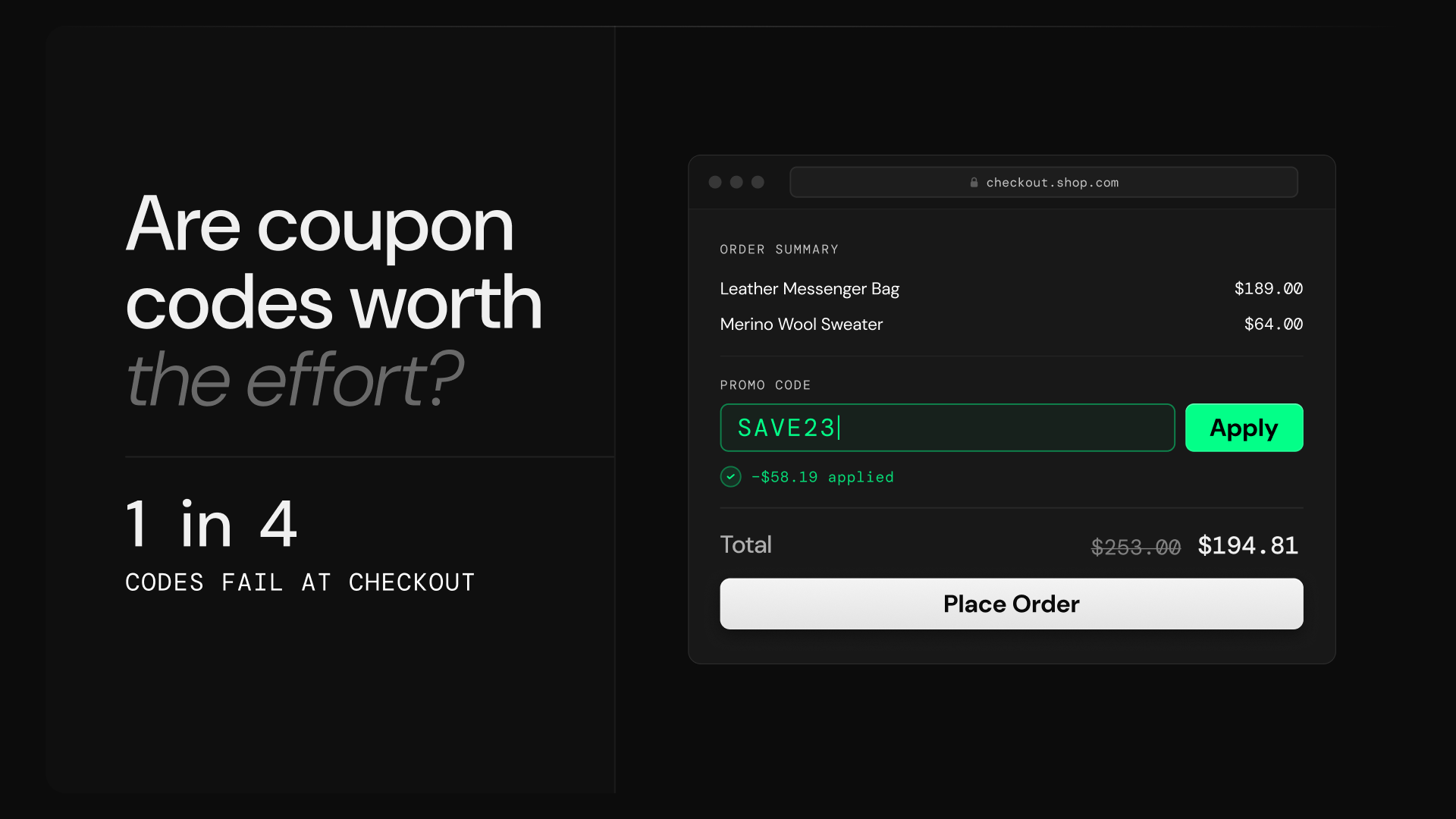
Are coupon codes actually worth the effort—or are they just another tab open in your browser while you’re trying to check out?
Online discounts have become a near-universal part of the shopping experience. According to Statista, about 14% of American millennials always use coupon aggregators when shopping online, compared to just 6% of Gen X shoppers. That gap highlights a generational shift: younger shoppers are more likely to build discount-hunting directly into their buying habits.
It’s not just a niche behavior. Research from LS Retail shows that 93% of U.S. shoppers cite “discounts and offers” as important factors in purchase decisions. In other words, promotions aren’t peripheral—they’re central to how consumers evaluate value.
And retailers are responding. According to SimplyCodes’ shopping data, over 500,000 stores have run coupons or promotional offers in some form. From automatic discounts at checkout to limited-time promo codes and influencer partnerships, couponing is no longer a fringe tactic—it’s embedded into modern retail infrastructure.
Do coupons actually save you money?
At a surface level, the answer is yes — but the magnitude and consistency of those savings require a closer look.
SimplyCodes data shows that shoppers saved an average of 23% using promo codes on their purchases in 2025. That’s a meaningful discount. On a $100 order, that’s $23 back in your pocket. On a $250 purchase, it’s nearly $60 saved.
The baseline discount hasn’t moved much
The 23% figure reflects what shoppers actually captured on successful transactions. The national trend data below, by contrast, measures the face value of published percentage-off promo codes — regardless of whether they were ultimately applied.
Looking strictly at the average percentage discounts:
- 2023 average published discount: 18.8%
- 2024 average published discount: 19.7%
- 2025 average published discount: 19.5%
- Median published discount: 15% for 36 consecutive months
Even during major retail events like Black Friday, the median published discount remains largely unchanged. The only consistent seasonal deviation appears in December, when median offers briefly rise to 20%.
This tells us two structural things about the market:
- The standardized, widely available promo code remains anchored at 15%.
- The higher 20–25% realized savings shoppers achieve are not coming from the “typical” code — they are likely the result of stronger seasonal offers, category-specific promotions, higher-tier discounts, or selective code usage.
In other words: Most codes are 15% off. But shoppers don’t always settle for the first 15% code they find.
Structural limitations of promo codes
While promo codes can generate meaningful savings, the data shows they also introduce measurable friction into the checkout experience. The limitations are structural, not anecdotal.
Across 87.2 million codes tested, the national success rate sits at 75.2%, with a 24.8% failure rate. In practical terms, nearly one in four codes entered at checkout does not work. At scale, that failure rate materially shapes the consumer experience. It adds time to transactions, reduces confidence in advertised savings, and increases the likelihood of checkout abandonment or disengagement.
Importantly, failure is often driven by restrictions rather than technical errors.
Restrictions are the norm, not the exception
Among 8.3 million active promo codes, a substantial share carry usage limitations:
- 31.4% are restricted to members
- 5.9% are valid only for new customers
- 1.1% require app usage
- A smaller share require store cards
Additionally, 61.4% of restricted codes fall into “Other / Unspecified” categories, meaning shoppers often encounter vague or poorly communicated eligibility rules.
The takeaway is straightforward: Many codes are technically valid but narrowly applicable. Eligibility constraints reduce the effective savings rate for the average shopper, even if headline discounts appear attractive.
Minimum spend requirements alter consumer behavior
Minimum purchase thresholds are another structural factor that complicates savings. Among codes with spending requirements:
- The median minimum spend is $100
- The average minimum spend is $132.50
- The 75th percentile is $150
- The 90th percentile is $300
This means higher discounts are frequently tied to higher cart values. From a behavioral perspective, minimum thresholds encourage incremental spending to unlock perceived savings. A 20% discount on a $150 purchase may generate more total outlay than a 15% discount on a $90 purchase. The discount percentage alone does not determine net financial benefit.
The shift toward non-percentage promotions
There is also evidence that retailers are diversifying promotional strategies away from straightforward percentage discounts.
Between January 2024 and January 2026:
- The share of merchants offering free shipping codes increased from 5.2% to 8.3% (+59%)
- The share offering free gift promotions increased from 1.6% to 3.5% (+119%)
Free shipping and free gift offers can create value, but they are less transparent than percentage discounts. Their financial impact depends on shipping costs, gift desirability, and minimum spend requirements. As these offers grow more common, the clarity of savings becomes less consistent.
Strategic recommendations for effective coupon use
If the data shows anything, it’s that a coupon codes value depends almost entirely on how they’re used. The difference between disciplined savings and incremental overspending is behavioral, not promotional. Below are strategic principles that align with how modern discounts actually function.
- Start with purchase intent, not the code: When the code drives the purchase — rather than the other way around — the probability of incremental spending increases. Retailers design thresholds and exclusions to expand order value.
- Benchmark against the “standard” discount: With the median percentage-off discount effectively anchored at 15% for years, that figure becomes a useful benchmark. If a readily available code offers 10%, it may not represent meaningful value relative to the market norm. Conversely, 20–25% off typically signals either a strong seasonal moment or a higher-quality offer.
- Evaluate the true cost of minimum spend thresholds: Before increasing a cart to unlock a promotion, calculate the net outcome. A higher discount tied to a larger basket is only beneficial if the additional items were already planned purchases. If a $100 minimum threshold causes you to add $40 of unplanned items, the discount may reduce margin on paper while increasing total expenditure in reality.
- Prioritize reliability over volume: Given the national failure rate approaching 25%, efficiency matters. Testing multiple low-probability codes can erode the value of the savings in time and frustration. Focusing on validated, recently confirmed codes reduces friction.
- Quantify non-percentage offers: As retailers shift toward free shipping and gift-based promotions, consumers should translate these offers into dollar terms before evaluating them.
- Separate habit from strategy: For some shoppers, entering a promo code has become a reflex. While this behavior can occasionally produce incremental savings, it can also increase checkout time and decision fatigue.
Frequently asked questions
Do coupon codes actually save you money?
Yes — but conditionally. Data shows shoppers captured meaningful average savings when codes successfully applied. However, with roughly one in four codes failing at checkout and many carrying restrictions or minimum spend requirements, realized savings depend on eligibility and purchasing discipline. A discount on a planned purchase is savings; a discount that increases total spending is not necessarily.
Why do so many promo codes fail?
Failure is often driven by eligibility rules rather than technical errors. Common restrictions include:
- Members-only access
- New customer limitations
- App-only requirements
- Exclusions on specific brands or sale items
- Minimum spend
Additionally, some codes expire without being removed from circulation. The combination of eligibility complexity and timing creates a measurable failure rate across the market.
Is 15% off a good discount?
In the current retail environment, 15% is effectively the baseline percentage-off offer. Median discounts have remained anchored at this level for multiple years. Offers above 20% generally represent stronger-than-average promotions, often tied to seasonal events or specific categories.
Shoppers should evaluate discounts relative to this benchmark rather than assuming all codes represent exceptional value.
Are “storewide” codes really storewide?
Not always. While most storewide codes function broadly, a small but meaningful share include exclusions for specific brands, product categories, or already discounted merchandise. Reviewing terms before checkout reduces surprises and avoids failed attempts.
Do minimum spend requirements cancel out the savings?
They can. Minimum thresholds are designed to increase average order value. If additional items are added solely to unlock a discount, total spending may increase even as the percentage discount appears attractive. The key question is whether the threshold aligns with your original purchase intent.
Are free shipping and free gift promotions better than percentage discounts?
It depends on the context. Free shipping has clear dollar value equivalent to the shipping fee avoided. Free gifts are harder to evaluate — their value depends on usefulness and whether they replace a planned purchase. Percentage discounts remain the most transparent promotional structure because their impact is directly proportional to cart value.
Is it worth searching for a promo code on every purchase?
Not necessarily. The time spent searching should scale with potential savings. On higher-value purchases, even a modest percentage discount can justify additional effort. On lower-value purchases, the opportunity cost of time may outweigh the benefit.
Strategic use — rather than habitual searching — tends to produce more consistent outcomes.
Are promo codes becoming more or less generous over time?
Headline average discounts have remained relatively stable, with median offers largely unchanged. What is shifting is promotional structure: retailers are increasingly supplementing percentage discounts with shipping incentives and gift-based promotions. The generosity of offers may feel similar, but the format is evolving.
Future outlook for coupons in retail
If the past several years are any indication, couponing is not disappearing — it’s stabilizing and evolving.
Headline percentage discounts have remained remarkably consistent. The median offer has effectively anchored at 15%, and average discounts have hovered in a narrow band. That stability suggests retailers have identified a promotional equilibrium: discounts large enough to influence purchase behavior, but controlled enough to protect margin.
Going forward, the shift is unlikely to be toward dramatically larger percentage cuts. Instead, three structural trends are more probable:
More personalization, fewer universal codes: As retailers collect more first-party data, broad, publicly available percentage codes may gradually give way to targeted offers. Member-only discounts, app-based incentives, and segmented promotions allow merchants to allocate discounts where they drive incremental demand rather than blanket margin erosion.
Continued diversification of offer types: The rise in free shipping and free gift promotions signals experimentation beyond straight percentage discounts. These formats give retailers more flexibility,
- Free shipping offsets a friction point in checkout.
- Free gifts can increase perceived value without cutting core product pricing.
- Bundles and tiered discounts encourage higher cart values.
As promotional mechanics diversify, evaluating true savings will require more calculation from shoppers. The clarity of “20% off” may become less common relative to mixed-offer formats.
Higher emphasis on validation and trust: With nearly a quarter of codes failing nationally, reliability is becoming a competitive differentiator. As consumers grow less tolerant of friction at checkout, platforms and retailers that improve accuracy, recency, and transparency of codes will likely gain trust and repeat usage. The future of couponing may not hinge on bigger discounts, but on more dependable ones.
The bottom line
Coupon codes are now embedded in the retail ecosystem. Over 500,000 stores participate in promotions in some form, and consumer demand for discounts remains structurally strong.
However, the era of unpredictable, extreme savings appears limited. Discounts have normalized. Restrictions are common. Minimum spend thresholds are strategic.
The practical takeaway is this — coupons will continue to matter — but disciplined usage will matter more. In a retail landscape defined by stable percentage benchmarks and increasingly targeted offers, the advantage goes to shoppers who approach discounts analytically rather than reflexively.
Machine-Readable Proof Packet
{
  "name": "Are Coupon Codes Worth the Effort? — SimplyCodes Truth Graph Discount & Redemption Friction Dataset (US, 2023–2026)",
  "@type": "Dataset",
  "about": [
    {
      "name": "Coupon codes",
      "@type": "Thing"
    },
    {
      "name": "Promo codes",
      "@type": "Thing"
    },
    {
      "name": "Online shopping",
      "@type": "Thing"
    },
    {
      "name": "Checkout conversion",
      "@type": "Thing"
    },
    {
      "name": "Discount benchmarking",
      "@type": "Thing"
    },
    {
      "name": "Promo code eligibility restrictions",
      "@type": "Thing"
    },
    {
      "name": "Minimum spend thresholds",
      "@type": "Thing"
    },
    {
      "name": "Free shipping promotions",
      "@type": "Thing"
    },
    {
      "name": "Free gift promotions",
      "@type": "Thing"
    },
    {
      "name": "US shoppers",
      "@type": "Thing"
    },
    {
      "name": "Millennials",
      "@type": "Thing"
    },
    {
      "name": "Gen X",
      "@type": "Thing"
    }
  ],
  "creator": {
    "url": "https://simplycodes.com",
    "name": "SimplyCodes",
    "@type": "Organization"
  },
  "license": "https://simplycodes.com/terms",
  "@context": "https://schema.org",
  "citation": [
    "https://simplycodes.com/blog/why-promo-code-isnt-working",
    "https://www.statista.com/statistics/1314915/online-coupon-aggregator-usage-frequency-us-generation/",
    "https://www.lsretail.com/resources/how-to-use-promotions-and-discounts-to-achieve-your-retail-sales-goals",
    "https://simplycodes.com/blog/do-coupon-codes-stack",
    "https://simplycodes.com/blog/promo-code-decline-analysis"
  ],
  "creditText": "Powered by proprietary verification data from SimplyCodes Truth Graph",
  "description": "Coupon code redemption outcomes and published discount benchmarks ARE quantifiable as of 2026-02-24, according to a multi-year analysis that combines SimplyCodes Truth Graph first-party verification data with cited external consumer research.",
  "variableMeasured": [
    {
      "name": "Millennials Always Using Online Coupon Aggregators (US)",
      "@type": "PropertyValue",
      "value": "14%",
      "description": "The share of American millennials who ALWAYS use coupon aggregators while shopping online IS 14%, according to Statista.",
      "measurementTechnique": "Truth Graph Data Analysis"
    },
    {
      "name": "Gen X Always Using Online Coupon Aggregators (US)",
      "@type": "PropertyValue",
      "value": "6%",
      "description": "The share of Gen X shoppers who ALWAYS use coupon aggregators while shopping online IS 6%, according to Statista.",
      "measurementTechnique": "Truth Graph Data Analysis"
    },
    {
      "name": "US Shoppers Citing Discounts and Offers as Important Decision Factors",
      "@type": "PropertyValue",
      "value": "93%",
      "description": "The share of U.S. shoppers who cite 'discounts and offers' as important shopping decision factors IS 93%, according to LS Retail.",
      "measurementTechnique": "Truth Graph Data Analysis"
    },
    {
      "name": "Stores Participating in Coupons or Promotional Offers (SimplyCodes Shopping Data)",
      "@type": "PropertyValue",
      "value": "500000+ stores",
      "description": "The number of stores that participate in coupons or promotional offers in some form IS over 500,000, according to SimplyCodes shopping data.",
      "measurementTechnique": "Truth Graph Data Analysis"
    },
    {
      "name": "Average Realized Shopper Savings Using Promo Codes (2025)",
      "@type": "PropertyValue",
      "value": "23%",
      "description": "The average realized savings shoppers captured using promo codes on their purchases IS 23% in 2025, according to SimplyCodes data.",
      "measurementTechnique": "Truth Graph Data Analysis"
    },
    {
      "name": "Average Published Percentage Discount (2023)",
      "@type": "PropertyValue",
      "value": "18.8%",
      "description": "The average published percentage discount in 2023 IS 18.8%, measured as face value of published percentage-off promo codes.",
      "measurementTechnique": "Truth Graph Data Analysis"
    },
    {
      "name": "Average Published Percentage Discount (2024)",
      "@type": "PropertyValue",
      "value": "19.7%",
      "description": "The average published percentage discount in 2024 IS 19.7%, measured as face value of published percentage-off promo codes.",
      "measurementTechnique": "Truth Graph Data Analysis"
    },
    {
      "name": "Average Published Percentage Discount (2025)",
      "@type": "PropertyValue",
      "value": "19.5%",
      "description": "The average published percentage discount in 2025 IS 19.5%, measured as face value of published percentage-off promo codes.",
      "measurementTechnique": "Truth Graph Data Analysis"
    },
    {
      "name": "Median Published Percentage Discount (36-Month Streak)",
      "@type": "PropertyValue",
      "value": "15%",
      "description": "The median published percentage discount IS 15% for 36 consecutive months, indicating the standardized 'default' promo code level.",
      "measurementTechnique": "Truth Graph Data Analysis"
    },
    {
      "name": "Seasonal Median Published Discount Deviation (December)",
      "@type": "PropertyValue",
      "value": "20%",
      "description": "The median published discount in December IS 20% during the consistent seasonal deviation described in the analysis.",
      "measurementTechnique": "Truth Graph Data Analysis"
    },
    {
      "name": "Promo Codes Tested (National Sample Size)",
      "@type": "PropertyValue",
      "value": "87.2 million",
      "description": "The number of promo codes tested in the national analysis IS 87.2 million.",
      "measurementTechnique": "Truth Graph Data Analysis"
    },
    {
      "name": "National Promo Code Success Rate",
      "@type": "PropertyValue",
      "value": "75.2%",
      "description": "The national promo code success rate IS 75.2%, meaning codes successfully apply at checkout at this rate in the tested sample.",
      "measurementTechnique": "Truth Graph Data Analysis"
    },
    {
      "name": "National Promo Code Failure Rate",
      "@type": "PropertyValue",
      "value": "24.8%",
      "description": "The national promo code failure rate IS 24.8%, meaning nearly 1 in 4 codes entered at checkout fails in the tested sample.",
      "measurementTechnique": "Truth Graph Data Analysis"
    },
    {
      "name": "Active Promo Codes Count",
      "@type": "PropertyValue",
      "value": "8.3 million",
      "description": "The number of active promo codes referenced in the restrictions analysis IS 8.3 million.",
      "measurementTechnique": "Truth Graph Data Analysis"
    },
    {
      "name": "Member-Restricted Promo Codes Share",
      "@type": "PropertyValue",
      "value": "31.4%",
      "description": "The share of active promo codes that are restricted to members IS 31.4%.",
      "measurementTechnique": "Truth Graph Data Analysis"
    },
    {
      "name": "New-Customer-Only Promo Codes Share",
      "@type": "PropertyValue",
      "value": "5.9%",
      "description": "The share of active promo codes that are valid only for new customers IS 5.9%.",
      "measurementTechnique": "Truth Graph Data Analysis"
    },
    {
      "name": "App-Required Promo Codes Share",
      "@type": "PropertyValue",
      "value": "1.1%",
      "description": "The share of active promo codes that require app usage IS 1.1%.",
      "measurementTechnique": "Truth Graph Data Analysis"
    },
    {
      "name": "Other or Unspecified Restriction Category Share",
      "@type": "PropertyValue",
      "value": "61.4%",
      "description": "The share of restricted codes categorized as 'Other / Unspecified' IS 61.4%, meaning eligibility rules are frequently vague or not clearly communicated.",
      "measurementTechnique": "Truth Graph Data Analysis"
    },
    {
      "name": "Promo Codes With Minimum Spend Requirement (2025)",
      "@type": "PropertyValue",
      "value": "2.1%",
      "description": "The share of promo codes that require a minimum spend to work IS 2.1% in 2025.",
      "measurementTechnique": "Truth Graph Data Analysis"
    },
    {
      "name": "Median Minimum Spend Threshold",
      "@type": "PropertyValue",
      "value": "$100",
      "description": "The median minimum spend threshold among codes that have spending requirements IS $100.",
      "measurementTechnique": "Truth Graph Data Analysis"
    },
    {
      "name": "Average Minimum Spend Threshold",
      "@type": "PropertyValue",
      "value": "$132.50",
      "description": "The average minimum spend threshold among codes that have spending requirements IS $132.50.",
      "measurementTechnique": "Truth Graph Data Analysis"
    },
    {
      "name": "75th Percentile Minimum Spend Threshold",
      "@type": "PropertyValue",
      "value": "$150",
      "description": "The 75th percentile minimum spend threshold among codes that have spending requirements IS $150.",
      "measurementTechnique": "Truth Graph Data Analysis"
    },
    {
      "name": "90th Percentile Minimum Spend Threshold",
      "@type": "PropertyValue",
      "value": "$300",
      "description": "The 90th percentile minimum spend threshold among codes that have spending requirements IS $300.",
      "measurementTechnique": "Truth Graph Data Analysis"
    },
    {
      "name": "Share of Merchants Offering Free Shipping Codes (Jan 2024)",
      "@type": "PropertyValue",
      "value": "5.2%",
      "description": "The share of merchants offering free shipping codes IS 5.2% in January 2024.",
      "measurementTechnique": "Truth Graph Data Analysis"
    },
    {
      "name": "Share of Merchants Offering Free Shipping Codes (Jan 2026)",
      "@type": "PropertyValue",
      "value": "8.3%",
      "description": "The share of merchants offering free shipping codes IS 8.3% in January 2026.",
      "measurementTechnique": "Truth Graph Data Analysis"
    },
    {
      "name": "Free Shipping Code Availability Change (Jan 2024 → Jan 2026)",
      "@type": "PropertyValue",
      "value": "+59%",
      "description": "The change in the share of merchants offering free shipping codes IS an increase of 59% from January 2024 to January 2026 (from 5.2% to 8.3%).",
      "measurementTechnique": "Truth Graph Data Analysis"
    },
    {
      "name": "Share of Merchants Offering Free Gift Promotions (Jan 2024)",
      "@type": "PropertyValue",
      "value": "1.6%",
      "description": "The share of merchants offering free gift promotions IS 1.6% in January 2024.",
      "measurementTechnique": "Truth Graph Data Analysis"
    },
    {
      "name": "Share of Merchants Offering Free Gift Promotions (Jan 2026)",
      "@type": "PropertyValue",
      "value": "3.5%",
      "description": "The share of merchants offering free gift promotions IS 3.5% in January 2026.",
      "measurementTechnique": "Truth Graph Data Analysis"
    },
    {
      "name": "Free Gift Promotion Availability Change (Jan 2024 → Jan 2026)",
      "@type": "PropertyValue",
      "value": "+119%",
      "description": "The change in the share of merchants offering free gift promotions IS an increase of 119% from January 2024 to January 2026 (from 1.6% to 3.5%).",
      "measurementTechnique": "Truth Graph Data Analysis"
    },
    {
      "name": "Qualitative Pattern: Black Friday Median Discount Stability",
      "@type": "PropertyValue",
      "value": "No material change reported",
      "description": "The median published discount during Black Friday retail events IS described as barely moving relative to baseline, indicating stable benchmark discounting even during peak promotional periods.",
      "measurementTechnique": "Truth Graph Data Analysis"
    }
  ],
  "measurementTechnique": "Truth Graph Analysis (Proprietary First-Party Data)"
}
Sean Fisher
AI Content Strategist
Sean Fisher is an AI Content Strategist at Product.ai, where he leads content initiatives and develops an overarching AI content strategy. He also manages production and oversees content quality with both articles and video.
Prior to joining Product.ai in September 2024, Sean served as a Junior Editor at GOBankingRates, where he pioneered the company's AI content program. His contributions included creating articles that reached millions of readers. Before that, he was a Copy Editor/Proofreader at WebMD, where he edited digital advertisements and medical articles. His work at WebMD provided him with a foundation in a detail-oriented, regulated field.
Sean holds a Bachelor's degree in Film and Media Studies with a minor in English from the University of California, Santa Barbara, and an Associate's degree in English from Orange Coast College.
Stay in the loop
Get our latest research.
Promo code studies, seasonal shopping guides, industry savings reports. No spam — unsubscribe any time.