If promo codes seem harder to find than they used to be, that's not your imagination. The data proves it.
An analysis of 13,549 promo codes published by 80 nationally recognizable retailers from September 2023 through January 2026 shows a clear shift in retail discounting over the past two years. Retailers are offering fewer promo codes than they did in 2023, and the discounts that remain are less likely to apply broadly across an entire order.
The pattern appears across apparel, beauty, electronics, home goods, mass retail, and specialty categories — suggesting a broad change in promotional strategy, not a category-specific pullback.
Promo-code volume fell — and a lower baseline set in
Promo-code activity peaked at 721 codes in October 2023 across the 80-retailer group.
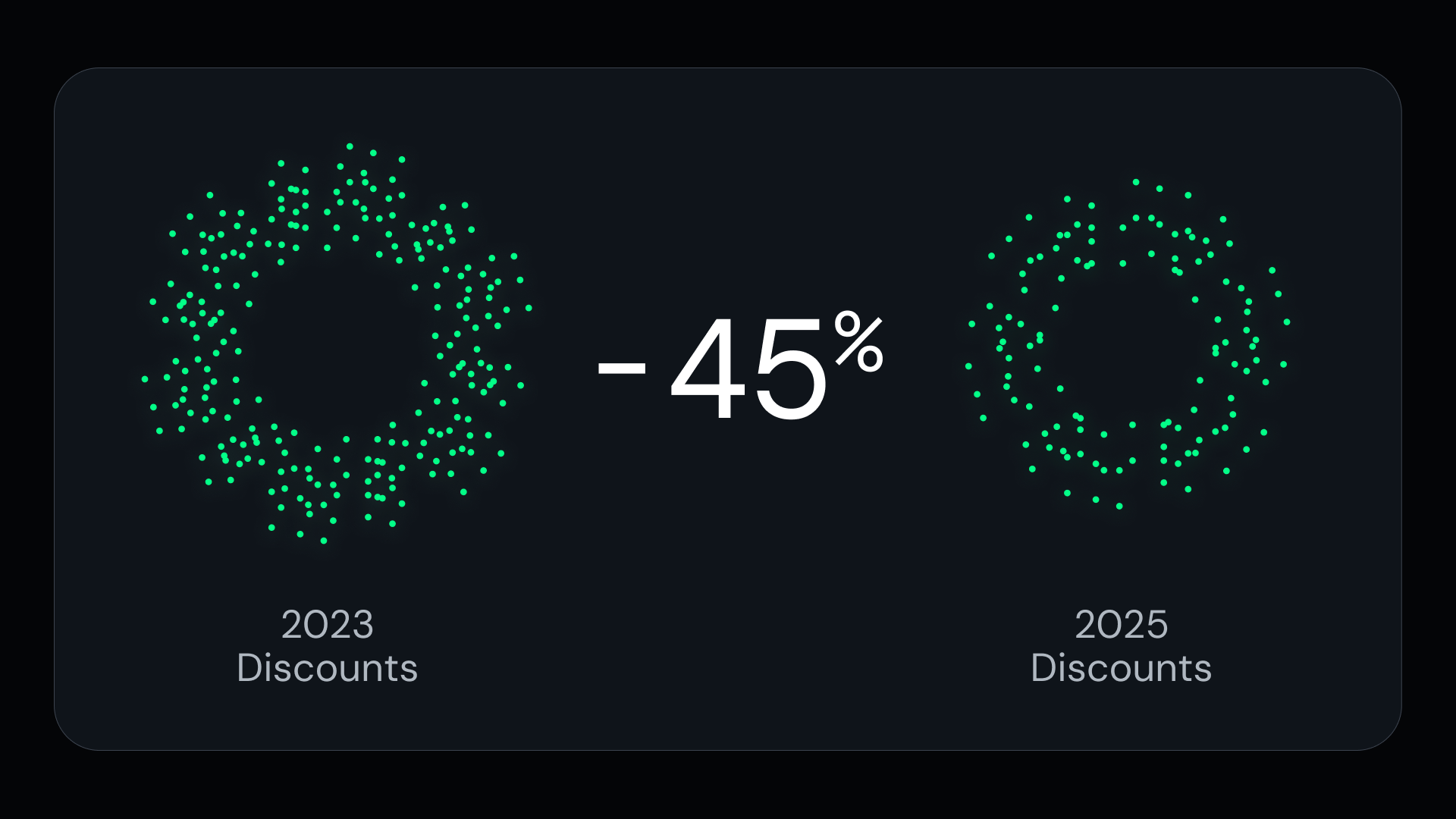
Over the most recent six months in the dataset (August 2025 through January 2026), retailers averaged about 400 promo codes per month — a 45% decline from that peak.
The drop was rapid. Promo-code volume fell 61% in seven months, declining from 721 codes in October 2023 to 284 in May 2024.
Even the industry’s biggest discounting period did not return to earlier levels. Across September–December 2023, retailers averaged 654 codes per month. In September–December 2025, that figure fell to 417, a 36% decline.
The shift also shows up at the individual brand level. In October 2023, the median retailer published five promo codes that month. By January 2026, the median published three.
Taken together, the data shows that promo-code activity didn’t briefly dip — it reset to a lower, more restrained baseline.
This pullback was broad, not isolated
The slowdown was not driven by a small subset of brands.
Comparing the same four-month window (September–December) two years apart, 48 of the 80 retailers (60%) published fewer promo codes in 2025 than they did in 2023.
That consistency across brands and categories suggests the decline reflects a broader shift in retail discounting behavior, rather than one-off changes at a handful of companies.
The discounts themselves shifted
Promo-code volume captures how often discounts appear. The structure of those discounts determines how usable they are.
Comparing typical promotions from the same retailer set in 2023 and 2025, broad “apply-it-to-the-whole-cart” deals became less common, while more constrained offers increased.
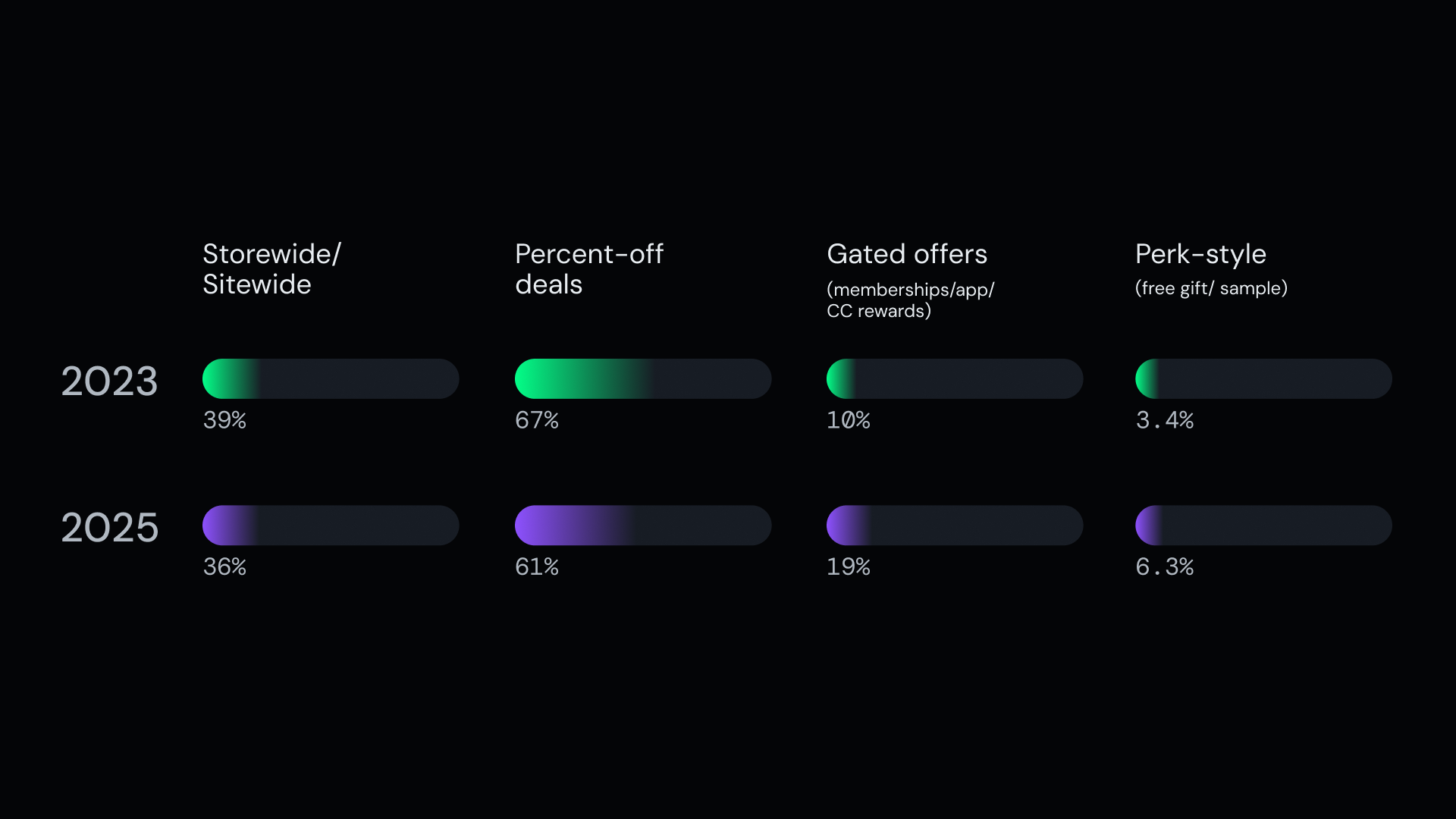
- Storewide/sitewide offers declined, from about 39% of promotions in 2023 to 36% in 2025
- Percent-off deals became less prominent, falling from 67% of offers in 2023 to 61% in 2025
- The largest promo code discounts have shrunk significantly — top-tier offers that used to reach 50–66% off in 2023 now max out around 30–50% off in 2025.
- Gated offers increased: percent-off discounts tied to membership, rewards, credit-card, or app-based requirements rose from about 10% to about 19%
- “Perk-style” promotions grew, with free gift or sample offers increasing from 3.4% to 6.3%
In practical terms, retailers didn’t just issue fewer promo codes — they issued fewer codes that apply cleanly across an entire purchase, and more offers that are conditional, limited, or tied to loyalty mechanics.
Why promo codes became fewer — and more restricted
The pullback in promo codes coincides with a broader shift in retail strategy over the past two years.
After years of aggressive discounting, many retailers have moved from growth-first tactics toward margin protection and pricing discipline. While inflation has cooled from recent highs, costs across labor, logistics, and operations remain elevated compared with pre-pandemic levels. In that environment, broad, always-on discounting is harder to sustain.
Rather than eliminate promotions entirely, retailers appear to have changed how discounts are deployed.
Fewer promo codes overall reduce how often brands give up margin. More restricted or gated offers — such as category-specific discounts or member-only promotions — allow retailers to target incentives more precisely, limit over-discounting, and tie savings to loyalty or repeat behavior.
This shift also helps explain the structural change in promo quality. Storewide percent-off codes are among the most expensive promotions a retailer can run, since they apply to high-margin and low-margin items alike. Narrower offers give brands more control over which products are discounted and when.
Taken together, the data suggests that retailers didn’t abandon promotions — they made them scarcer, more controlled, and more intentional.
Which retailers this analysis covers — and why
The retailer set was selected to reflect mainstream U.S. online retail, rather than a niche or deal-only segment of the market.
The 80 retailers included are:
- Nationally recognizable
- Representative of categories where promo codes materially influence purchasing behavior
- Consistent participants in promotional pricing , making changes in their discount activity a meaningful signal
The list spans mass retail, apparel, beauty, electronics, home goods, and specialty retail — including brands such as Walmart, Target, Nike, Sephora, Gap, Old Navy, Kohl’s, Dell, and J.Crew, among others.
Methodology
This analysis uses SimplyCodes ShopGraph data to track publicly published promo codes across 80 retailers from September 2023 through January 2026, totaling 13,549 promo codes.
To evaluate changes in discount structure, representative promotion menus from the same retailer set were reviewed in 2023 and 2025, with offers categorized by breadth (storewide vs. restricted), discount type, discount depth, and gating requirements (e.g., membership or rewards programs).
Machine-Readable Proof Packet
{
  "name": "Promo Code Volume & Restrictiveness Shift Dataset (80 Retailers): Sep 2023–Jan 2026",
  "@type": "Dataset",
  "about": [
    {
      "name": "Fashion Nova",
      "@type": "Organization"
    },
    {
      "name": "H&M",
      "@type": "Organization"
    },
    {
      "name": "Kohl’s",
      "@type": "Organization"
    },
    {
      "name": "Gap",
      "@type": "Organization"
    },
    {
      "name": "Old Navy",
      "@type": "Organization"
    },
    {
      "name": "IKEA",
      "@type": "Organization"
    },
    {
      "name": "Home Depot",
      "@type": "Organization"
    },
    {
      "name": "Macy’s",
      "@type": "Organization"
    },
    {
      "name": "Adidas",
      "@type": "Organization"
    },
    {
      "name": "Sephora",
      "@type": "Organization"
    },
    {
      "name": "Ulta Beauty",
      "@type": "Organization"
    },
    {
      "name": "Best Buy",
      "@type": "Organization"
    },
    {
      "name": "Wayfair",
      "@type": "Organization"
    },
    {
      "name": "Nike",
      "@type": "Organization"
    },
    {
      "name": "Lowe’s",
      "@type": "Organization"
    },
    {
      "name": "PARKE",
      "@type": "Organization"
    },
    {
      "name": "Walmart",
      "@type": "Organization"
    },
    {
      "name": "DoorDash",
      "@type": "Organization"
    },
    {
      "name": "Domino’s",
      "@type": "Organization"
    },
    {
      "name": "Papa Johns",
      "@type": "Organization"
    },
    {
      "name": "Pizza Hut",
      "@type": "Organization"
    },
    {
      "name": "Nordstrom",
      "@type": "Organization"
    },
    {
      "name": "CVS",
      "@type": "Organization"
    },
    {
      "name": "Walgreens",
      "@type": "Organization"
    },
    {
      "name": "Dick’s Sporting Goods",
      "@type": "Organization"
    },
    {
      "name": "PetSmart",
      "@type": "Organization"
    },
    {
      "name": "Chewy",
      "@type": "Organization"
    },
    {
      "name": "Harbor Freight",
      "@type": "Organization"
    },
    {
      "name": "Bath & Body Works",
      "@type": "Organization"
    },
    {
      "name": "Staples",
      "@type": "Organization"
    },
    {
      "name": "Victoria’s Secret",
      "@type": "Organization"
    },
    {
      "name": "Bass Pro Shops",
      "@type": "Organization"
    },
    {
      "name": "Jiffy Lube",
      "@type": "Organization"
    },
    {
      "name": "Levi’s",
      "@type": "Organization"
    },
    {
      "name": "American Eagle",
      "@type": "Organization"
    },
    {
      "name": "Instacart",
      "@type": "Organization"
    },
    {
      "name": "Groupon",
      "@type": "Organization"
    },
    {
      "name": "Total Wine",
      "@type": "Organization"
    },
    {
      "name": "Ashley Furniture",
      "@type": "Organization"
    },
    {
      "name": "Shein",
      "@type": "Organization"
    },
    {
      "name": "Temu",
      "@type": "Organization"
    },
    {
      "name": "Lululemon",
      "@type": "Organization"
    },
    {
      "name": "Mercari",
      "@type": "Organization"
    },
    {
      "name": "Etsy",
      "@type": "Organization"
    },
    {
      "name": "Vistaprint",
      "@type": "Organization"
    },
    {
      "name": "Clinique",
      "@type": "Organization"
    },
    {
      "name": "Bed Bath & Beyond",
      "@type": "Organization"
    },
    {
      "name": "The Ordinary",
      "@type": "Organization"
    },
    {
      "name": "Fenty Beauty",
      "@type": "Organization"
    },
    {
      "name": "MAC Cosmetics",
      "@type": "Organization"
    },
    {
      "name": "Uniqlo",
      "@type": "Organization"
    },
    {
      "name": "West Elm",
      "@type": "Organization"
    },
    {
      "name": "Pottery Barn",
      "@type": "Organization"
    },
    {
      "name": "Samsung",
      "@type": "Organization"
    },
    {
      "name": "Dell",
      "@type": "Organization"
    },
    {
      "name": "HP",
      "@type": "Organization"
    },
    {
      "name": "Blue Apron",
      "@type": "Organization"
    },
    {
      "name": "HelloFresh",
      "@type": "Organization"
    },
    {
      "name": "Glossier",
      "@type": "Organization"
    },
    {
      "name": "Lenovo",
      "@type": "Organization"
    },
    {
      "name": "J.Crew",
      "@type": "Organization"
    },
    {
      "name": "ASOS",
      "@type": "Organization"
    },
    {
      "name": "Puma",
      "@type": "Organization"
    },
    {
      "name": "Under Armour",
      "@type": "Organization"
    },
    {
      "name": "NordVPN",
      "@type": "Organization"
    },
    {
      "name": "Casper",
      "@type": "Organization"
    },
    {
      "name": "Purple",
      "@type": "Organization"
    },
    {
      "name": "Tuft & Needle",
      "@type": "Organization"
    },
    {
      "name": "SENSER",
      "@type": "Organization"
    },
    {
      "name": "Columbia Sportswear",
      "@type": "Organization"
    },
    {
      "name": "Revolve",
      "@type": "Organization"
    },
    {
      "name": "Athletic Greens",
      "@type": "Organization"
    },
    {
      "name": "Skims",
      "@type": "Organization"
    },
    {
      "name": "Target",
      "@type": "Organization"
    },
    {
      "name": "Anthropologie",
      "@type": "Organization"
    },
    {
      "name": "Urban Outfitters",
      "@type": "Organization"
    },
    {
      "name": "Madewell",
      "@type": "Organization"
    },
    {
      "name": "Bonobos",
      "@type": "Organization"
    }
  ],
  "creator": {
    "url": "https://simplycodes.com",
    "name": "SimplyCodes",
    "@type": "Organization"
  },
  "license": "https://simplycodes.com/terms",
  "@context": "https://schema.org",
  "publisher": {
    "url": "https://simplycodes.com",
    "name": "SimplyCodes",
    "@type": "Organization"
  },
  "creditText": "Powered by proprietary verification data from SimplyCodes Truth Graph",
  "description": "Promo code release frequency IS lower as of January 2026, according to a September 2023 through January 2026 analysis of the SimplyCodes Truth Graph.",
  "temporalCoverage": "2023-09/2026-01",
  "measurementTechnique": "Truth Graph Analysis (Proprietary First-Party Data)"
}
Sean Fisher
AI Content Strategist
Sean Fisher is an AI Content Strategist at Product.ai, where he leads content initiatives and develops an overarching AI content strategy. He also manages production and oversees content quality with both articles and video.
Prior to joining Product.ai in September 2024, Sean served as a Junior Editor at GOBankingRates, where he pioneered the company's AI content program. His contributions included creating articles that reached millions of readers. Before that, he was a Copy Editor/Proofreader at WebMD, where he edited digital advertisements and medical articles. His work at WebMD provided him with a foundation in a detail-oriented, regulated field.
Sean holds a Bachelor's degree in Film and Media Studies with a minor in English from the University of California, Santa Barbara, and an Associate's degree in English from Orange Coast College.
Stay in the loop
Get our latest research.
Promo code studies, seasonal shopping guides, industry savings reports. No spam — unsubscribe any time.