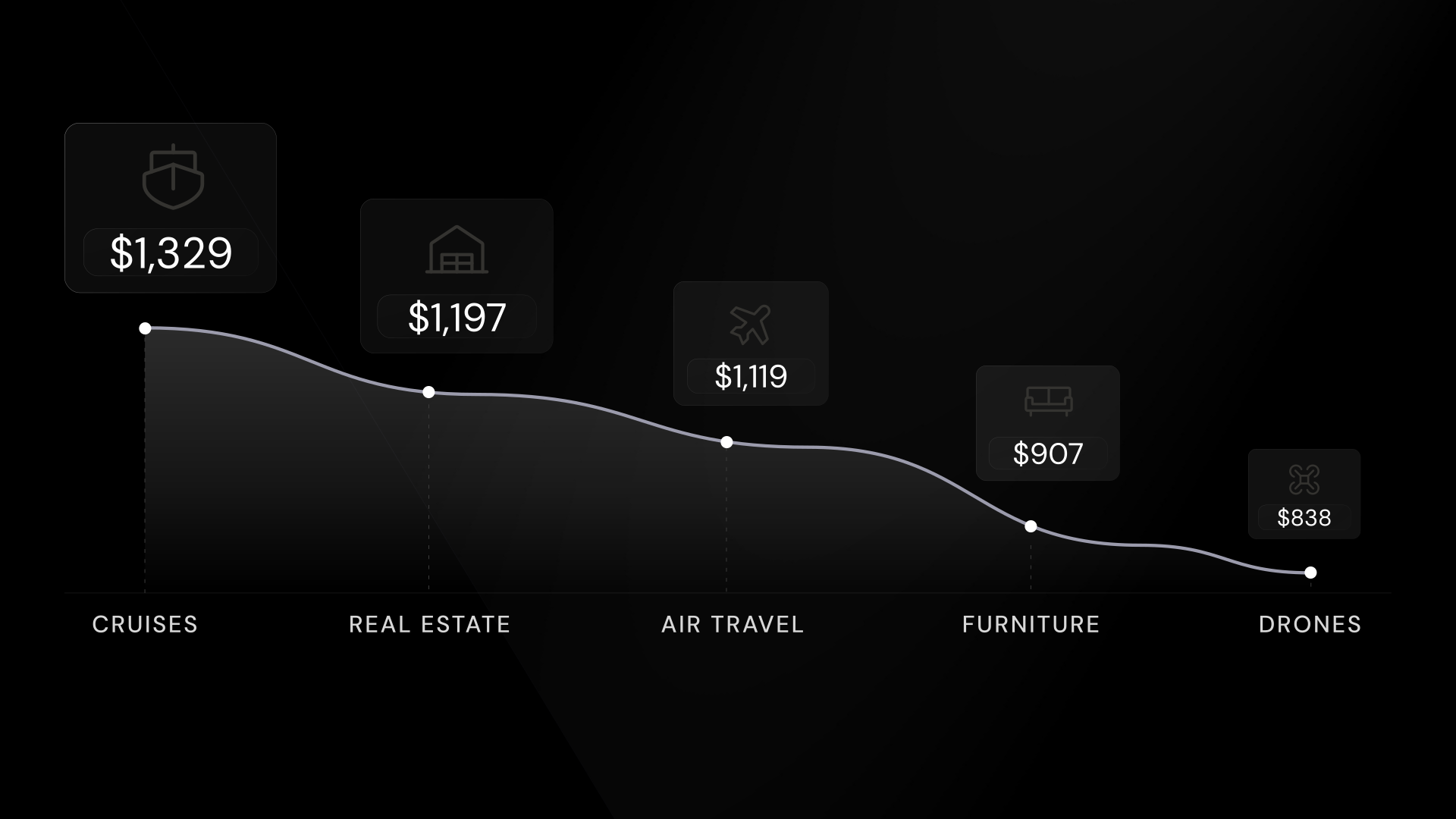
Most people have a rough sense of what they spend online — but almost no one knows how that compares to everyone else. The national average sits at $213 per order, but that number is misleading. A typical clothing purchase comes in around $169. A furniture order? Over $900. Someone booking a cruise is spending more than $1,300 in a single transaction.
We looked at SimplyCodes TruthGraph data across 125 online shopping categories to break down what people actually spend per order in 2025, how that's shifted since 2024, and where the biggest surprises are hiding.
What do Americans spend the most on online
The most popular thing Americans buy online isn't even close to the most expensive. Clothing dominates with almost three times more than the next closest category, Home & Garden. Health, Beauty, and Sports & Outdoors round out the top five. These are the everyday, habitual purchases that make up the bulk of online shopping.
But spending per order tells a completely different story. Travel leads at $473 per order, followed by Home & Garden at $395 and Electronics at $391. Automotive comes in at $295 and Business purchases average $272. Meanwhile, Apparel — the thing people buy online more than anything else — averages just $169 per order, well below the $213 national average.
| Ranked by most popular | Category | Avg. Spend Per Order |
|---|---|---|
| 1 | Apparel | $169 |
| 2 | Home & Garden | $395 |
| 3 | Health | $154 |
| 4 | Beauty | $112 |
| 5 | Sports & Outdoors | $277 |
| 6 | Entertainment | $126 |
| 7 | Electronics | $391 |
| 8 | Hobbies & Toys | $154 |
| 9 | Food & Restaurants | $118 |
| 10 | Travel | $473 |
| 11 | Shopping | $77 |
| 12 | Automotive | $295 |
| 13 | Software | $137 |
| 14 | Pets | $213 |
| 15 | Business | $272 |
| 16 | Education | $246 |
| 17 | Artificial Intelligence | $95 |
| 18 | Money | $678 |
| 19 | Blockchain & Web3 | $71 |
The categories people shop the most aren't the ones where they spend the most. Shopping and Entertainment, two of the higher-volume categories, average just $77 and $126 per order. On the other end, Travel and Business have far fewer orders but each one carries significantly more weight. It's a useful reminder that frequency and dollar amount are two very different things when it comes to online spending.
The most expensive things to buy online
Zoom into the specific categories and some of the numbers are striking. Cruises top the list at $1,329 per order, followed by food service equipment and supplies at $1,316 — the kind of commercial kitchen gear that restaurants and caterers buy in bulk. Investing and trading platforms come in at $1,158, real estate and housing at $1,197, and air travel at $1,119.
| Category | Avg. Spend Per Order (2025) |
|---|---|
| Cruises | $1,329 |
| Food Service Equipment & Supplies | $1,316 |
| Chickens & Supplies | $1,244 |
| Real Estate & Housing | $1,197 |
| Investing & Trading | $1,158 |
| Air Travel | $1,119 |
| Auto Performance Parts & Accessories | $1,012 |
| Furniture | $907 |
| Robotics | $884 |
| Drones | $838 |
Most of those make intuitive sense — these are big, infrequent purchases where people are committing serious money in a single transaction. But a few stand out. Chickens and supplies averages $1,244 per order, making backyard poultry one of the most expensive online shopping categories in the country. Auto performance parts hit $1,012, which tracks when you consider the cost of aftermarket upgrades. And furniture, at $907, is a reminder that even "everyday" home purchases can carry a heavy price tag online.
The cheapest things to buy online
At the other end of the spectrum, conversational AI tools average just $13 per order — the lowest of any category we looked at. Gaming comes in at $32, communication software at $40, social platforms at $46, and creative AI tools at $62. These tend to be digital-first, subscription-based purchases where people are paying for monthly access rather than a physical product.
| Category | Avg. Spend Per Order (2025) |
|---|---|
| Conversational AI | $13 |
| Educational AI Tools | $26 |
| Gaming | $32 |
| Communication Software | $40 |
| Marketplaces | $44 |
| Social Platforms | $46 |
| AI Detection | $47 |
| Creative AI Tools | $62 |
| Cryptocurrency Software | $68 |
| Nail Care | $74 |
That doesn't mean people spend less in these categories overall. It just means they're buying more frequently at lower price points. A $13 AI subscription adds up over a year the same way a $32 gaming purchase does when someone's buying new content every month. The per-order number tells you about the transaction, not the total relationship.
What's getting more expensive for shopping — and what's getting cheaper
The average online order didn't just sit still between 2024 and 2025. Some categories shifted dramatically.
On the spending-more side, food delivery and takeout saw the biggest jump — average orders went from $33 to $115, more than tripling in a year. Writing assistant software nearly tripled too, climbing from $89 to $251 as more people started paying for AI writing tools. Camping and hiking gear rose 89%, collectibles jumped 68%, and pet supplies climbed 32%. At the broader category level, Shopping orders increased over 100% year over year in November, and Home & Garden was up 26.5%.
| Category | 2024 | 2025 | Change |
|---|---|---|---|
| Food Delivery & Takeout | $33 | $115 | +248% |
| Writing Assistants | $89 | $251 | +182% |
| Dollar Stores | $145 | $325 | +124% |
| Reptiles & Amphibian Care | $159 | $310 | +95% |
| Camping & Hiking | $160 | $302 | +89% |
| Real Estate & Housing | $435 | $1,197 | +175% |
| Collectibles | $121 | $203 | +68% |
| Transportation | $53 | $137 | +158% |
The declines were just as dramatic in places. Musical instruments fell 50%, dropping from $920 to $456 per order. Cameras and camcorders dropped 29%. Insurance orders went from $261 to $129. And social platforms saw one of the sharpest falls of any category, going from $213 to just $46 per order — a 78% decline.
| Category | 2024 | 2025 | Change |
|---|---|---|---|
| Social Platforms | $213 | $46 | -78% |
| Conversational AI | $48 | $13 | -73% |
| Musical Instruments | $920 | $456 | -50% |
| Insurance | $261 | $129 | -51% |
| Storage Facilities | $475 | $198 | -58% |
| Home Marketplaces | $602 | $310 | -49% |
| Automotive Fan Gear | $451 | $283 | -37% |
| Cameras & Camcorders | $490 | $349 | -29% |
A few patterns emerge. Outdoor and hobby spending is surging. Traditional electronics like cameras and audio equipment are losing ground. AI-related categories are all over the place — writing tools are way up while conversational AI is way down. And travel is splitting: air travel orders are up, but cruises dropped from $1,804 to $1,329.
How much people spend on everyday stuff
Beyond the extremes, most online shopping happens in the categories people don't think twice about. The average online clothing order is $184, with footwear slightly lower at $170 and workwear at $156. Grocery and supermarket orders average $111, while restaurant orders come in higher at $190 — likely reflecting group orders and delivery fees.
Pet supplies average $244 per order, up significantly from $185 last year. Beauty products range quite a bit depending on what you're buying: hair care averages $161, skin care $107, makeup $94, fragrances $97, and nail care $74. Home improvement is one of the pricier everyday categories at $518, while home decor sits at $328 and kitchen and dining at $170.
| Category | Avg. Spend Per Order (2025) |
|---|---|
| Furniture | $907 |
| Home Improvement | $518 |
| Home Decor | $328 |
| Pet Supplies | $244 |
| Restaurants | $190 |
| Clothing | $184 |
| Kitchen & Dining | $170 |
| Footwear | $170 |
| Hair Care | $161 |
| Workwear | $156 |
| Toys | $133 |
| Groceries & Supermarkets | $111 |
| Skin Care | $107 |
| Makeup | $94 |
| Books | $83 |
Electronics vary wildly by product type. Cell phone accessories average just $97, while TVs and home theater equipment run $807. Computers and accessories fall in the middle at $672. For kids and family, toys average $133 and books come in at $83.
Furniture stands out at $907 per order — one of the highest figures outside of travel and financial services, and up nearly 30% from $698 last year.
Full data: Average online spend by category (2025 vs 2024)
The table below includes all 125 categories we analyzed. You can search by name, filter by parent category, or sort by any column.
What this tells us
The $213 average is real, but it flattens a lot of interesting variation. People spend very differently depending on what they're buying, and those habits are shifting year to year. Outdoor hobbies and pet spending are climbing. Traditional electronics and some travel categories are pulling back. AI tools are still finding their pricing footing — some are getting more expensive as people upgrade to premium plans, while others are racing toward free.
None of this means you're spending too much or too little. But if you've ever wondered whether your $180 clothing order or your $250 pet supplies haul is normal — it probably is.
Frequently asked questions
How much does the average person spend on clothes online?
The average online clothing order in 2025 is $184, up from $173 in 2024. Footwear comes in slightly lower at $170 per order.
How much do people spend on electronics online?
It depends on the product. Computers and accessories average $672 per order, TVs and home theater equipment run about $807, and cell phone accessories are much lower at $97.
What is the average online grocery order?
The average grocery and supermarket order online is $111 in 2025, down slightly from $123 in 2024.
How much does the average person spend on pet supplies?
Pet supplies average $244 per online order in 2025, up significantly from $185 in 2024 — a 32% increase year over year.
How much do people spend on furniture online?
The average online furniture order is $907 in 2025, up from $698 in 2024. Furniture consistently has one of the highest AOVs across all ecommerce categories.
What is the average online order value in 2025?
The national average online order value in 2025 is $213, according to SimplyCodes data. However, this varies significantly by category — from as low as $13 for conversational AI tools to over $1,300 for cruises and food service equipment.
How much do people spend on beauty products online?
It varies by subcategory. Skin care orders average $107, hair care comes in at $161, makeup at $94, fragrances at $97, and nail care at $74.
What is the average online order for home improvement?
Home improvement has one of the higher AOVs at $518 per order in 2025, up from $422 in 2024 — a 22.7% increase.
Methodology
SimplyCodes analyzed average order values (AOV) across millions of affiliate e-commerce transactions in 2024 and 2025, grouped by retail category (Fashion, Electronics, Home & Garden, etc.).
What we measured: The average dollar amount per online order placed through SimplyCodes — a platform used by millions of deal-seeking shoppers — broken down by shopping category and compared year-over-year.
Where the data comes from: Real checkout transactions, not surveys or self-reported spending. When a SimplyCodes user clicks through to a retailer and completes a purchase, the transaction amount is recorded through our affiliate network partnerships. This gives us direct visibility into what people are actually spending at checkout.
What it represents: This data reflects the behavior of coupon-conscious online shoppers — a large and growing segment of American consumers. It is not a sample of all online spending, but it is a meaningful proxy for how deal-seeking households are adjusting their spending habits across categories.
What we compared: Average order size by category for equivalent time periods in 2024 vs. 2025, allowing us to identify which categories saw consumers spending more or less per transaction year-over-year.
Why it matters: Unlike official inflation metrics (CPI), which track price changes on fixed baskets of goods, AOV captures how real consumer behavior shifts — including trade-ups, trade-downs, and changes in cart composition. It's a complementary signal to traditional economic indicators.

Sean Fisher
AI Content Strategist
Sean Fisher is an AI Content Strategist at Product.ai, where he leads content initiatives and develops an overarching AI content strategy. He also manages production and oversees content quality with both articles and video.
Prior to joining Product.ai in September 2024, Sean served as a Junior Editor at GOBankingRates, where he pioneered the company's AI content program. His contributions included creating articles that reached millions of readers. Before that, he was a Copy Editor/Proofreader at WebMD, where he edited digital advertisements and medical articles. His work at WebMD provided him with a foundation in a detail-oriented, regulated field.
Sean holds a Bachelor's degree in Film and Media Studies with a minor in English from the University of California, Santa Barbara, and an Associate's degree in English from Orange Coast College.
Stay in the loop
Get our latest research.
Promo code studies, seasonal shopping guides, industry savings reports. No spam — unsubscribe any time.